




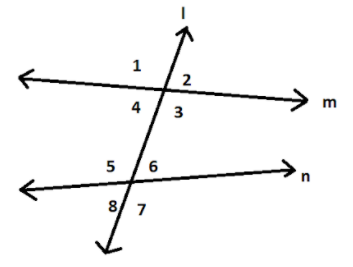
State Euclid’s fifth postulate. Using the same write the pairs of angles, having the sum less than \[180^\circ \]. (From the figure given)
Answer
 Verified
618.6k+ views
Hint: Write Euclid’s postulate as it is described by Euclid in the first place. Then use the facts given in the postulate to analyze the figure and find the solution.
Complete step by step solution: Euclid’s fifth postulate:
If a straight line falling on two straight lines makes the interior angles on the same side of it taken together less than two right angles i.e., 180∘, then the two straight lines, if produced indefinitely meet on that side on which sum of angles is less than two right angles.
So, here according to this image it is given, there are two given lines m and n, and the line l is intersecting these two lines.
Now, if we check the right side of the line l, we can see 4 angles, 2, 3, 6 and 7.
So, as per Euclid’s fifth postulate, if produced indefinitely meet on that side on which sum of angles is less than two right angles. So, we get,
\[\angle 3 + \angle 6 < 180^\circ \].
Note: The fifth postulate is also known as the Parallel Postulate because it can be used to prove properties of parallel lines.
In a plane, given a line and a point not on the line, there are exactly three possibilities with regard to the number of lines through the point:
1) There is exactly one line parallel to the given line;
2) There is no line parallel to the given line;
3) There is more than one line parallel to the given line.
Complete step by step solution: Euclid’s fifth postulate:
If a straight line falling on two straight lines makes the interior angles on the same side of it taken together less than two right angles i.e., 180∘, then the two straight lines, if produced indefinitely meet on that side on which sum of angles is less than two right angles.
So, here according to this image it is given, there are two given lines m and n, and the line l is intersecting these two lines.
Now, if we check the right side of the line l, we can see 4 angles, 2, 3, 6 and 7.
So, as per Euclid’s fifth postulate, if produced indefinitely meet on that side on which sum of angles is less than two right angles. So, we get,
\[\angle 3 + \angle 6 < 180^\circ \].
Note: The fifth postulate is also known as the Parallel Postulate because it can be used to prove properties of parallel lines.
In a plane, given a line and a point not on the line, there are exactly three possibilities with regard to the number of lines through the point:
1) There is exactly one line parallel to the given line;
2) There is no line parallel to the given line;
3) There is more than one line parallel to the given line.
Recently Updated Pages
Master Class 12 Business Studies: Engaging Questions & Answers for Success

Master Class 12 Biology: Engaging Questions & Answers for Success
Master Class 12 Chemistry: Engaging Questions & Answers for Success
Class 12 Question and Answer - Your Ultimate Solutions Guide
Master Class 11 Social Science: Engaging Questions & Answers for Success
Master Class 11 English: Engaging Questions & Answers for Success
Trending doubts
What is the full form of NDA a National Democratic class 10 social science CBSE
Explain the Treaty of Vienna of 1815 class 10 social science CBSE
Who Won 36 Oscar Awards? Record Holder Revealed
Bharatiya Janata Party was founded in the year A 1979 class 10 social science CBSE
What is the median of the first 10 natural numbers class 10 maths CBSE
Why is it 530 pm in india when it is 1200 afternoon class 10 social science CBSE