




State clock rule to determine the polarity of any face of a circular current loop.
Answer
 Verified
576.3k+ views
Hint: As the name suggests in the problem “Clock rule”, it is a trick rule which helps us find the polarity of a current carrying loop if the direction of current is known and vice versa. We will first analyze the direction of current with respect to the direction in which a clock can move, that is clockwise or counterclockwise. As a clock can move in only these two directions, the Clock rule easily helps us find the polarity of the circular current loop as there are only two magnetic polarities, the North pole and the South pole.
Complete answer:
The clock rule states that, if in a current loop the current is moving in the direction of the clock, that is, clockwise , the magnetic polarity of that current loop is found to be the South Pole.
And, if the current in the loop is moving in the direction opposite to that of the clock, that is, in the counterclockwise direction, the magnetic polarity of that current loop is found to be North Pole.
This can be explained by the given diagram:
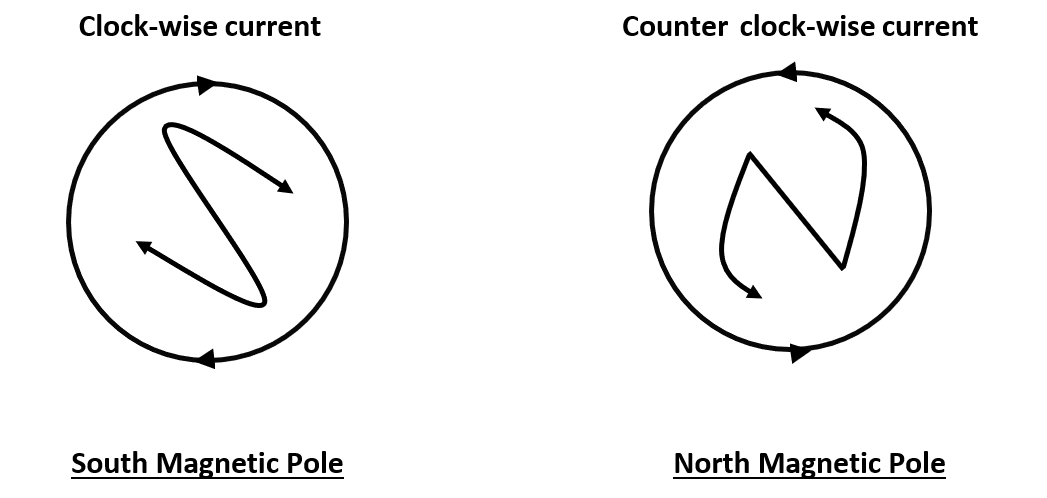
Here, we can clearly see that polarity of a current loop can be very easily determined using the clock rule.
Note:
These are some very short basic principles from the chapters of Electricity and Magnetism. They are not only used in solving these short type questions but are widely used in problems that generally consist of Solenoid and Toroid or any problem containing a magnetic loop within itself, which needs to be solved.
Complete answer:
The clock rule states that, if in a current loop the current is moving in the direction of the clock, that is, clockwise , the magnetic polarity of that current loop is found to be the South Pole.
And, if the current in the loop is moving in the direction opposite to that of the clock, that is, in the counterclockwise direction, the magnetic polarity of that current loop is found to be North Pole.
This can be explained by the given diagram:
Here, we can clearly see that polarity of a current loop can be very easily determined using the clock rule.
Note:
These are some very short basic principles from the chapters of Electricity and Magnetism. They are not only used in solving these short type questions but are widely used in problems that generally consist of Solenoid and Toroid or any problem containing a magnetic loop within itself, which needs to be solved.
Recently Updated Pages
Master Class 11 English: Engaging Questions & Answers for Success

Master Class 11 Social Science: Engaging Questions & Answers for Success
Master Class 11 Maths: Engaging Questions & Answers for Success
Master Class 11 Biology: Engaging Questions & Answers for Success
Master Class 11 Physics: Engaging Questions & Answers for Success
Master Class 11 Chemistry: Engaging Questions & Answers for Success
Trending doubts
Explain the Treaty of Vienna of 1815 class 10 social science CBSE
What is the full form of POSCO class 10 social science CBSE
What planets have no moons Which one has only one moon class 10 physics CBSE
Define Potential, Developed, Stock and Reserved resources
In cricket, which Indian bowler is known as the "Yorker King"?
The diagonals of a rhombus are 10cm and 24cm Find the class 10 maths CBSE