




State Charles law at constant pressure and constant volume.
Answer
 Verified
650.1k+ views
Hint: The announcement of Charles' law is as per the following: the volume (V) of a given mass of a gas, at the steady weight (P), is straightforwardly relative to its temperature (T).
Complete answer:
Charles' law, or the law of volumes, was found in 1787 by Jacques Charles.
It expresses that, for a given mass of a perfect gas at a consistent weight, the volume is straightforwardly relative to its outright temperature, expecting in a shut framework.
As a numerical condition, Charles' law is composed as either:
\[V\propto T,\]
\[or\,V/T={{k}_{2}}\]
\[or\,{{V}_{1}}/{{T}_{1}}={{V}_{2}}/{{T}_{2}}\]
where the volume of a gas is the supreme temperature and \[{{k}_{2}}\]is a proportionality constant.
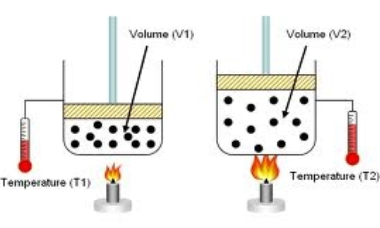
Paul's remark has it right. Charles' Law states "When the weight on an example of a dry gas is held steady, the Kelvin temperature and volume will be legitimately related."
The law says that by the chance that you organize things with the goal that the weight of the gas is fixed then you'll see that \[V\propto T\]. The temperature of the gas may change the weight or the volume, and by and large it's difficult to foresee which will occur.
Note:
We measure the volume of the gas and the temperature of the gas, we have the values \[{{V}_{1\,}}\] and \[{{T}_{1}}\]. Next, begin raising or bringing down the temperature of the gas. The volume should change, thus will the weight, yet once the heat stops again the weight will have returned to its unique worth yet the volume will have changed. Charles' Law says that whenever we do this, we will find that\[\dfrac{{{V}_{2}}}{{{V}_{1}}}=\dfrac{{{T}_{2}}}{{{T}_{1}}}\].
Complete answer:
Charles' law, or the law of volumes, was found in 1787 by Jacques Charles.
It expresses that, for a given mass of a perfect gas at a consistent weight, the volume is straightforwardly relative to its outright temperature, expecting in a shut framework.
As a numerical condition, Charles' law is composed as either:
\[V\propto T,\]
\[or\,V/T={{k}_{2}}\]
\[or\,{{V}_{1}}/{{T}_{1}}={{V}_{2}}/{{T}_{2}}\]
where the volume of a gas is the supreme temperature and \[{{k}_{2}}\]is a proportionality constant.
Paul's remark has it right. Charles' Law states "When the weight on an example of a dry gas is held steady, the Kelvin temperature and volume will be legitimately related."
The law says that by the chance that you organize things with the goal that the weight of the gas is fixed then you'll see that \[V\propto T\]. The temperature of the gas may change the weight or the volume, and by and large it's difficult to foresee which will occur.
Note:
We measure the volume of the gas and the temperature of the gas, we have the values \[{{V}_{1\,}}\] and \[{{T}_{1}}\]. Next, begin raising or bringing down the temperature of the gas. The volume should change, thus will the weight, yet once the heat stops again the weight will have returned to its unique worth yet the volume will have changed. Charles' Law says that whenever we do this, we will find that\[\dfrac{{{V}_{2}}}{{{V}_{1}}}=\dfrac{{{T}_{2}}}{{{T}_{1}}}\].
Recently Updated Pages
Difference Between Prokaryotic Cells and Eukaryotic Cells

If x a + bt + ct2 where x is in meters and t is in class 11 physics CBSE
A car covers the first half distance between two places class 11 physics CBSE
The resultant of two vectors overrightarrow P and overrightarrow class 11 physics CBSE
Find the value of cos 135 class 11 maths CBSE
A mass M is held in place by an applied force F and class 11 physics CBSE
Trending doubts
One Metric ton is equal to kg A 10000 B 1000 C 100 class 11 physics CBSE
Find the value of the expression given below sin 30circ class 11 maths CBSE
Draw a diagram of nephron and explain its structur class 11 biology CBSE
10 examples of friction in our daily life
Proton was discovered by A Thomson B Rutherford C Chadwick class 11 chemistry CBSE
Bond order ofO2 O2+ O2 and O22 is in order A O2 langle class 11 chemistry CBSE