




Starting from the Lewis structure, determine the Hybridization types of the central atom of $ TeC{l_4} $ and $ IC{l_4}^ - $ ?
Answer
 Verified
564.9k+ views
Hint: Hybridization is a process of mixing orbitals of different energy to generate new hybrid orbitals of same energy as well as shape. Tellurium and iodine are members of the fifth period which have vacant $ d $ orbital.
Complete Step By Step Answer:
As we know the atomic number of tellurium is $ 52 $ so its electronic configuration will become $ \left[ {Kr} \right]4{d^{10}}5{s^2}5{p^4} $ . From the electronic configuration we can see that Tellurium has $ 6 $ electrons in its valence shell. Similarly, electronic configuration of chlorine with atomic number $ 17 $ is $ \left[ {Ne} \right]3{s^2}3{p^5} $ . From the electronic configuration we can see that the chlorine atom has $ 7 $ electrons in its valence shell.
In the molecule of $ TeC{l_4} $ , four chlorine atoms share one electron with Tellurium. Hence, four electrons of Tellurium are shared with chlorine atoms. So, the atom of tellurium has two lone pair electrons left. So finally, we say that when $ TeC{l_4} $ is formed four bonding electrons and two lone pair electrons undergo hybridization. Hence, hybridization of $ TeC{l_4} $ is $ \left( {s{p^3}d} \right) $ .
As we know the atomic number of iodine is $ 53 $ so its electronic configuration will become $ \left[ {Kr} \right]4{d^{10}}5{s^2}5{p^5} $ . From the electronic configuration we can see that iodine has $ 7 $ electrons in its valence shell.
In the molecule of $ IC{l_4}^ - $ , four chlorine atoms share one electron with the iodine atom. Hence, four electrons of iodine are shared with four chlorine atoms. So, there are $ 3 $ electrons and $ 1 $ negative charge is still remaining to the iodine atom which together form $ 4 $ electrons or $ 2 $ pair electrons. The atom of iodine has two lone pair electrons left. So finally, we say that when $ IC{l_4}^ - $ is formed by four bonding electrons and two lone pair electrons present above and below the plane will undergo hybridization. Hence, hybridization of $ IC{l_4}^ - $ is $ \left( {s{p^3}{d^2}} \right) $ .
$ \Rightarrow $ Lewis structure of $ TeC{l_4} $ and $ IC{l_4}^ - $ is:
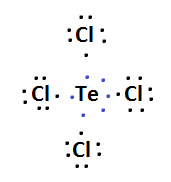
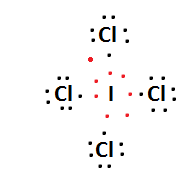
$ \Rightarrow $ Hybridization of $ TeC{l_4} $ is $ \left( {s{p^3}d} \right) $ and $ IC{l_4}^ - $ is $ \left( {s{p^3}{d^2}} \right) $
Note:
$ \left( {s{p^3}d} \right) $ hybridization is also found in the case of $ PC{l_5},P{F_5} $ and having trigonal bipyramidal geometry. $ \left( {s{p^3}{d^2}} \right) $ hybridization is also found in case of $ S{F_6},Cr{F_6}^{ - 3} $ and having octahedral geometry.
Complete Step By Step Answer:
As we know the atomic number of tellurium is $ 52 $ so its electronic configuration will become $ \left[ {Kr} \right]4{d^{10}}5{s^2}5{p^4} $ . From the electronic configuration we can see that Tellurium has $ 6 $ electrons in its valence shell. Similarly, electronic configuration of chlorine with atomic number $ 17 $ is $ \left[ {Ne} \right]3{s^2}3{p^5} $ . From the electronic configuration we can see that the chlorine atom has $ 7 $ electrons in its valence shell.
In the molecule of $ TeC{l_4} $ , four chlorine atoms share one electron with Tellurium. Hence, four electrons of Tellurium are shared with chlorine atoms. So, the atom of tellurium has two lone pair electrons left. So finally, we say that when $ TeC{l_4} $ is formed four bonding electrons and two lone pair electrons undergo hybridization. Hence, hybridization of $ TeC{l_4} $ is $ \left( {s{p^3}d} \right) $ .
As we know the atomic number of iodine is $ 53 $ so its electronic configuration will become $ \left[ {Kr} \right]4{d^{10}}5{s^2}5{p^5} $ . From the electronic configuration we can see that iodine has $ 7 $ electrons in its valence shell.
In the molecule of $ IC{l_4}^ - $ , four chlorine atoms share one electron with the iodine atom. Hence, four electrons of iodine are shared with four chlorine atoms. So, there are $ 3 $ electrons and $ 1 $ negative charge is still remaining to the iodine atom which together form $ 4 $ electrons or $ 2 $ pair electrons. The atom of iodine has two lone pair electrons left. So finally, we say that when $ IC{l_4}^ - $ is formed by four bonding electrons and two lone pair electrons present above and below the plane will undergo hybridization. Hence, hybridization of $ IC{l_4}^ - $ is $ \left( {s{p^3}{d^2}} \right) $ .
$ \Rightarrow $ Lewis structure of $ TeC{l_4} $ and $ IC{l_4}^ - $ is:
$ \Rightarrow $ Hybridization of $ TeC{l_4} $ is $ \left( {s{p^3}d} \right) $ and $ IC{l_4}^ - $ is $ \left( {s{p^3}{d^2}} \right) $
Note:
$ \left( {s{p^3}d} \right) $ hybridization is also found in the case of $ PC{l_5},P{F_5} $ and having trigonal bipyramidal geometry. $ \left( {s{p^3}{d^2}} \right) $ hybridization is also found in case of $ S{F_6},Cr{F_6}^{ - 3} $ and having octahedral geometry.
Recently Updated Pages
If x a + bt + ct2 where x is in meters and t is in class 11 physics CBSE

A car covers the first half distance between two places class 11 physics CBSE
The resultant of two vectors overrightarrow P and overrightarrow class 11 physics CBSE
Find the value of cos 135 class 11 maths CBSE
A mass M is held in place by an applied force F and class 11 physics CBSE
A solution of glucose in water is labelled as 10 dfracwv class 11 chemistry CBSE
Trending doubts
Find the value of the expression given below sin 30circ class 11 maths CBSE
What is the maximum height of a projectile class 11 physics CBSE
Derive an expression for maximum height and range of class 11 physics CBSE
Describe various types of epithelial tissues with the class 11 biology CBSE
Lysosomes are known as suicidal bags of cell why class 11 biology CBSE
State and derive law of conservation of momentum class 11 physics CBSE