




Standing waves are produced in \[10m\] long stretched strings. If the string vibrates in 5 segments and wave velocity is \[20m{s^{ - 1}}\] , then its frequency will be
A. \[5Hz\]
B. \[2Hz\]
C. \[10Hz\]
D. \[12Hz\]
Answer
 Verified
528.9k+ views
Hint: To answer the question, we will build a simple diagram based on the question. The entire length of the string is \[10m\] , and there are five segments, so we will compute the length of one segment and determine the value of $\lambda $ , and then calculate the frequency $(\nu )$ using this $\lambda $ .
Complete answer:
Before we go into the question, let's have a look at what a standing wave is. The combination of two waves flowing in opposite directions, each with the same amplitude and frequency, is known as a standing wave.
Now, let us come to the question;
The wavelength of a stretched string's fundamental vibrational mode is twice the length of the string.
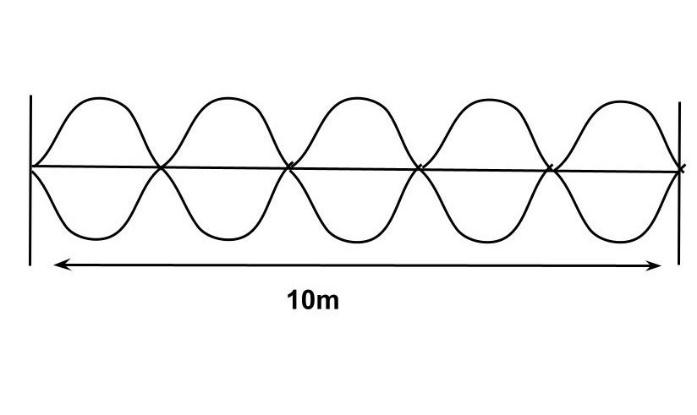
Because the string produces standing waves and vibrates in five parts, it can be shown as
\[\therefore 5\dfrac{\lambda }{2} = 10\]
Therefore, from here we will find value of $\lambda $
\[ \Rightarrow \lambda = 4{\mkern 1mu} m\]
The wave's velocity, \[v\] , is given to us in the question as $v = 20m{s^{ - 1}}$
Hence, the frequency will be \[\nu = \dfrac{v}{\lambda } = \dfrac{{20}}{4} = 5{\mkern 1mu} {s^{ - 1}} = 5{\mkern 1mu} Hz\]
Therefore, the frequency is \[5Hz\]
The correct option is: (A) \[5Hz\]
Note:
It's important to note that standing waves don't just appear out of nowhere. They call for energy to be delivered into a system at a specific frequency. That is, when a system's driving frequency is identical to its natural frequency. Resonance is the term for this situation. Standing waves are invariably linked to resonance.
Complete answer:
Before we go into the question, let's have a look at what a standing wave is. The combination of two waves flowing in opposite directions, each with the same amplitude and frequency, is known as a standing wave.
Now, let us come to the question;
The wavelength of a stretched string's fundamental vibrational mode is twice the length of the string.
Because the string produces standing waves and vibrates in five parts, it can be shown as
\[\therefore 5\dfrac{\lambda }{2} = 10\]
Therefore, from here we will find value of $\lambda $
\[ \Rightarrow \lambda = 4{\mkern 1mu} m\]
The wave's velocity, \[v\] , is given to us in the question as $v = 20m{s^{ - 1}}$
Hence, the frequency will be \[\nu = \dfrac{v}{\lambda } = \dfrac{{20}}{4} = 5{\mkern 1mu} {s^{ - 1}} = 5{\mkern 1mu} Hz\]
Therefore, the frequency is \[5Hz\]
The correct option is: (A) \[5Hz\]
Note:
It's important to note that standing waves don't just appear out of nowhere. They call for energy to be delivered into a system at a specific frequency. That is, when a system's driving frequency is identical to its natural frequency. Resonance is the term for this situation. Standing waves are invariably linked to resonance.
Recently Updated Pages
Master Class 12 Economics: Engaging Questions & Answers for Success

Master Class 12 English: Engaging Questions & Answers for Success
Master Class 12 Social Science: Engaging Questions & Answers for Success
Master Class 12 Maths: Engaging Questions & Answers for Success
Master Class 12 Physics: Engaging Questions & Answers for Success
Master Class 11 Social Science: Engaging Questions & Answers for Success
Trending doubts
One Metric ton is equal to kg A 10000 B 1000 C 100 class 11 physics CBSE
Difference Between Prokaryotic Cells and Eukaryotic Cells
Find the value of the expression given below sin 30circ class 11 maths CBSE
Two of the body parts which do not appear in MRI are class 11 biology CBSE
Draw a diagram of nephron and explain its structur class 11 biology CBSE
10 examples of friction in our daily life