




Staminodes occur in family
A. Papilionidae / Arachis
B. Malvaceae / Hibiscus
C. Caesalpinioideae / Cassia
D. Cruciferae / Iberis
Answer
 Verified
603k+ views
Hint: Staminode is present in the flower. In addition to it, staminodes are the sterile or abortive stamen present in flowers. Staminodes are the stamens, i.e., the male reproductive unit of flowering plants.
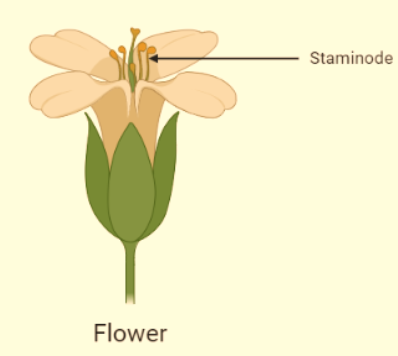
Complete answer: The term staminode means the sterile or abortive stamen often referred to as rudimentary. The stamens which do not produce pollen grain are called staminodes. Pollen grains can be considered as the male gametes produced by the male reproductive part of the flower that is the stamen. Staminodes are the same as stamen but are sterile in nature and do not take part in reproduction. They are inconspicuous and are usually found in the inner whorl of flowers, but in some flowers, they are so long that they protrude from the corolla. The stamens in Caesalpinioideae are mostly ten or also less than ten due to their reduction in staminodes. Cassia is also referred to as Chinese cinnamon which shows the presence of staminodes that is the infertile stamen. In Hibiscus, Arachis, and Iberis staminodes are not present. Staminodes are a characteristic feature of the Caesalpinioideae family and not of Papilionaceae, Malvaceae, and Cruciferae family. So, staminodes are present in Cassia which belongs to the Cesalpinoideae family.
Therefore, option C is the correct answer.
Note: In some flowers the staminodes are modified to produce nectar in flowers. Such a modified staminode is seen in Witch Hazel. One of the examples of staminode is the tree which is growing in South America known as the cannonball tree. Cassia or Chinese cinnamon is used as a spice and also for medicinal use.
Complete answer: The term staminode means the sterile or abortive stamen often referred to as rudimentary. The stamens which do not produce pollen grain are called staminodes. Pollen grains can be considered as the male gametes produced by the male reproductive part of the flower that is the stamen. Staminodes are the same as stamen but are sterile in nature and do not take part in reproduction. They are inconspicuous and are usually found in the inner whorl of flowers, but in some flowers, they are so long that they protrude from the corolla. The stamens in Caesalpinioideae are mostly ten or also less than ten due to their reduction in staminodes. Cassia is also referred to as Chinese cinnamon which shows the presence of staminodes that is the infertile stamen. In Hibiscus, Arachis, and Iberis staminodes are not present. Staminodes are a characteristic feature of the Caesalpinioideae family and not of Papilionaceae, Malvaceae, and Cruciferae family. So, staminodes are present in Cassia which belongs to the Cesalpinoideae family.
Therefore, option C is the correct answer.
Note: In some flowers the staminodes are modified to produce nectar in flowers. Such a modified staminode is seen in Witch Hazel. One of the examples of staminode is the tree which is growing in South America known as the cannonball tree. Cassia or Chinese cinnamon is used as a spice and also for medicinal use.
Recently Updated Pages
Master Class 11 Social Science: Engaging Questions & Answers for Success

Master Class 11 English: Engaging Questions & Answers for Success
Master Class 11 Maths: Engaging Questions & Answers for Success
Master Class 11 Chemistry: Engaging Questions & Answers for Success
Master Class 11 Biology: Engaging Questions & Answers for Success
Master Class 11 Physics: Engaging Questions & Answers for Success
Trending doubts
One Metric ton is equal to kg A 10000 B 1000 C 100 class 11 physics CBSE
Difference Between Prokaryotic Cells and Eukaryotic Cells
Draw a diagram of a plant cell and label at least eight class 11 biology CBSE
Two of the body parts which do not appear in MRI are class 11 biology CBSE
Which gas is abundant in air class 11 chemistry CBSE
10 examples of friction in our daily life