



Square OABC is drawn with vertex O as origin, vertex A on the positive side of the x−axis and vertex C on the positive side of the y-axis. If each side of the square OABC is of length 6 units, draw OABC on a graph paper and then use the graph to find the coordinates of vertices A, B and C.
Answer
 Verified
649.5k+ views
Hint: A coordinate graph is a set of two number lines that run perpendicular to one another. These number lines are called axes. The horizontal number line is the x-axis, and the vertical number line is the y-axis. In this question, we draw each point on the graph paper as per condition in the question, and then find the coordinates of the vertices A, B and C.
Complete step-by-step solution -
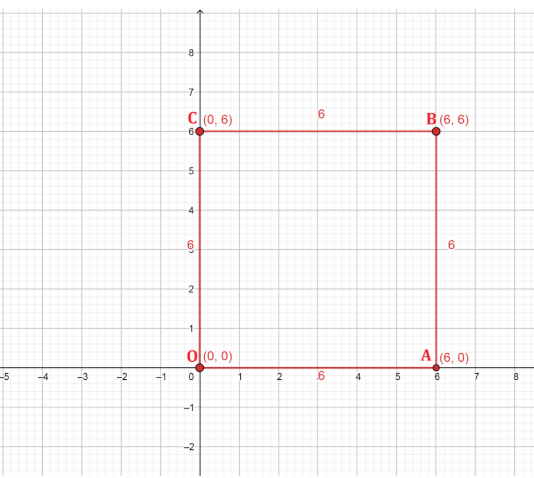
In square OABC as shown in the graph, It is given that the vertex O (0,0) is an origin and as we can see according to the coordinate diagram.
The length of one side of the square is 6 units long in the positive side of X axis and the point indicated by the vertex A.
Also, the length of the second side of the square is also 6 units long in the positive side of the Y axis and the point indicated by the vertex C.
Therefore there is a third vertex that has their x coordinate as 6 and y coordinate is also 6 and which is indicated by the vertex B.
Hence, the value of vertices A and C that are on line with the axis are (6,0) and (0,6) respectively.
For the value of x and y we use the coordinates (6,0) and (0,6), as we can see the value of the x axis is 6 and the value of y is also 6.
Hence the coordinates of the vertex B is (x, y) = (6,6).
Therefore, the coordinates of the vertices A, B and C are (6,0), (6,6) and (0,6).
Note: Note that the ordered pairs are written in parentheses (x-coordinate, y-coordinate) and there is no space after the comma. The two axes intersect where each of them is equal to zero, and this intersection point is called the origin.
Complete step-by-step solution -
In square OABC as shown in the graph, It is given that the vertex O (0,0) is an origin and as we can see according to the coordinate diagram.
The length of one side of the square is 6 units long in the positive side of X axis and the point indicated by the vertex A.
Also, the length of the second side of the square is also 6 units long in the positive side of the Y axis and the point indicated by the vertex C.
Therefore there is a third vertex that has their x coordinate as 6 and y coordinate is also 6 and which is indicated by the vertex B.
Hence, the value of vertices A and C that are on line with the axis are (6,0) and (0,6) respectively.
For the value of x and y we use the coordinates (6,0) and (0,6), as we can see the value of the x axis is 6 and the value of y is also 6.
Hence the coordinates of the vertex B is (x, y) = (6,6).
Therefore, the coordinates of the vertices A, B and C are (6,0), (6,6) and (0,6).
Note: Note that the ordered pairs are written in parentheses (x-coordinate, y-coordinate) and there is no space after the comma. The two axes intersect where each of them is equal to zero, and this intersection point is called the origin.
Recently Updated Pages
Master Class 11 Social Science: Engaging Questions & Answers for Success

Master Class 11 English: Engaging Questions & Answers for Success
Master Class 11 Maths: Engaging Questions & Answers for Success
Master Class 11 Chemistry: Engaging Questions & Answers for Success
Master Class 11 Biology: Engaging Questions & Answers for Success
Class 11 Question and Answer - Your Ultimate Solutions Guide
Trending doubts
What is BLO What is the full form of BLO class 8 social science CBSE
Which Indian state shares the longest international class 8 social science CBSE
What are the 12 elements of nature class 8 chemistry CBSE
Citizens of India can vote at the age of A 18 years class 8 social science CBSE
Right to vote is a AFundamental Right BFundamental class 8 social science CBSE
Full form of STD, ISD and PCO