




Sporogenesis is
a. Development and formation of spores
b. Production of mitospores
c. Production of meiospores
d. Formation of zygote and embryo
Answer
 Verified
650.1k+ views
Hint: Sporogenesis is the process of formation and development of spores which can be mitospores or meiospores. This term is also used to refer to the process of reproduction via spores. These reproductive spores are formed in eukaryotic organisms. Most spores are haploid and are formed by cell division.
Complete answer:
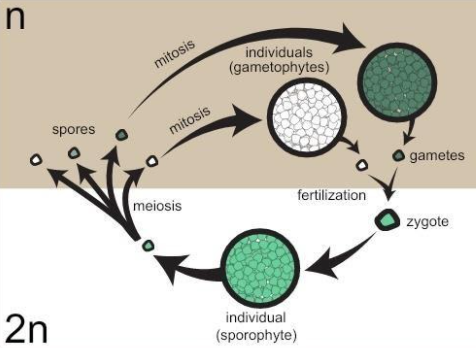
> Option A, is correct as sporogenesis is the process of development and formation of spores.
> Option B, can not be considered right as production of mitospores is a type of sporogenesis in which spores are formed by mitosis.
> Option C, Production of meiospores is a type of sporogenesis in which spores are formed by meiosis. So, this is not a correct option according to the question.
> Option D, The process of formation of zygote or embryo is known as fertilization . Hence, this option is not correct.
Hence, The correct answer is option (A).
Additional information:
- Sporogenesis can occur via meiosis (In sporophytes) or it can occur via mitosis (In fungi and algae). Meiosis sporogenesis is for sexual reproduction whereas meiotic sporogenesis is for asexual reproduction.
- Sporogenesis occurs in reproductive structures termed as sporangia. The process involves sporogenous cells undergoing cell division to give rise to spores.
- Some algae and fungi form resting spores made to survive unfavourable conditions. The spores of these are protected through the formation of a thick cell wall so that they can withstand the harsh conditions of the environment.
Note: Reproduction via spores involves the spreading of spores by water or air. In heterogeneous organisms, two types of spores exist: microspores give rise to males and megaspores give rise to females. In homosporous organisms, all spores look alike and grow into individuals carrying reproductive parts of both genders.
Complete answer:
> Option A, is correct as sporogenesis is the process of development and formation of spores.
> Option B, can not be considered right as production of mitospores is a type of sporogenesis in which spores are formed by mitosis.
> Option C, Production of meiospores is a type of sporogenesis in which spores are formed by meiosis. So, this is not a correct option according to the question.
> Option D, The process of formation of zygote or embryo is known as fertilization . Hence, this option is not correct.
Hence, The correct answer is option (A).
Additional information:
- Sporogenesis can occur via meiosis (In sporophytes) or it can occur via mitosis (In fungi and algae). Meiosis sporogenesis is for sexual reproduction whereas meiotic sporogenesis is for asexual reproduction.
- Sporogenesis occurs in reproductive structures termed as sporangia. The process involves sporogenous cells undergoing cell division to give rise to spores.
- Some algae and fungi form resting spores made to survive unfavourable conditions. The spores of these are protected through the formation of a thick cell wall so that they can withstand the harsh conditions of the environment.
Note: Reproduction via spores involves the spreading of spores by water or air. In heterogeneous organisms, two types of spores exist: microspores give rise to males and megaspores give rise to females. In homosporous organisms, all spores look alike and grow into individuals carrying reproductive parts of both genders.
Recently Updated Pages
Master Class 12 Economics: Engaging Questions & Answers for Success

Master Class 12 Social Science: Engaging Questions & Answers for Success
Master Class 12 English: Engaging Questions & Answers for Success
Master Class 12 Maths: Engaging Questions & Answers for Success
Master Class 12 Physics: Engaging Questions & Answers for Success
Master Class 12 Biology: Engaging Questions & Answers for Success
Trending doubts
Draw a labelled sketch of the human eye class 12 physics CBSE
Which are the Top 10 Largest Countries of the World?
Draw ray diagrams each showing i myopic eye and ii class 12 physics CBSE
Which is the correct genotypic ratio of mendel dihybrid class 12 biology CBSE
Differentiate between homogeneous and heterogeneous class 12 chemistry CBSE
Which animal never drinks water in its entire life class 12 biology CBSE