




Spin multiplicity of triplet nitrene is:
(a) 1
(b) 2
(c) 3
(d) 4
Answer
 Verified
630.6k+ views
Hint: To answer this question you should know that the formula which is generally used for the prediction of spin multiplicity value is (2S+1). Now you may have some idea about this term and you can predict the value for triplet nitrene.
Complete step by step answer:
First, we should know about the singlet and triplet excited states.
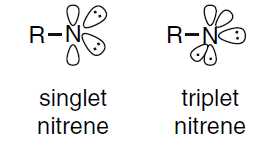
Singlet and triplet is derived using the equation for multiplicity, 2S+1
2S+1, where S is the total spin angular momentum (sum of all the electron spins). Individual spins are denoted as spin up (s=+1/2) or spin down (s=−1/2). If we were to calculate the S for the excited singlet state, the equation would be 2[(+1/2)+(−1/2)]+1=2(0)+1 = 1, therefore making the center orbital in the figure a singlet state.
If the spin multiplicity for the excited triplet state was calculated, we obtain 2[(+1/2)+(+1/2)]+1=2(1)+1 = 3, which gives a triplet state as expected.
Therefore, when nitrene is in the triplet state, its spin multiplicity = 3. Which makes option C the correct option.
Note: Let’s talk about some differences between singlet and triplet excited states.
A singlet or a triplet can form when one electron is excited to a higher energy level. In an excited singlet state, the electron is promoted in the same spin orientation as it was in the ground state (paired). In a triplet excited state, the electron that is promoted has the same spin orientation (parallel) to the other unpaired electron.
Complete step by step answer:
First, we should know about the singlet and triplet excited states.
Singlet and triplet is derived using the equation for multiplicity, 2S+1
2S+1, where S is the total spin angular momentum (sum of all the electron spins). Individual spins are denoted as spin up (s=+1/2) or spin down (s=−1/2). If we were to calculate the S for the excited singlet state, the equation would be 2[(+1/2)+(−1/2)]+1=2(0)+1 = 1, therefore making the center orbital in the figure a singlet state.
If the spin multiplicity for the excited triplet state was calculated, we obtain 2[(+1/2)+(+1/2)]+1=2(1)+1 = 3, which gives a triplet state as expected.
Therefore, when nitrene is in the triplet state, its spin multiplicity = 3. Which makes option C the correct option.
Note: Let’s talk about some differences between singlet and triplet excited states.
A singlet or a triplet can form when one electron is excited to a higher energy level. In an excited singlet state, the electron is promoted in the same spin orientation as it was in the ground state (paired). In a triplet excited state, the electron that is promoted has the same spin orientation (parallel) to the other unpaired electron.
Recently Updated Pages
Master Class 11 Social Science: Engaging Questions & Answers for Success

Master Class 11 English: Engaging Questions & Answers for Success
Master Class 11 Maths: Engaging Questions & Answers for Success
Master Class 11 Chemistry: Engaging Questions & Answers for Success
Master Class 11 Biology: Engaging Questions & Answers for Success
Master Class 11 Physics: Engaging Questions & Answers for Success
Trending doubts
One Metric ton is equal to kg A 10000 B 1000 C 100 class 11 physics CBSE
Difference Between Prokaryotic Cells and Eukaryotic Cells
How many of the following diseases can be studied with class 11 biology CBSE
Draw a diagram of a plant cell and label at least eight class 11 biology CBSE
Two of the body parts which do not appear in MRI are class 11 biology CBSE
10 examples of friction in our daily life