




Sperms are stored in the
(a) Testis
(b) Prostate gland
(c) Epididymis
(d) Seminal vesicle
Answer
 Verified
620.1k+ views
Hint: After spermatogenesis i.e development of spermatozoa or sperms in the long tubules, they are temporarily stored in a coiled tube that aids sperms in achieving its final maturity and motility.
Complete step by step answer:
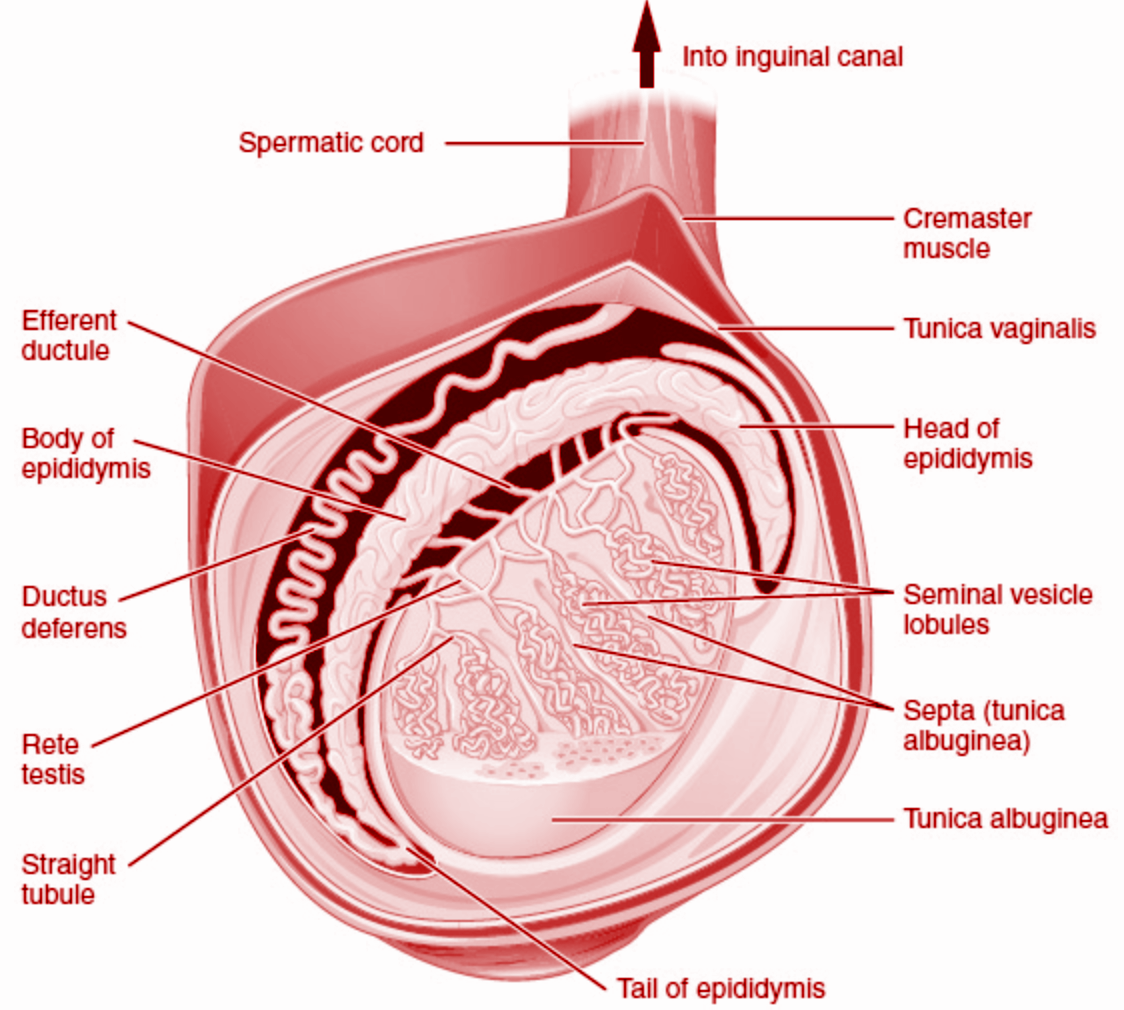
The male reproductive system consists of a pair of testis along with accessory ducts, glands, and external genitalia which are located in the pelvis region of the body. The epididymis is an organ lying posteriorly to each testis and lined with pseudostratified epithelium. Functionally, it is the site of sperm maturation where the sperm acquire motility and the ability to fertilize the ovum. It stores sperms temporarily. Testis and epididymis are together called testicles.
So, the correct answer is ‘Epididymis.’
Additional information:
- Each testis is an oval structure encapsulated in a tough fibrous connective tissue ‘tunica albuginea’. This tissue not only surrounds the testis but also extends inward to divide the cavity of the testis into many small lobules. Each lobule, in turn, is filled with 1-4 highly coiled seminiferous tubules.
- Seminal vesicles are the accessory glands of the male reproductive system that are located behind the bladder. More specifically, they are situated at the junction of vas deferens and prostate gland. About $60\%$ of the semen in seminal fluid is produced by seminal vesicles. Seminal fluid contains fructose, citrate, inositol, and prostaglandins along with some proteins.
- The prostate glands are situated just inferior to the urinary bladder. It secretes a thin, milky fluid that contains calcium, citrate, and phosphate ions. The slightly alkaline fluid of prostate glands helps in the neutralization of the relatively acidic secretions of vas deferens. They also enhance the motility of spermatozoa.
Note:
- The testis is located outside the abdominal cavity in the scrotum. This provides a temperature of about $3\circ \ C$ lower than the normal body temperature. This is essential for the production of viable sperms in the process of spermatogenesis.
- During the last two months before birth, testis descends into the scrotum through the inguinal canal.
- Failure or incomplete descent of testis on one or both sides in a newborn is called cryptorchidism.
Complete step by step answer:
The male reproductive system consists of a pair of testis along with accessory ducts, glands, and external genitalia which are located in the pelvis region of the body. The epididymis is an organ lying posteriorly to each testis and lined with pseudostratified epithelium. Functionally, it is the site of sperm maturation where the sperm acquire motility and the ability to fertilize the ovum. It stores sperms temporarily. Testis and epididymis are together called testicles.
So, the correct answer is ‘Epididymis.’
Additional information:
- Each testis is an oval structure encapsulated in a tough fibrous connective tissue ‘tunica albuginea’. This tissue not only surrounds the testis but also extends inward to divide the cavity of the testis into many small lobules. Each lobule, in turn, is filled with 1-4 highly coiled seminiferous tubules.
- Seminal vesicles are the accessory glands of the male reproductive system that are located behind the bladder. More specifically, they are situated at the junction of vas deferens and prostate gland. About $60\%$ of the semen in seminal fluid is produced by seminal vesicles. Seminal fluid contains fructose, citrate, inositol, and prostaglandins along with some proteins.
- The prostate glands are situated just inferior to the urinary bladder. It secretes a thin, milky fluid that contains calcium, citrate, and phosphate ions. The slightly alkaline fluid of prostate glands helps in the neutralization of the relatively acidic secretions of vas deferens. They also enhance the motility of spermatozoa.
Note:
- The testis is located outside the abdominal cavity in the scrotum. This provides a temperature of about $3\circ \ C$ lower than the normal body temperature. This is essential for the production of viable sperms in the process of spermatogenesis.
- During the last two months before birth, testis descends into the scrotum through the inguinal canal.
- Failure or incomplete descent of testis on one or both sides in a newborn is called cryptorchidism.
Recently Updated Pages
Master Class 12 Business Studies: Engaging Questions & Answers for Success

Master Class 12 Chemistry: Engaging Questions & Answers for Success
Master Class 12 Biology: Engaging Questions & Answers for Success
Class 12 Question and Answer - Your Ultimate Solutions Guide
Master Class 11 English: Engaging Questions & Answers for Success
Master Class 11 Social Science: Engaging Questions & Answers for Success
Trending doubts
Which are the Top 10 Largest Countries of the World?
Draw a labelled sketch of the human eye class 12 physics CBSE
Differentiate between homogeneous and heterogeneous class 12 chemistry CBSE
Differentiate between Pyramid of energy and pyramid class 12 biology CBSE
Why is the cell called the structural and functional class 12 biology CBSE
Draw the diagram of the pyramid of energy Explain In class 12 biology CBSE