




How many sperms are formed from a secondary spermatocyte?
Answer
 Verified
543.6k+ views
Hint: Sperms are the male gamete and are fertilized with the female gamete to produce offspring. It is formed by the process of spermatogenesis. Meiotic division takes place in the spermatogonia to form up the sperms.
Complete answer:
Sperms are the male sex organs that are produced in the testis. Spermatogenesis is the process that is used to produce these gametes. The spermatogonia are present on the side walls of seminiferous tubules that multiply by mitotic division and increase in number.
Each spermatogonia is diploid and contains 46 chromosomes. Some of the spermatogonia called primary spermatocytes periodically undergo meiosis. A primary spermatocyte completes the first meiotic division leading to formation of two equal, haploid cells called secondary spermatocytes, which have only 23 chromosomes each. The secondary spermatocytes undergo the second meiotic division to produce four equal, haploid spermatids. After spermatogenesis, sperm heads become embedded in the sertoli cells,and are finally released from the seminiferous tubules by the process called spermiation.
We can conclude that Primary spermatocytes are diploid (2N) cells. After meiosis I, two secondary spermatocytes are thus formed which are haploid (N). The secondary spermatocytes contain half the number of chromosomes to that of primary spermatocytes.
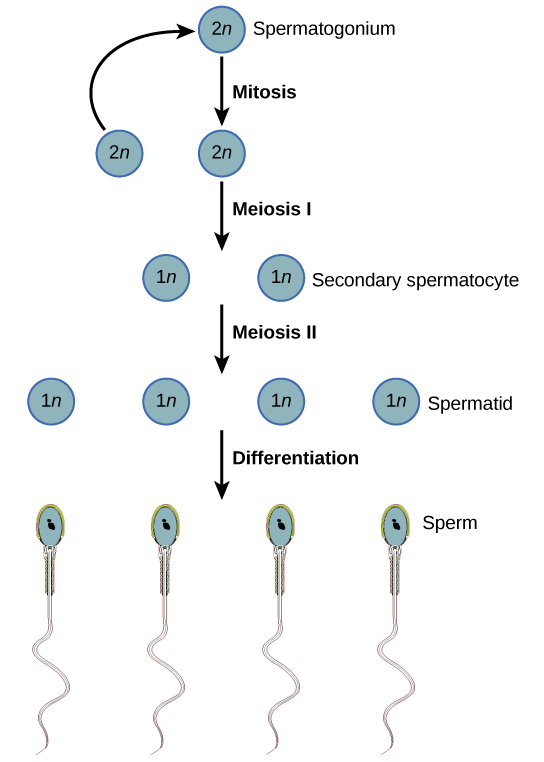
IMAGE SHOWING SPERMATOGENESIS
NOTE:
Spermatocytes are the male gametophytes that are derived from immature germ cells called spermatogonia. They are found in the testis, in a structure called as seminiferous tubules. They are mainly of two types : primary and secondary spermatocytes. They are formed through the process of spermatocytogenesis.
Complete answer:
Sperms are the male sex organs that are produced in the testis. Spermatogenesis is the process that is used to produce these gametes. The spermatogonia are present on the side walls of seminiferous tubules that multiply by mitotic division and increase in number.
Each spermatogonia is diploid and contains 46 chromosomes. Some of the spermatogonia called primary spermatocytes periodically undergo meiosis. A primary spermatocyte completes the first meiotic division leading to formation of two equal, haploid cells called secondary spermatocytes, which have only 23 chromosomes each. The secondary spermatocytes undergo the second meiotic division to produce four equal, haploid spermatids. After spermatogenesis, sperm heads become embedded in the sertoli cells,and are finally released from the seminiferous tubules by the process called spermiation.
We can conclude that Primary spermatocytes are diploid (2N) cells. After meiosis I, two secondary spermatocytes are thus formed which are haploid (N). The secondary spermatocytes contain half the number of chromosomes to that of primary spermatocytes.
IMAGE SHOWING SPERMATOGENESIS
NOTE:
Spermatocytes are the male gametophytes that are derived from immature germ cells called spermatogonia. They are found in the testis, in a structure called as seminiferous tubules. They are mainly of two types : primary and secondary spermatocytes. They are formed through the process of spermatocytogenesis.
Recently Updated Pages
Basicity of sulphurous acid and sulphuric acid are

Master Class 12 Economics: Engaging Questions & Answers for Success
Master Class 12 Biology: Engaging Questions & Answers for Success
Master Class 11 English: Engaging Questions & Answers for Success
Master Class 11 Physics: Engaging Questions & Answers for Success
Master Class 11 Computer Science: Engaging Questions & Answers for Success
Trending doubts
Draw a labelled sketch of the human eye class 12 physics CBSE
The chemical formula of tear gas is A CO Cl 2 B C 10 class 12 chemistry CBSE
Draw ray diagrams each showing i myopic eye and ii class 12 physics CBSE
Which are the Top 10 Largest Countries of the World?
Differentiate between homogeneous and heterogeneous class 12 chemistry CBSE
Which is the correct genotypic ratio of mendel dihybrid class 12 biology CBSE