




How many $s{p^3}$ hybridised carbon atoms are in Acetophenone?
Answer
 Verified
602.7k+ views
Hint:
Acetophenone is an organic compound. Acetophenone is the simplest aromatic ketone with the chemical formula \[{C_6}{H_5}C\left( O \right)C{H_3}\]. $s{p^3}$ hybridisation is formed by the intermixing of one $s$ orbital and three $p$ orbitals.
Complete step by step solution
The concept of hybridisation is given by Pauling. According to Pauling the atomic orbitals having slightly different energy and shape are intermixed to form hybrid orbital. These hybrid orbitals are involved in bond formation and these hybrid orbitals are equivalent in energy.
$sp$ hybridisation-In this hybridisation one $s$ and one $p$ orbitals intermixes. Due to this intermixing two equivalent $sp$ hybrid orbitals are formed. Similarly, in $s{p^2}$ hybridisation one \[s\] and two \[p\] orbitals intermix. Due to this intermixing three equivalent $s{p^2}$ hybrid orbitals are formed .Similarly in case of $s{p^3}$ hybridisation one \[s\] and one $p$ orbitals intermixes. Due to this intermixing four equivalent $s{p^3}$ hybrid orbitals are formed.
Acetophenone has the chemical formula ${C_6}{H_5}C\left( O \right)C{H_3}$.
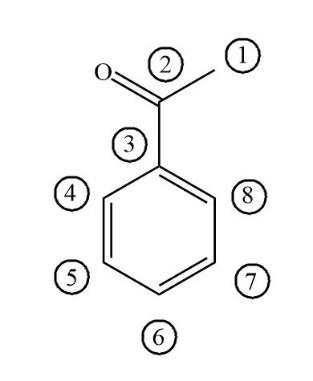
Above is the figure of Acetophenone. It has eight carbon atoms, in which six carbon atoms involved in the formation of benzene. Then one carbon is involved in the ketone functional group and the other carbon atom is involved in methyl.
First take a look at all benzene involved carbons i.e. the carbon numbers $3,4,5,6,7,8$ .All these six carbons have $3$ sigma bonds and $1$ pi bonds connected to carbon atoms. So, the hybridisation of all six carbons which is involved in benzene is $s{p^2}$ hybridised. Now take a look at carbonyl carbon i.e. carbon number $2$ which has \[3\] sigma bonds and \[1\] pi bonds connected to oxygen.
Now take a look at carbon number $1$,which is connected to one carbonyl carbon and three hydrogen atoms. So, the hybridisation of carbon $1$ becomes $s{p^3}$ hybridised.
Hence only one carbon i.e. carbon $1$ becomes $s{p^3}$ hybridised.
Note:
Thus in case of $sp$ hybridisation one $s$ and one \[p\] orbital involved so $sp$ hybridisation has $50\% $s and $50\% $\[p\] character. Similarly in $s{p^2}$hybridisation one $s$ and two \[p\] orbitals are involved so $s{p^2}$hybridisation has $33.33\% $$s$ and $66.66\% $\[p\] character. While $s{p^3}$ in hybridisation one $s$ and three \[p\] orbitals are involved so $s{p^3}$ hybridisation has $25\% $$s$ and $75\% $ $75\% $\[p\] character.
Acetophenone is an organic compound. Acetophenone is the simplest aromatic ketone with the chemical formula \[{C_6}{H_5}C\left( O \right)C{H_3}\]. $s{p^3}$ hybridisation is formed by the intermixing of one $s$ orbital and three $p$ orbitals.
Complete step by step solution
The concept of hybridisation is given by Pauling. According to Pauling the atomic orbitals having slightly different energy and shape are intermixed to form hybrid orbital. These hybrid orbitals are involved in bond formation and these hybrid orbitals are equivalent in energy.
$sp$ hybridisation-In this hybridisation one $s$ and one $p$ orbitals intermixes. Due to this intermixing two equivalent $sp$ hybrid orbitals are formed. Similarly, in $s{p^2}$ hybridisation one \[s\] and two \[p\] orbitals intermix. Due to this intermixing three equivalent $s{p^2}$ hybrid orbitals are formed .Similarly in case of $s{p^3}$ hybridisation one \[s\] and one $p$ orbitals intermixes. Due to this intermixing four equivalent $s{p^3}$ hybrid orbitals are formed.
Acetophenone has the chemical formula ${C_6}{H_5}C\left( O \right)C{H_3}$.
Above is the figure of Acetophenone. It has eight carbon atoms, in which six carbon atoms involved in the formation of benzene. Then one carbon is involved in the ketone functional group and the other carbon atom is involved in methyl.
First take a look at all benzene involved carbons i.e. the carbon numbers $3,4,5,6,7,8$ .All these six carbons have $3$ sigma bonds and $1$ pi bonds connected to carbon atoms. So, the hybridisation of all six carbons which is involved in benzene is $s{p^2}$ hybridised. Now take a look at carbonyl carbon i.e. carbon number $2$ which has \[3\] sigma bonds and \[1\] pi bonds connected to oxygen.
Now take a look at carbon number $1$,which is connected to one carbonyl carbon and three hydrogen atoms. So, the hybridisation of carbon $1$ becomes $s{p^3}$ hybridised.
Hence only one carbon i.e. carbon $1$ becomes $s{p^3}$ hybridised.
Note:
Thus in case of $sp$ hybridisation one $s$ and one \[p\] orbital involved so $sp$ hybridisation has $50\% $s and $50\% $\[p\] character. Similarly in $s{p^2}$hybridisation one $s$ and two \[p\] orbitals are involved so $s{p^2}$hybridisation has $33.33\% $$s$ and $66.66\% $\[p\] character. While $s{p^3}$ in hybridisation one $s$ and three \[p\] orbitals are involved so $s{p^3}$ hybridisation has $25\% $$s$ and $75\% $ $75\% $\[p\] character.
Recently Updated Pages
Three beakers labelled as A B and C each containing 25 mL of water were taken A small amount of NaOH anhydrous CuSO4 and NaCl were added to the beakers A B and C respectively It was observed that there was an increase in the temperature of the solutions contained in beakers A and B whereas in case of beaker C the temperature of the solution falls Which one of the following statements isarecorrect i In beakers A and B exothermic process has occurred ii In beakers A and B endothermic process has occurred iii In beaker C exothermic process has occurred iv In beaker C endothermic process has occurred

Master Class 11 Social Science: Engaging Questions & Answers for Success
Master Class 11 Physics: Engaging Questions & Answers for Success
Master Class 11 Maths: Engaging Questions & Answers for Success
Master Class 11 Economics: Engaging Questions & Answers for Success
Master Class 11 Computer Science: Engaging Questions & Answers for Success
Three beakers labelled as A B and C each containing 25 mL of water were taken A small amount of NaOH anhydrous CuSO4 and NaCl were added to the beakers A B and C respectively It was observed that there was an increase in the temperature of the solutions contained in beakers A and B whereas in case of beaker C the temperature of the solution falls Which one of the following statements isarecorrect i In beakers A and B exothermic process has occurred ii In beakers A and B endothermic process has occurred iii In beaker C exothermic process has occurred iv In beaker C endothermic process has occurred
Master Class 11 Social Science: Engaging Questions & Answers for Success
Master Class 11 Physics: Engaging Questions & Answers for Success
Trending doubts
One Metric ton is equal to kg A 10000 B 1000 C 100 class 11 physics CBSE
There are 720 permutations of the digits 1 2 3 4 5 class 11 maths CBSE
State and prove Bernoullis theorem class 11 physics CBSE
Draw a diagram of a plant cell and label at least eight class 11 biology CBSE
Difference Between Prokaryotic Cells and Eukaryotic Cells
1 Quintal is equal to a 110 kg b 10 kg c 100kg d 1000 class 11 physics CBSE