




Sound cannot propagate in _________________________.
A. Vacuum
B. Solid
C. Liquid
D. Gases
Answer
 Verified
630.6k+ views
Hint: In this question, we know that sound is able to propagate through any medium because of the pressure variation causing alternating rarefaction and compression of the sound particle in the medium like in air, gas, and solid. But in a vacuum, we don’t find particles in which this pressure variation could take place and hence sound is also not propagated in sound.
Complete Step-by-Step solution:
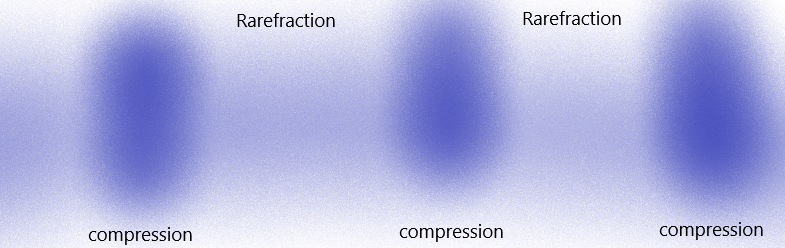
Sound waves are always caused by a source and it propagates by making the particles in the medium vibrate. This sound source transfers the vibrations to the particles surrounding it in the medium. The medium can be solid, liquid, gaseous, or plasma. These vibrating particles cause rarefaction and compression which create a pressure variation in the surrounding region in the medium. Now, this process of alternating compression and rarefaction helps the sound waves to propagate as can be seen from figure 1.
In short, we can say that when the sound waves propagate in a medium the particles gain these vibrations and then transfer them to the surrounding particles, allowing sound to travel.
Whereas in a vacuum as there are no particles to vibrate, therefore there is no pressure variation in the surrounding, so sound cannot travel. We can see an example for the same that is in the near-vacuum region in outer space which is practically not a complete vacuum region and there are minute amounts of gas particles which can help in the propagation of sound. But, the density of these gases is much lesser than the earth's atmosphere, which causes less sound and even though the sound is propagating our ears are not sensitive enough to detect this sound, and therefore we consider space as soundless.
So the correct answer is option A.
Note: For solving these types of questions we need to be well versed with some basic concepts of sound and light. We also need to know how these behave in different mediums like in gas, liquid, solid, and vacuum. It's also important to understand how different parameters affect these two waves like temperature, pressure, refractive index, and density of the particle.
Complete Step-by-Step solution:
Sound waves are always caused by a source and it propagates by making the particles in the medium vibrate. This sound source transfers the vibrations to the particles surrounding it in the medium. The medium can be solid, liquid, gaseous, or plasma. These vibrating particles cause rarefaction and compression which create a pressure variation in the surrounding region in the medium. Now, this process of alternating compression and rarefaction helps the sound waves to propagate as can be seen from figure 1.
Figure 1
In short, we can say that when the sound waves propagate in a medium the particles gain these vibrations and then transfer them to the surrounding particles, allowing sound to travel.
Whereas in a vacuum as there are no particles to vibrate, therefore there is no pressure variation in the surrounding, so sound cannot travel. We can see an example for the same that is in the near-vacuum region in outer space which is practically not a complete vacuum region and there are minute amounts of gas particles which can help in the propagation of sound. But, the density of these gases is much lesser than the earth's atmosphere, which causes less sound and even though the sound is propagating our ears are not sensitive enough to detect this sound, and therefore we consider space as soundless.
So the correct answer is option A.
Note: For solving these types of questions we need to be well versed with some basic concepts of sound and light. We also need to know how these behave in different mediums like in gas, liquid, solid, and vacuum. It's also important to understand how different parameters affect these two waves like temperature, pressure, refractive index, and density of the particle.
Recently Updated Pages
Master Class 12 Business Studies: Engaging Questions & Answers for Success

Master Class 12 Biology: Engaging Questions & Answers for Success
Master Class 12 Chemistry: Engaging Questions & Answers for Success
Class 12 Question and Answer - Your Ultimate Solutions Guide
Master Class 11 Social Science: Engaging Questions & Answers for Success
Master Class 11 English: Engaging Questions & Answers for Success
Trending doubts
Explain the Treaty of Vienna of 1815 class 10 social science CBSE
Who Won 36 Oscar Awards? Record Holder Revealed
What is the median of the first 10 natural numbers class 10 maths CBSE
Why is it 530 pm in india when it is 1200 afternoon class 10 social science CBSE
Why is there a time difference of about 5 hours between class 10 social science CBSE
What is the full form of POSCO class 10 social science CBSE