




How do you solve the triangle if it has legs with lengths of $ 18 $ and $ 28 $ and there is a $ 90 $ degree angle, X and Y are the other two angles ?
Answer
 Verified
529.5k+ views
Hint: The given question requires to solve the right angled triangle given the length of the two legs as $ 18 $ units and $ 28 $ units. Solving a triangle means that we have to find all the missing sides and angles of the given triangle. So, we have to find the length of the hypotenuse of the given right angled triangle and the measure of the other two angles. This can be done easily using the Pythagoras theorem and trigonometry.
Complete step by step solution:
Let us consider a right angled triangle XYZ with $ Z = {90^ \circ } $ . Also,
Considering the given right angle is right angled at Z, that is $ \angle Z = {90^\circ } $ . So, the figure is given below:
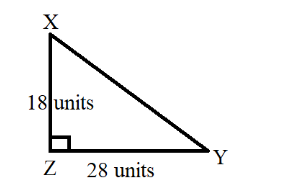
Now, length of XZ $ = 18 $ units
Also, length of YZ $ = 28 $ units
Following the Pythagoras theorem, we have \[{\left( {Hypotenuse} \right)^2} = {\left( {Base} \right)^2} + {\left( {Altitude} \right)^2}\].
So, applying the Pythagoras theorem in the given triangle ABC, we get, $ {\left( {XY} \right)^2} = {\left( {XZ} \right)^2} + {\left( {YZ} \right)^2} $ .
So, $ {\left( {XY} \right)^2} = {\left( {18} \right)^2} + {\left( {28} \right)^2} $
$ \Rightarrow {\left( {XY} \right)^2} = 324 + 784 $
$ \Rightarrow {\left( {XY} \right)^2} = 1108 $
$ \Rightarrow XY = \sqrt {1108} $
$ \Rightarrow XY = 33.286 $ units (approximately)
Now, we know all the sides of the triangle.
We can also find the remaining two angles with the help of trigonometry.
We know that, $ \tan Y = \dfrac{{18}}{{28}} = \left( {\dfrac{9}{{14}}} \right) $ .
$ \Rightarrow Y = {\tan ^{ - 1}}\left( {\dfrac{9}{{14}}} \right) $
Similarly for the angle X, we have, $ \tan X = \dfrac{{28}}{{18}} = \left( {\dfrac{{14}}{9}} \right) $ .
$ \Rightarrow X = {\tan ^{ - 1}}\left( {\dfrac{{14}}{9}} \right) $
So, this is the solution of the triangle given to us.
Note: For solving such type of question, where we need to find the third side of a triangle using the Pythagoras theorem, we need to know the position of right angle in the triangle beforehand since we need to know which of the three sides is the hypotenuse of the right angled triangle and then apply the Pythagoras theorem \[{\left( {Hypotenuse} \right)^2} = {\left( {Base} \right)^2} + {\left( {Altitude} \right)^2}\].
Complete step by step solution:
Let us consider a right angled triangle XYZ with $ Z = {90^ \circ } $ . Also,
Considering the given right angle is right angled at Z, that is $ \angle Z = {90^\circ } $ . So, the figure is given below:
Now, length of XZ $ = 18 $ units
Also, length of YZ $ = 28 $ units
Following the Pythagoras theorem, we have \[{\left( {Hypotenuse} \right)^2} = {\left( {Base} \right)^2} + {\left( {Altitude} \right)^2}\].
So, applying the Pythagoras theorem in the given triangle ABC, we get, $ {\left( {XY} \right)^2} = {\left( {XZ} \right)^2} + {\left( {YZ} \right)^2} $ .
So, $ {\left( {XY} \right)^2} = {\left( {18} \right)^2} + {\left( {28} \right)^2} $
$ \Rightarrow {\left( {XY} \right)^2} = 324 + 784 $
$ \Rightarrow {\left( {XY} \right)^2} = 1108 $
$ \Rightarrow XY = \sqrt {1108} $
$ \Rightarrow XY = 33.286 $ units (approximately)
Now, we know all the sides of the triangle.
We can also find the remaining two angles with the help of trigonometry.
We know that, $ \tan Y = \dfrac{{18}}{{28}} = \left( {\dfrac{9}{{14}}} \right) $ .
$ \Rightarrow Y = {\tan ^{ - 1}}\left( {\dfrac{9}{{14}}} \right) $
Similarly for the angle X, we have, $ \tan X = \dfrac{{28}}{{18}} = \left( {\dfrac{{14}}{9}} \right) $ .
$ \Rightarrow X = {\tan ^{ - 1}}\left( {\dfrac{{14}}{9}} \right) $
So, this is the solution of the triangle given to us.
Note: For solving such type of question, where we need to find the third side of a triangle using the Pythagoras theorem, we need to know the position of right angle in the triangle beforehand since we need to know which of the three sides is the hypotenuse of the right angled triangle and then apply the Pythagoras theorem \[{\left( {Hypotenuse} \right)^2} = {\left( {Base} \right)^2} + {\left( {Altitude} \right)^2}\].
Recently Updated Pages
Master Class 11 Computer Science: Engaging Questions & Answers for Success

Master Class 11 Business Studies: Engaging Questions & Answers for Success
Master Class 11 Economics: Engaging Questions & Answers for Success
Master Class 11 English: Engaging Questions & Answers for Success
Master Class 11 Maths: Engaging Questions & Answers for Success
Master Class 11 Biology: Engaging Questions & Answers for Success
Trending doubts
One Metric ton is equal to kg A 10000 B 1000 C 100 class 11 physics CBSE
There are 720 permutations of the digits 1 2 3 4 5 class 11 maths CBSE
Discuss the various forms of bacteria class 11 biology CBSE
Draw a diagram of a plant cell and label at least eight class 11 biology CBSE
State the laws of reflection of light
Explain zero factorial class 11 maths CBSE