




How do you solve the triangle given $m\angle B={{105}^{\circ }},b=23,a=14$ ?
Answer
 Verified
552k+ views
Hint: We solve this problem using the Lami’s formula which is $\dfrac{a}{\sin \angle A}=\dfrac{b}{\sin \angle B}=\dfrac{c}{\sin \angle C}$ . We divide the formula into two separate formulae and then put the known values to get the desired values.
Complete step by step solution:
The details that we have been provided about the triangle $\Delta ABC$ are that
$m\angle B={{105}^{\circ }},b=23,a=14$
We can see that as we are given the length of a side and its opposite angle, we can easily apply the Lami’s theorem. Lami's theorem states that for any triangle $\Delta ABC$ , if $a,b,c$ are the three sides of the triangle and $\angle A,\angle B,\angle C$ are the three angles, then there is a formula which relates all of them. This formula is,
$\dfrac{a}{\sin \angle A}=\dfrac{b}{\sin \angle B}=\dfrac{c}{\sin \angle C}$
This huge equation can be broken down into two equations, which are
$\dfrac{a}{\sin \angle A}=\dfrac{b}{\sin \angle B}....\left( 1 \right)$
$\dfrac{c}{\sin \angle C}=\dfrac{b}{\sin \angle B}....\left( 2 \right)$
Let us first solve the equation $\left( 1 \right)$ . We put the values of $a,b,\angle B$ in the equation to get,
$\Rightarrow \dfrac{14}{\sin \angle A}=\dfrac{23}{\sin \angle {{105}^{\circ }}}$
Taking reciprocals on both sides of the above equation, we get,
$\Rightarrow \dfrac{\sin \angle A}{14}=\dfrac{\sin \angle {{105}^{\circ }}}{23}$
Multiplying both sides of the above equation by $14$ , we get,
$\Rightarrow \sin \angle A=\dfrac{\sin \angle {{105}^{\circ }}}{23}\times 14$
Upon simplification, we get,
$\Rightarrow \sin \angle A=\dfrac{0.9659}{1.6428}$
This gives,
$\Rightarrow \sin \angle A=0.5879$
Taking ${{\sin }^{-1}}$ on both sides, we get,
$\begin{align}
& \Rightarrow \angle A={{\sin }^{-1}}\left( 0.5879 \right) \\
& \Rightarrow \angle A={{36.012}^{\circ }} \\
\end{align}$
Let us now solve the equation $\left( 2 \right)$ . But, there are two unknowns and only one equation available. Thus, we have to incorporate a second equation, which is the sum of internal angles of a triangle,
$\angle A+\angle B+\angle C={{180}^{\circ }}$
Putting the values of $\angle A,\angle B$ in the above equation, we get,
$\begin{align}
& \Rightarrow {{36.012}^{\circ }}+{{105}^{\circ }}+\angle C={{180}^{\circ }} \\
& \Rightarrow \angle C={{38.988}^{\circ }} \\
\end{align}$
We can now solve the equation $\left( 2 \right)$ easily. Putting the values of $\angle C,\angle B,b$ ,we get,
$\begin{align}
& \Rightarrow \dfrac{c}{\sin {{38.988}^{\circ }}}=\dfrac{23}{\sin {{105}^{\circ }}} \\
& \Rightarrow c=\dfrac{23}{\sin {{105}^{\circ }}}\times \sin {{38.988}^{\circ }} \\
& \Rightarrow c=14.981 \\
\end{align}$
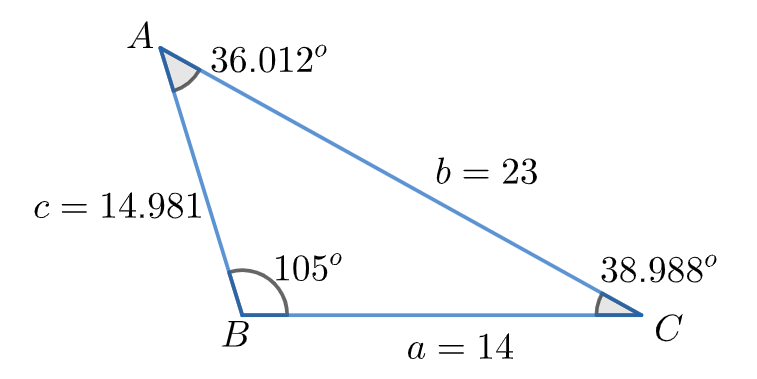
Therefore, we can conclude that the triangle $\Delta ABC$ has the angles $\angle A={{36.012}^{\circ }},\angle B={{105}^{\circ }},\angle C={{38.988}^{\circ }}$ and the sides $a=14,b=23,c=14.981$.
Note: We should apply the Lami’s theorem properly and should remember that the formula is only valid for $\text{sine}$ trigonometric ratio and not for any other trigonometric ratios. Most of the students make mistakes here. Also, it is not advisable to use this formula for more than three variables.
Complete step by step solution:
The details that we have been provided about the triangle $\Delta ABC$ are that
$m\angle B={{105}^{\circ }},b=23,a=14$
We can see that as we are given the length of a side and its opposite angle, we can easily apply the Lami’s theorem. Lami's theorem states that for any triangle $\Delta ABC$ , if $a,b,c$ are the three sides of the triangle and $\angle A,\angle B,\angle C$ are the three angles, then there is a formula which relates all of them. This formula is,
$\dfrac{a}{\sin \angle A}=\dfrac{b}{\sin \angle B}=\dfrac{c}{\sin \angle C}$
This huge equation can be broken down into two equations, which are
$\dfrac{a}{\sin \angle A}=\dfrac{b}{\sin \angle B}....\left( 1 \right)$
$\dfrac{c}{\sin \angle C}=\dfrac{b}{\sin \angle B}....\left( 2 \right)$
Let us first solve the equation $\left( 1 \right)$ . We put the values of $a,b,\angle B$ in the equation to get,
$\Rightarrow \dfrac{14}{\sin \angle A}=\dfrac{23}{\sin \angle {{105}^{\circ }}}$
Taking reciprocals on both sides of the above equation, we get,
$\Rightarrow \dfrac{\sin \angle A}{14}=\dfrac{\sin \angle {{105}^{\circ }}}{23}$
Multiplying both sides of the above equation by $14$ , we get,
$\Rightarrow \sin \angle A=\dfrac{\sin \angle {{105}^{\circ }}}{23}\times 14$
Upon simplification, we get,
$\Rightarrow \sin \angle A=\dfrac{0.9659}{1.6428}$
This gives,
$\Rightarrow \sin \angle A=0.5879$
Taking ${{\sin }^{-1}}$ on both sides, we get,
$\begin{align}
& \Rightarrow \angle A={{\sin }^{-1}}\left( 0.5879 \right) \\
& \Rightarrow \angle A={{36.012}^{\circ }} \\
\end{align}$
Let us now solve the equation $\left( 2 \right)$ . But, there are two unknowns and only one equation available. Thus, we have to incorporate a second equation, which is the sum of internal angles of a triangle,
$\angle A+\angle B+\angle C={{180}^{\circ }}$
Putting the values of $\angle A,\angle B$ in the above equation, we get,
$\begin{align}
& \Rightarrow {{36.012}^{\circ }}+{{105}^{\circ }}+\angle C={{180}^{\circ }} \\
& \Rightarrow \angle C={{38.988}^{\circ }} \\
\end{align}$
We can now solve the equation $\left( 2 \right)$ easily. Putting the values of $\angle C,\angle B,b$ ,we get,
$\begin{align}
& \Rightarrow \dfrac{c}{\sin {{38.988}^{\circ }}}=\dfrac{23}{\sin {{105}^{\circ }}} \\
& \Rightarrow c=\dfrac{23}{\sin {{105}^{\circ }}}\times \sin {{38.988}^{\circ }} \\
& \Rightarrow c=14.981 \\
\end{align}$
Therefore, we can conclude that the triangle $\Delta ABC$ has the angles $\angle A={{36.012}^{\circ }},\angle B={{105}^{\circ }},\angle C={{38.988}^{\circ }}$ and the sides $a=14,b=23,c=14.981$.
Note: We should apply the Lami’s theorem properly and should remember that the formula is only valid for $\text{sine}$ trigonometric ratio and not for any other trigonometric ratios. Most of the students make mistakes here. Also, it is not advisable to use this formula for more than three variables.
Recently Updated Pages
Master Class 10 Computer Science: Engaging Questions & Answers for Success

Master Class 10 General Knowledge: Engaging Questions & Answers for Success
Master Class 10 English: Engaging Questions & Answers for Success
Master Class 10 Social Science: Engaging Questions & Answers for Success
Master Class 10 Maths: Engaging Questions & Answers for Success
Master Class 10 Science: Engaging Questions & Answers for Success
Trending doubts
What is the median of the first 10 natural numbers class 10 maths CBSE
Which women's tennis player has 24 Grand Slam singles titles?
Who is the Brand Ambassador of Incredible India?
Why is there a time difference of about 5 hours between class 10 social science CBSE
Write a letter to the principal requesting him to grant class 10 english CBSE
A moving boat is observed from the top of a 150 m high class 10 maths CBSE