



How do you solve the triangle ABC given a = 5, b = 8, c = 12?
Answer
 Verified
585.6k+ views
Hint: To solve a triangle means to find the values of all three sides and the three angles of that very triangle. Here, we are given the values of all three sides and we have to find the value of the three angles. For this, we will use ‘The Law of Cosines’. It is given by ${c^2} = {a^2} + {b^2} - 2ab\cos C$, where $a$, $b$ and $c$ are the sides of the triangle and $C$ is the angle between sides $a$ and $b$.
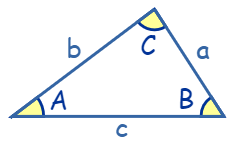
Complete step by step solution:
We have ${c^2} = {a^2} + {b^2} - 2ab\cos C$
It is given that $a = 5$, $b = 8$ and $c = 12$. On substituting the values of $a$, $b$ and $c$ in the cosine law given above, we get
$ \Rightarrow {12^2} = {5^2} + {8^2} - 2 \times 5 \times 8 \times \cos C$
$
\Rightarrow 144 = 25 + 64 - 80\cos C \\
\Rightarrow 144 = 89 - 80\cos C \\
$
Now rearranging the like expression on one side, we get
$
\Rightarrow 80\cos C = 89 - 144 \\
\Rightarrow 80\cos C = - 55 \\
$
On dividing both sides by $80$, we get
$
\Rightarrow \dfrac{{80\cos C}}{{80}} = \dfrac{{ - 55}}{{80}} \\
\Rightarrow \cos C = - 0.6875 \\
$
Now. To find angle $C$, we have to find the inverse cosine of $ - 0.6875$
$
\Rightarrow C = {\cos ^{ - 1}}( - 0.6875) \\
\Rightarrow C = {133.43^o} \\
$
So we have angle $C = {133.43^o}$.
Similarly for angle $B$, we will use the cosine law as
${b^2} = {a^2} + {c^2} - 2ac\cos B$
On substituting the known values of $a$, $b$ and $c$ in the cosine law given above, we get
$ \Rightarrow {8^2} = {5^2} + {12^2} - 2 \times 5 \times 12 \times \cos B$
$
\Rightarrow 64 = 25 + 144 - 120\cos B \\
\Rightarrow 64 = 169 - 120\cos B \\
$
Now rearranging the like expression on one side, we get
$
\Rightarrow 120\cos B = 169 - 64 \\
\Rightarrow 120\cos B = 105 \\
$
On dividing both sides by $120$, we get
$
\Rightarrow \dfrac{{120\cos B}}{{120}} = \dfrac{{105}}{{120}} \\
\Rightarrow \cos B = 0.875 \\
$
Now. To find the angle $B$, we have to find the inverse cosine of $0.875$
$
\Rightarrow B = {\cos ^{ - 1}}(0.875) \\
\Rightarrow B = {28.95^o} \\
$
So we have angle $B = {28.95^o}$.
Now. We have angle $B = {28.95^o}$ and angle $C = {133.43^o}$
As we know the sum of all the angles of a triangle is ${180^o}$.
So in $\Delta ABC$, we have
$ \Rightarrow A + B + C = {180^o}$
On substituting the values of $B$ and $C$, we get
$
\Rightarrow A + {28.95^o} + {133.43^o} = {180^o} \\
\Rightarrow A + {162.38^o} = {180^o} \\
\Rightarrow A = {17.62^o} \\
$
Hence, we have the values of all the three angles as $A = {17.62^O}$, $B = {28.95^o}$ and $C = {133.43^o}$.
Note: The Law of Cosines can also be used when the value of two sides of a triangle and the angle between the two sides is given. Also, it is evident that the law of cosine is not only restricted to right-angle triangles, it can be used for all types of triangles.
Complete step by step solution:
We have ${c^2} = {a^2} + {b^2} - 2ab\cos C$
It is given that $a = 5$, $b = 8$ and $c = 12$. On substituting the values of $a$, $b$ and $c$ in the cosine law given above, we get
$ \Rightarrow {12^2} = {5^2} + {8^2} - 2 \times 5 \times 8 \times \cos C$
$
\Rightarrow 144 = 25 + 64 - 80\cos C \\
\Rightarrow 144 = 89 - 80\cos C \\
$
Now rearranging the like expression on one side, we get
$
\Rightarrow 80\cos C = 89 - 144 \\
\Rightarrow 80\cos C = - 55 \\
$
On dividing both sides by $80$, we get
$
\Rightarrow \dfrac{{80\cos C}}{{80}} = \dfrac{{ - 55}}{{80}} \\
\Rightarrow \cos C = - 0.6875 \\
$
Now. To find angle $C$, we have to find the inverse cosine of $ - 0.6875$
$
\Rightarrow C = {\cos ^{ - 1}}( - 0.6875) \\
\Rightarrow C = {133.43^o} \\
$
So we have angle $C = {133.43^o}$.
Similarly for angle $B$, we will use the cosine law as
${b^2} = {a^2} + {c^2} - 2ac\cos B$
On substituting the known values of $a$, $b$ and $c$ in the cosine law given above, we get
$ \Rightarrow {8^2} = {5^2} + {12^2} - 2 \times 5 \times 12 \times \cos B$
$
\Rightarrow 64 = 25 + 144 - 120\cos B \\
\Rightarrow 64 = 169 - 120\cos B \\
$
Now rearranging the like expression on one side, we get
$
\Rightarrow 120\cos B = 169 - 64 \\
\Rightarrow 120\cos B = 105 \\
$
On dividing both sides by $120$, we get
$
\Rightarrow \dfrac{{120\cos B}}{{120}} = \dfrac{{105}}{{120}} \\
\Rightarrow \cos B = 0.875 \\
$
Now. To find the angle $B$, we have to find the inverse cosine of $0.875$
$
\Rightarrow B = {\cos ^{ - 1}}(0.875) \\
\Rightarrow B = {28.95^o} \\
$
So we have angle $B = {28.95^o}$.
Now. We have angle $B = {28.95^o}$ and angle $C = {133.43^o}$
As we know the sum of all the angles of a triangle is ${180^o}$.
So in $\Delta ABC$, we have
$ \Rightarrow A + B + C = {180^o}$
On substituting the values of $B$ and $C$, we get
$
\Rightarrow A + {28.95^o} + {133.43^o} = {180^o} \\
\Rightarrow A + {162.38^o} = {180^o} \\
\Rightarrow A = {17.62^o} \\
$
Hence, we have the values of all the three angles as $A = {17.62^O}$, $B = {28.95^o}$ and $C = {133.43^o}$.
Note: The Law of Cosines can also be used when the value of two sides of a triangle and the angle between the two sides is given. Also, it is evident that the law of cosine is not only restricted to right-angle triangles, it can be used for all types of triangles.

Recently Updated Pages
Master Class 12 Business Studies: Engaging Questions & Answers for Success

Master Class 12 Biology: Engaging Questions & Answers for Success
Master Class 12 Chemistry: Engaging Questions & Answers for Success
Class 12 Question and Answer - Your Ultimate Solutions Guide
Master Class 11 Social Science: Engaging Questions & Answers for Success
Master Class 11 English: Engaging Questions & Answers for Success
Trending doubts
What is the situation called when no party gets the class 9 social science CBSE
What is the Full Form of ICSE / ISC ?
Find the sum of series 1 + 2 + 3 + 4 + 5 + + 100 class 9 maths CBSE
Fill the blanks with the suitable prepositions 1 The class 9 english CBSE
Difference Between Plant Cell and Animal Cell
What is pollution? How many types of pollution? Define it