



How do you solve the triangle ABC given A = 30 degrees, b = 4, c = 6?
Answer
 Verified
569.4k+ views
Hint: Draw a rough diagram of a right-angle triangle with the given angle A = 30 degrees and the side length b = 4, c = 6 where a, b and c are the sides opposite to the angles A, B and C respectively. Apply the cosine formulas: $\cos A=\dfrac{{{b}^{2}}+{{c}^{2}}-{{a}^{2}}}{2bc}$ to find the values of sides a. Now, once the value of side ‘a’ is found use the sine rule: $\dfrac{a}{\sin A}=\dfrac{b}{\sin B}=\dfrac{c}{\sin C}$ to find the values of angle B and C.
Complete step by step answer:
Here, we have been provided with a triangle having angle A = 30 degrees, b = 4 and c = 6. We are asked to find the missing side ‘a’ and the measure of the angles B and C.
First, let us draw a rough diagram of the triangle according to the given question.
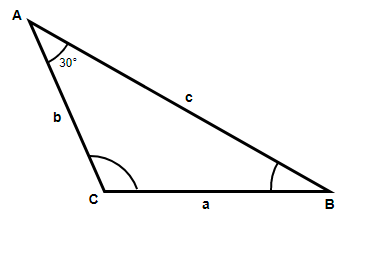
In the above figure we have according to the convention of naming the sides we have to assume that the sides opposite to the angles A, B and C are a, b and c respectively. Let us first determine the length of side a.
Using the cosine rule $\cos A=\dfrac{{{b}^{2}}+{{c}^{2}}-{{a}^{2}}}{2bc}$ we get,
$\begin{align}
& \Rightarrow \cos {{30}^{\circ }}=\dfrac{{{4}^{2}}+{{6}^{2}}-{{a}^{2}}}{2\times 4\times 6} \\
& \Rightarrow \cos {{30}^{\circ }}=\dfrac{52-{{a}^{2}}}{48} \\
\end{align}$
We know that $cos{{30}^{\circ }}=\dfrac{\sqrt{3}}{2}$, so substituting this value we get,
$\begin{align}
& \Rightarrow \dfrac{\sqrt{3}}{2}=\dfrac{52-{{a}^{2}}}{48} \\
& \Rightarrow 24\sqrt{3}=52-{{a}^{2}} \\
& \Rightarrow {{a}^{2}}=52-24\sqrt{3} \\
\end{align}$
Using the value $\sqrt{3}=1.732$ and taking square root both the sides we get,
$\therefore a=3.23$
Now we need to find the missing angles B and C. using the sine rule $\dfrac{a}{\sin A}=\dfrac{b}{\sin B}=\dfrac{c}{\sin C}$ we get,
$\begin{align}
& \Rightarrow \dfrac{3.23}{\sin {{30}^{\circ }}}=\dfrac{4}{\sin B}=\dfrac{6}{\sin C} \\
& \Rightarrow \dfrac{3.23}{\left( \dfrac{1}{2} \right)}=\dfrac{4}{\sin B}=\dfrac{6}{\sin C} \\
& \Rightarrow 6.46=\dfrac{4}{\sin B}=\dfrac{6}{\sin C} \\
\end{align}$
(1) Considering the relation: $6.46=\dfrac{4}{\sin B}$ we get,
$\begin{align}
& \Rightarrow \sin B=\dfrac{4}{6.46} \\
& \Rightarrow B={{\sin }^{-1}}\left( \dfrac{4}{6.46} \right) \\
& \Rightarrow B={{\sin }^{-1}}\left( 0.62 \right) \\
& \therefore B={{38.25}^{\circ }} \\
\end{align}$
(2) Considering the relation: $6.46=\dfrac{6}{\sin C}$ we get,
$\begin{align}
& \Rightarrow \sin C=\dfrac{6}{6.46} \\
& \Rightarrow C={{\sin }^{-1}}\left( \dfrac{6}{6.46} \right) \\
& \Rightarrow C={{\sin }^{-1}}\left( 0.93 \right) \\
\end{align}$
Now, if we will find the value of $\cos C$ then it will turn out to be negative that means C is an obtuse angle. Therefore we have,
$\begin{align}
& \Rightarrow C={{180}^{\circ }}-{{\sin }^{-1}}\left( 0.93 \right) \\
& \Rightarrow C={{180}^{\circ }}-{{68.25}^{\circ }} \\
& \therefore C={{111.75}^{\circ }} \\
\end{align}$
Note: Always remember that the sum of all the interior angles of a triangle is always 180 degrees. You must check the values of the cosine function before concluding the angle. This is because cosine function is negative in the second quadrant that means if it is negative then there must be an obtuse angle in the triangle. We cannot figure it out using the sine function because it is positive in the second quadrant also.
Complete step by step answer:
Here, we have been provided with a triangle having angle A = 30 degrees, b = 4 and c = 6. We are asked to find the missing side ‘a’ and the measure of the angles B and C.
First, let us draw a rough diagram of the triangle according to the given question.
In the above figure we have according to the convention of naming the sides we have to assume that the sides opposite to the angles A, B and C are a, b and c respectively. Let us first determine the length of side a.
Using the cosine rule $\cos A=\dfrac{{{b}^{2}}+{{c}^{2}}-{{a}^{2}}}{2bc}$ we get,
$\begin{align}
& \Rightarrow \cos {{30}^{\circ }}=\dfrac{{{4}^{2}}+{{6}^{2}}-{{a}^{2}}}{2\times 4\times 6} \\
& \Rightarrow \cos {{30}^{\circ }}=\dfrac{52-{{a}^{2}}}{48} \\
\end{align}$
We know that $cos{{30}^{\circ }}=\dfrac{\sqrt{3}}{2}$, so substituting this value we get,
$\begin{align}
& \Rightarrow \dfrac{\sqrt{3}}{2}=\dfrac{52-{{a}^{2}}}{48} \\
& \Rightarrow 24\sqrt{3}=52-{{a}^{2}} \\
& \Rightarrow {{a}^{2}}=52-24\sqrt{3} \\
\end{align}$
Using the value $\sqrt{3}=1.732$ and taking square root both the sides we get,
$\therefore a=3.23$
Now we need to find the missing angles B and C. using the sine rule $\dfrac{a}{\sin A}=\dfrac{b}{\sin B}=\dfrac{c}{\sin C}$ we get,
$\begin{align}
& \Rightarrow \dfrac{3.23}{\sin {{30}^{\circ }}}=\dfrac{4}{\sin B}=\dfrac{6}{\sin C} \\
& \Rightarrow \dfrac{3.23}{\left( \dfrac{1}{2} \right)}=\dfrac{4}{\sin B}=\dfrac{6}{\sin C} \\
& \Rightarrow 6.46=\dfrac{4}{\sin B}=\dfrac{6}{\sin C} \\
\end{align}$
(1) Considering the relation: $6.46=\dfrac{4}{\sin B}$ we get,
$\begin{align}
& \Rightarrow \sin B=\dfrac{4}{6.46} \\
& \Rightarrow B={{\sin }^{-1}}\left( \dfrac{4}{6.46} \right) \\
& \Rightarrow B={{\sin }^{-1}}\left( 0.62 \right) \\
& \therefore B={{38.25}^{\circ }} \\
\end{align}$
(2) Considering the relation: $6.46=\dfrac{6}{\sin C}$ we get,
$\begin{align}
& \Rightarrow \sin C=\dfrac{6}{6.46} \\
& \Rightarrow C={{\sin }^{-1}}\left( \dfrac{6}{6.46} \right) \\
& \Rightarrow C={{\sin }^{-1}}\left( 0.93 \right) \\
\end{align}$
Now, if we will find the value of $\cos C$ then it will turn out to be negative that means C is an obtuse angle. Therefore we have,
$\begin{align}
& \Rightarrow C={{180}^{\circ }}-{{\sin }^{-1}}\left( 0.93 \right) \\
& \Rightarrow C={{180}^{\circ }}-{{68.25}^{\circ }} \\
& \therefore C={{111.75}^{\circ }} \\
\end{align}$
Note: Always remember that the sum of all the interior angles of a triangle is always 180 degrees. You must check the values of the cosine function before concluding the angle. This is because cosine function is negative in the second quadrant that means if it is negative then there must be an obtuse angle in the triangle. We cannot figure it out using the sine function because it is positive in the second quadrant also.
Recently Updated Pages
Master Class 12 Economics: Engaging Questions & Answers for Success

Master Class 12 English: Engaging Questions & Answers for Success
Master Class 12 Social Science: Engaging Questions & Answers for Success
Master Class 12 Maths: Engaging Questions & Answers for Success
Master Class 12 Physics: Engaging Questions & Answers for Success
Master Class 9 General Knowledge: Engaging Questions & Answers for Success
Trending doubts
What is the color of ferrous sulphate crystals? How does this color change after heating? Name the products formed on strongly heating ferrous sulphate crystals. What type of chemical reaction occurs in this type of change.
What is the difference between Atleast and Atmost in class 9 maths CBSE
Define force and write its SI unit
Distinguish between Khadar and Bhangar class 9 social science CBSE
Describe any five main characteristics of alluvial class 9 social science CBSE
What is the importance of natural resources? Why is it necessary to conserve them?
What is the color of ferrous sulphate crystals? How does this color change after heating? Name the products formed on strongly heating ferrous sulphate crystals. What type of chemical reaction occurs in this type of change.
What is the difference between Atleast and Atmost in class 9 maths CBSE
Define force and write its SI unit