




How do you solve the system $5x+2y=-15$ and $y=2x-12$ by graphing? \[\]
Answer
 Verified
558.3k+ views
Hint: We recall the three forms of writing a linear equation: the general form$Ax+By+C=0$, the slope intercept form $y=mx+c$ and standard form $Ax+By=D$.We recall that we need two points to plot a line. We plot the lines corresponding to the given equation using intercept points and find the solution as coordinates of their point of intersection. \[\]
Complete step-by-step solution:
We know from the Cartesian coordinate system that every linear equation $Ax+By+C=0$can be represented as a line. If the line is inclined with positive $x-$axis at an angle $\theta $ then its slope is given by $m=\tan \theta $ and if it cuts $y-$axis at a point $\left( 0,c \right)$ from the origin the $y-$intercept is given by $c$. The slope-intercept form of equation is given by
\[y=mx+c\]
The intercept form or the standard equation of line is given by
\[Ax+By=D\]
We are given the following equations in the question
\[\begin{align}
& 5x+2y=-15....\left( 1 \right) \\
& y=2x-12.....\left( 2 \right) \\
\end{align}\]
We know that unique solutions to two linear equations are obtained as the coordinates of the point of intersection of the lines corresponding to them. Let us plot line (1). We put $x=0$ and find the $y-$ intercept in equation (1) of line (1) as
\[\begin{align}
& 5\cdot 0+2y=-15 \\
& \Rightarrow 2y= -15 \\
& \Rightarrow y=\dfrac{-15}{2} \\
\end{align}\]
We put $y=0$ and find the $x-$ intercept in equation (1) of line (1) as
\[\begin{align}
& 5\cdot x+2\cdot 0=-15 \\
& \Rightarrow 5x=-15 \\
& \Rightarrow x=-3 \\
\end{align}\]
So we got two points for line (1) as $\left( 0,\dfrac{-15}{2} \right),\left( -3,0 \right)$. ). We put $x=0$ and find the $y-$ intercept in equation (2) of line (2) as
\[\begin{align}
& y=2\cdot 0-12 \\
& \Rightarrow y=0-12 \\
& \Rightarrow y=-12 \\
\end{align}\]
We put $y=0$ and find the $x-$ intercept in equation (2) of line (2) as
\[\begin{align}
& 0=2\cdot x-12 \\
& \Rightarrow 2x=12 \\
& \Rightarrow x=6 \\
\end{align}\]
So we got two points for line (2) as $\left( 0,-12 \right),\left( 6,0 \right)$. We plot line (1) and line (2). \[\]
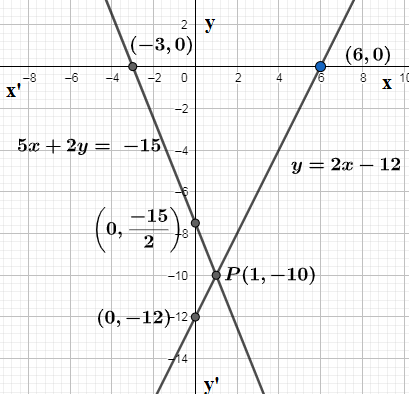
We see that the lines at intersect at the point $P\left( 1,-10 \right)$ and hence the solution is $x=1,y=-10$ \[\]
Note: We note that two linear equations ${{A}_{1}}x+{{B}_{1}}y+{{C}_{1}}=0,{{A}_{2}}x+{{B}_{2}}y+{{C}_{2}}=0$ have unique solution only when the ratios of coefficients of respective variables are not equal which means$\dfrac{{{A}_{1}}}{{{A}_{2}}}\ne \dfrac{{{B}_{1}}}{{{B}_{2}}}$. Here in this problem $\dfrac{5}{2}\ne \dfrac{2}{-1}$ and hence a unique solution exists. We should check if this is rough before solving linear equations.
Complete step-by-step solution:
We know from the Cartesian coordinate system that every linear equation $Ax+By+C=0$can be represented as a line. If the line is inclined with positive $x-$axis at an angle $\theta $ then its slope is given by $m=\tan \theta $ and if it cuts $y-$axis at a point $\left( 0,c \right)$ from the origin the $y-$intercept is given by $c$. The slope-intercept form of equation is given by
\[y=mx+c\]
The intercept form or the standard equation of line is given by
\[Ax+By=D\]
We are given the following equations in the question
\[\begin{align}
& 5x+2y=-15....\left( 1 \right) \\
& y=2x-12.....\left( 2 \right) \\
\end{align}\]
We know that unique solutions to two linear equations are obtained as the coordinates of the point of intersection of the lines corresponding to them. Let us plot line (1). We put $x=0$ and find the $y-$ intercept in equation (1) of line (1) as
\[\begin{align}
& 5\cdot 0+2y=-15 \\
& \Rightarrow 2y= -15 \\
& \Rightarrow y=\dfrac{-15}{2} \\
\end{align}\]
We put $y=0$ and find the $x-$ intercept in equation (1) of line (1) as
\[\begin{align}
& 5\cdot x+2\cdot 0=-15 \\
& \Rightarrow 5x=-15 \\
& \Rightarrow x=-3 \\
\end{align}\]
So we got two points for line (1) as $\left( 0,\dfrac{-15}{2} \right),\left( -3,0 \right)$. ). We put $x=0$ and find the $y-$ intercept in equation (2) of line (2) as
\[\begin{align}
& y=2\cdot 0-12 \\
& \Rightarrow y=0-12 \\
& \Rightarrow y=-12 \\
\end{align}\]
We put $y=0$ and find the $x-$ intercept in equation (2) of line (2) as
\[\begin{align}
& 0=2\cdot x-12 \\
& \Rightarrow 2x=12 \\
& \Rightarrow x=6 \\
\end{align}\]
So we got two points for line (2) as $\left( 0,-12 \right),\left( 6,0 \right)$. We plot line (1) and line (2). \[\]
We see that the lines at intersect at the point $P\left( 1,-10 \right)$ and hence the solution is $x=1,y=-10$ \[\]
Note: We note that two linear equations ${{A}_{1}}x+{{B}_{1}}y+{{C}_{1}}=0,{{A}_{2}}x+{{B}_{2}}y+{{C}_{2}}=0$ have unique solution only when the ratios of coefficients of respective variables are not equal which means$\dfrac{{{A}_{1}}}{{{A}_{2}}}\ne \dfrac{{{B}_{1}}}{{{B}_{2}}}$. Here in this problem $\dfrac{5}{2}\ne \dfrac{2}{-1}$ and hence a unique solution exists. We should check if this is rough before solving linear equations.
Recently Updated Pages
Master Class 11 Computer Science: Engaging Questions & Answers for Success

Master Class 11 Business Studies: Engaging Questions & Answers for Success
Master Class 11 Economics: Engaging Questions & Answers for Success
Master Class 11 English: Engaging Questions & Answers for Success
Master Class 11 Maths: Engaging Questions & Answers for Success
Master Class 11 Biology: Engaging Questions & Answers for Success
Trending doubts
One Metric ton is equal to kg A 10000 B 1000 C 100 class 11 physics CBSE
There are 720 permutations of the digits 1 2 3 4 5 class 11 maths CBSE
Discuss the various forms of bacteria class 11 biology CBSE
Draw a diagram of a plant cell and label at least eight class 11 biology CBSE
State the laws of reflection of light
Explain zero factorial class 11 maths CBSE