




How do you solve the simultaneous equations $y=3x+1$ and $2x+y=6$ ?
Answer
 Verified
601.8k+ views
Hint: We incorporate the graphical approach for this problem. For this, we express the given lines in some standard form, like the intercept form $\dfrac{x}{a}+\dfrac{y}{b}=1$ . After doing this, we will come to know about the intercepts of the two lines and can thus easily plot them. Then, we find their point of intersection, which will be the solution.
Complete step by step solution:
The given equations that we have are
$y=3x+1....\left( 1 \right)$
$2x+y=6....\left( 2 \right)$
We solve the two equations by graphical method. For this, we need to rewrite the equations in some standard form to draw their graphs easily. For this problem, the standard form that we use will be the intercept form. The intercept form of a straight line is
$\dfrac{x}{a}+\dfrac{y}{b}=1$
Where, $a$ is the $x$ -intercept and $b$ is the $y$ -intercept.
We start by rearranging the equation $\left( 1 \right)$ in the intercept form.
$\Rightarrow y-3x=1$
We divide both sides of the equation by $1$ . The equation thus becomes,
$\Rightarrow \dfrac{y}{1}-\dfrac{3x}{1}=1$
The above equation can be written as,
$\Rightarrow \dfrac{x}{-\dfrac{1}{3}}+\dfrac{y}{1}=1$
After comparing the above equation with the general intercept form, we get $a=-\dfrac{1}{3},b=1$ . Keeping these intercepts in mind, we draw the line on the graph.
Similarly, we rewrite the equation $\left( 2 \right)$ in the intercept form. We divide both sides of the equation by $6$ and get,
$\Rightarrow \dfrac{2x}{6}+\dfrac{y}{6}=1$
The above equation can be written after simplification as,
$\Rightarrow \dfrac{x}{3}+\dfrac{y}{6}=1$
After comparing the above equation with the general intercept form, we get $a=3,b=6$ . Keeping these intercepts in mind, we draw the line on the graph.
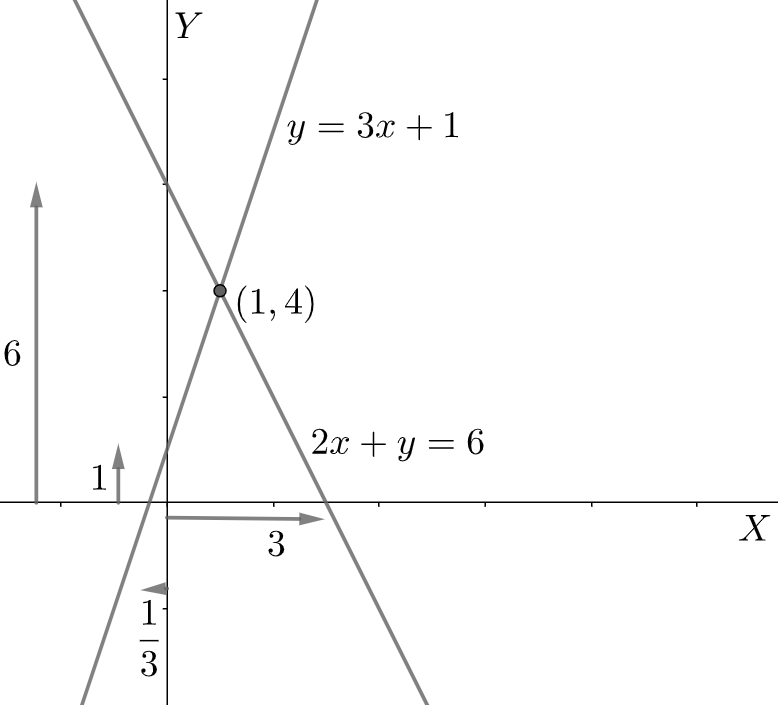
From the graph above, we can see that the two lines intersect at the point $\left( 1,4 \right)$.
Therefore, we can conclude that the solution of the given two equations is $x=1,y=4$.
Note: In this problem, we must be careful to observe that the first line has one negative intercept. Students often mistake by taking the intercepts to be positive, and draw a wrong line. This gives wrong results. This problem can also be solved by the substitution method, where we substitute one equation into the other to get the solution.
Complete step by step solution:
The given equations that we have are
$y=3x+1....\left( 1 \right)$
$2x+y=6....\left( 2 \right)$
We solve the two equations by graphical method. For this, we need to rewrite the equations in some standard form to draw their graphs easily. For this problem, the standard form that we use will be the intercept form. The intercept form of a straight line is
$\dfrac{x}{a}+\dfrac{y}{b}=1$
Where, $a$ is the $x$ -intercept and $b$ is the $y$ -intercept.
We start by rearranging the equation $\left( 1 \right)$ in the intercept form.
$\Rightarrow y-3x=1$
We divide both sides of the equation by $1$ . The equation thus becomes,
$\Rightarrow \dfrac{y}{1}-\dfrac{3x}{1}=1$
The above equation can be written as,
$\Rightarrow \dfrac{x}{-\dfrac{1}{3}}+\dfrac{y}{1}=1$
After comparing the above equation with the general intercept form, we get $a=-\dfrac{1}{3},b=1$ . Keeping these intercepts in mind, we draw the line on the graph.
Similarly, we rewrite the equation $\left( 2 \right)$ in the intercept form. We divide both sides of the equation by $6$ and get,
$\Rightarrow \dfrac{2x}{6}+\dfrac{y}{6}=1$
The above equation can be written after simplification as,
$\Rightarrow \dfrac{x}{3}+\dfrac{y}{6}=1$
After comparing the above equation with the general intercept form, we get $a=3,b=6$ . Keeping these intercepts in mind, we draw the line on the graph.
From the graph above, we can see that the two lines intersect at the point $\left( 1,4 \right)$.
Therefore, we can conclude that the solution of the given two equations is $x=1,y=4$.
Note: In this problem, we must be careful to observe that the first line has one negative intercept. Students often mistake by taking the intercepts to be positive, and draw a wrong line. This gives wrong results. This problem can also be solved by the substitution method, where we substitute one equation into the other to get the solution.
Recently Updated Pages
Basicity of sulphurous acid and sulphuric acid are

Master Class 10 Computer Science: Engaging Questions & Answers for Success
Master Class 10 Social Science: Engaging Questions & Answers for Success
Master Class 10 Science: Engaging Questions & Answers for Success
Class 10 Question and Answer - Your Ultimate Solutions Guide
Master Class 10 Maths: Engaging Questions & Answers for Success
Trending doubts
What is the Total Duration of Football Match?
Explain the Treaty of Vienna of 1815 class 10 social science CBSE
In football, which nation is called "La Roja"?
Why is there a time difference of about 5 hours between class 10 social science CBSE
10 examples of evaporation in daily life with explanations
What is the full form of POSCO class 10 social science CBSE