




How do you solve the right triangle $a=117ft$, $b=16.35ft$?
Answer
 Verified
597.3k+ views
Hint: We can assume the two lengths given to be the perpendicular and the base lengths respectively. The third side, the hypotenuse, can be determined by using the Pythagoras theorem. Then considering the sine of any of the angles of the triangle, apart from the right angle, we can determine the value of that angle. Finally, we can use the angle sum property to determine the value of the third angle as well.
Complete step by step solution:
We know that in a right triangle, one of the three angles is a right angle. One side is named as the perpendicular, the second as the base, and the third is the hypotenuse. Since the two given lengths of the sides a and b are not mentioned by these names, we assume a to be perpendicular length, and b to be the base length so that we can draw the triangle ABC as
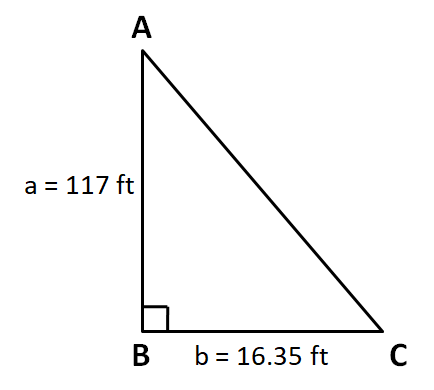
Let the dimension of the hypotenuse AC be $c\text{ }ft$.
Applying the Pythagoras theorem in the triangle ABC, we can write
$\Rightarrow A{{C}^{2}}=A{{B}^{2}}+B{{C}^{2}}$
Substituting $AB=a$, $BC=b$, and $AC=c$ in the above equation, we get
$\Rightarrow {{c}^{2}}={{a}^{2}}+{{b}^{2}}$
Now, according to the question, we can put $a=117ft$ and $b=16.35ft$ in the above equation to get
$\begin{align}
& \Rightarrow {{c}^{2}}={{117}^{2}}+{{16.35}^{2}} \\
& \Rightarrow {{c}^{2}}=13689+267.3225 \\
& \Rightarrow {{c}^{2}}=13965.3225 \\
\end{align}$
Taking square root both the sides, we get
$\begin{align}
& \Rightarrow c=\sqrt{13965.3225} \\
& \Rightarrow c=118.17ft \\
\end{align}$
Now, we know that the sine ratio is defined as
$\sin \theta =\dfrac{\text{Perpendicular}}{\text{Hypotenuse}}$
Therefore, for the triangle ABC we can write
$\Rightarrow \sin \angle BAC=\dfrac{BC}{AC}$
Putting $BC=b$ and $AC=c$
$\Rightarrow \sin \angle BAC=\dfrac{b}{c}$
Substituting $b=16.35ft$ and $c=118.17ft$ we get
$\begin{align}
& \Rightarrow \sin \angle BAC=\dfrac{16.35}{118.17} \\
& \Rightarrow \sin \angle BAC=0.1384 \\
\end{align}$
Taking sine inverse both the sides, we get
$\begin{align}
& \Rightarrow \angle BAC={{\sin }^{-1}}\left( 0.1384 \right) \\
& \Rightarrow \angle BAC={{7.95}^{\circ }}........\left( i \right) \\
\end{align}$
Now, applying angle sum property in the triangle, we can write
$\Rightarrow \angle ABC+\angle ACB+\angle BAC={{180}^{\circ }}$
From the figure, we can see that $\angle ABC={{90}^{\circ }}$. Substituting this above, we get
$\Rightarrow {{90}^{\circ }}+\angle ACB+\angle BAC={{180}^{\circ }}$
Now, we substitute the equation (i) in the above equation to get
$\begin{align}
& \Rightarrow {{90}^{\circ }}+\angle ACB+{{7.95}^{\circ }}={{180}^{\circ }} \\
& \Rightarrow \angle ACB+{{97.95}^{\circ }}={{180}^{\circ }} \\
\end{align}$
Finally, subtracting ${{97.95}^{\circ }}$ from both the sides, we get
\[\begin{align}
& \Rightarrow \angle ACB+{{97.95}^{\circ }}-{{97.95}^{\circ }}={{180}^{\circ }}-{{97.95}^{\circ }} \\
& \Rightarrow \angle ACB={{82.05}^{\circ }} \\
\end{align}\]
Note: We must understand what the terms “perpendicular” and “base” mean in the definition of the trigonometric ratios. The perpendicular is the side opposite to the angle whose trigonometric ratio is being considered. And the base is the side adjacent to the angle.
Complete step by step solution:
We know that in a right triangle, one of the three angles is a right angle. One side is named as the perpendicular, the second as the base, and the third is the hypotenuse. Since the two given lengths of the sides a and b are not mentioned by these names, we assume a to be perpendicular length, and b to be the base length so that we can draw the triangle ABC as
Let the dimension of the hypotenuse AC be $c\text{ }ft$.
Applying the Pythagoras theorem in the triangle ABC, we can write
$\Rightarrow A{{C}^{2}}=A{{B}^{2}}+B{{C}^{2}}$
Substituting $AB=a$, $BC=b$, and $AC=c$ in the above equation, we get
$\Rightarrow {{c}^{2}}={{a}^{2}}+{{b}^{2}}$
Now, according to the question, we can put $a=117ft$ and $b=16.35ft$ in the above equation to get
$\begin{align}
& \Rightarrow {{c}^{2}}={{117}^{2}}+{{16.35}^{2}} \\
& \Rightarrow {{c}^{2}}=13689+267.3225 \\
& \Rightarrow {{c}^{2}}=13965.3225 \\
\end{align}$
Taking square root both the sides, we get
$\begin{align}
& \Rightarrow c=\sqrt{13965.3225} \\
& \Rightarrow c=118.17ft \\
\end{align}$
Now, we know that the sine ratio is defined as
$\sin \theta =\dfrac{\text{Perpendicular}}{\text{Hypotenuse}}$
Therefore, for the triangle ABC we can write
$\Rightarrow \sin \angle BAC=\dfrac{BC}{AC}$
Putting $BC=b$ and $AC=c$
$\Rightarrow \sin \angle BAC=\dfrac{b}{c}$
Substituting $b=16.35ft$ and $c=118.17ft$ we get
$\begin{align}
& \Rightarrow \sin \angle BAC=\dfrac{16.35}{118.17} \\
& \Rightarrow \sin \angle BAC=0.1384 \\
\end{align}$
Taking sine inverse both the sides, we get
$\begin{align}
& \Rightarrow \angle BAC={{\sin }^{-1}}\left( 0.1384 \right) \\
& \Rightarrow \angle BAC={{7.95}^{\circ }}........\left( i \right) \\
\end{align}$
Now, applying angle sum property in the triangle, we can write
$\Rightarrow \angle ABC+\angle ACB+\angle BAC={{180}^{\circ }}$
From the figure, we can see that $\angle ABC={{90}^{\circ }}$. Substituting this above, we get
$\Rightarrow {{90}^{\circ }}+\angle ACB+\angle BAC={{180}^{\circ }}$
Now, we substitute the equation (i) in the above equation to get
$\begin{align}
& \Rightarrow {{90}^{\circ }}+\angle ACB+{{7.95}^{\circ }}={{180}^{\circ }} \\
& \Rightarrow \angle ACB+{{97.95}^{\circ }}={{180}^{\circ }} \\
\end{align}$
Finally, subtracting ${{97.95}^{\circ }}$ from both the sides, we get
\[\begin{align}
& \Rightarrow \angle ACB+{{97.95}^{\circ }}-{{97.95}^{\circ }}={{180}^{\circ }}-{{97.95}^{\circ }} \\
& \Rightarrow \angle ACB={{82.05}^{\circ }} \\
\end{align}\]
Note: We must understand what the terms “perpendicular” and “base” mean in the definition of the trigonometric ratios. The perpendicular is the side opposite to the angle whose trigonometric ratio is being considered. And the base is the side adjacent to the angle.
Recently Updated Pages
Class 10 Question and Answer - Your Ultimate Solutions Guide

Master Class 10 Computer Science: Engaging Questions & Answers for Success
Master Class 10 General Knowledge: Engaging Questions & Answers for Success
Master Class 12 Economics: Engaging Questions & Answers for Success
Master Class 12 Social Science: Engaging Questions & Answers for Success
Master Class 12 English: Engaging Questions & Answers for Success
Trending doubts
Explain the Treaty of Vienna of 1815 class 10 social science CBSE
The slogan Jai Hind was given by A Lal Bahadur Shastri class 10 social science CBSE
10 examples of evaporation in daily life with explanations
What is the full form of POSCO class 10 social science CBSE
Identify the feminine form of noun nephew a shenephew class 10 english CBSE
CSIR full form?