




Solve the pair of linear equations
$\dfrac{1}{3x+y}+\dfrac{1}{3x-y}=\dfrac{3}{4}$
$\dfrac{1}{2\left( 3x+y \right)}-\dfrac{1}{2\left( 3x-y \right)}=-\dfrac{1}{8}$
$3x+y\ne 0$ and $3x-y\ne 0$
Answer
 Verified
645k+ views
Hint: Assume $a=\dfrac{1}{3x+y}$ and $b=\dfrac{1}{3x-y}$. Hence form two linear equations in a and b. Solve for a and b. Now revert to original variables and hence form two linear equations in x and y. Solve for x and y. Remove extraneous roots, i.e. those roots at which either a or b is not defined.
Complete step-by-step answer:
Let $a=\dfrac{1}{3x+y}$ and $b=\dfrac{1}{3x-y}$.
Since $\dfrac{1}{3x+y}+\dfrac{1}{3x-y}=\dfrac{3}{4}$, we have
$a+b=\dfrac{3}{4}\text{ (i)}$
Also since $\dfrac{1}{2\left( 3x+y \right)}-\dfrac{1}{2\left( 3x-y \right)}=-\dfrac{1}{8}$ , we have
$\dfrac{a}{2}+\dfrac{b}{2}=\dfrac{-1}{8}$
Multiplying both sides by 2, we get
$\begin{align}
& \dfrac{2a}{2}-\dfrac{2b}{2}=\dfrac{-2}{8} \\
& \Rightarrow a-b=\dfrac{-1}{4}\text{ (ii)} \\
\end{align}$
Adding equation (i) and equation (ii), we get
$\begin{align}
& a+b+a-b=\dfrac{3}{4}-\dfrac{1}{4} \\
& \Rightarrow 2a=\dfrac{1}{2} \\
\end{align}$
Dividing both sides by 2, we get
$a=\dfrac{1}{2\times 2}=\dfrac{1}{4}$
Substituting the value of “a” in equation (i), we get
$\begin{align}
& a+b=\dfrac{3}{4} \\
& \Rightarrow \dfrac{1}{4}+b=\dfrac{3}{4} \\
& \Rightarrow b=\dfrac{3}{4}-\dfrac{1}{4}=\dfrac{2}{4}=\dfrac{1}{2} \\
\end{align}$
Hence, we have $a=\dfrac{1}{4}$ and $b=\dfrac{1}{2}$
Reverting to original variables, we get
$\begin{align}
& \dfrac{1}{3x+y}=\dfrac{1}{4} \\
& \\
\end{align}$
Taking reciprocals on both sides, we get
$3x+y=4\text{ (iii)}$
and
$\dfrac{1}{3x-y}=\dfrac{1}{2}$
Taking reciprocals on both sides, we get
$3x-y=2\text{ (iv)}$
Adding equation (iii) and equation (iv), we get
$\begin{align}
& 3x+y+3x-y=2+4 \\
& \Rightarrow 6x=6 \\
& \Rightarrow x=1 \\
\end{align}$
Substituting the value of x in equation (iii), we get
$\begin{align}
& 3x+y=4 \\
& \Rightarrow 3+y=4 \\
& \Rightarrow y=4-3=1 \\
\end{align}$
Hence we have x=1 and y=1.
At x=1 ,y =1, 3x+y = 4 and 3x-y =2
Since $3x+y\ne 0$ and $3x-y\ne 0$, we have
(x,y) = (1,1) is the solution of the given system of equations.
Note: Visualising graphically.
If we plot the curves $\dfrac{1}{3x+y}+\dfrac{1}{3x-y}=\dfrac{3}{4}$ and $\dfrac{1}{2\left( 3x+y \right)}-\dfrac{1}{2\left( 3x-y \right)}=-\dfrac{1}{8}$ on the same graph paper, then these curves will intersect at the point (1,1).
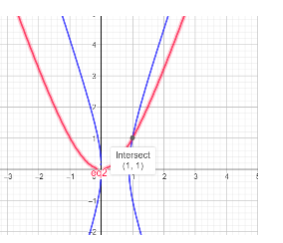
In the above graph, the blue curve is of $\dfrac{1}{3x+y}+\dfrac{1}{3x-y}=\dfrac{3}{4}$ equation and the pink curve of $\dfrac{1}{2\left( 3x+y \right)}-\dfrac{1}{2\left( 3x-y \right)}=-\dfrac{1}{8}$ equation. As can be seen from the graph, the two curves intersect at (1,1).
Complete step-by-step answer:
Let $a=\dfrac{1}{3x+y}$ and $b=\dfrac{1}{3x-y}$.
Since $\dfrac{1}{3x+y}+\dfrac{1}{3x-y}=\dfrac{3}{4}$, we have
$a+b=\dfrac{3}{4}\text{ (i)}$
Also since $\dfrac{1}{2\left( 3x+y \right)}-\dfrac{1}{2\left( 3x-y \right)}=-\dfrac{1}{8}$ , we have
$\dfrac{a}{2}+\dfrac{b}{2}=\dfrac{-1}{8}$
Multiplying both sides by 2, we get
$\begin{align}
& \dfrac{2a}{2}-\dfrac{2b}{2}=\dfrac{-2}{8} \\
& \Rightarrow a-b=\dfrac{-1}{4}\text{ (ii)} \\
\end{align}$
Adding equation (i) and equation (ii), we get
$\begin{align}
& a+b+a-b=\dfrac{3}{4}-\dfrac{1}{4} \\
& \Rightarrow 2a=\dfrac{1}{2} \\
\end{align}$
Dividing both sides by 2, we get
$a=\dfrac{1}{2\times 2}=\dfrac{1}{4}$
Substituting the value of “a” in equation (i), we get
$\begin{align}
& a+b=\dfrac{3}{4} \\
& \Rightarrow \dfrac{1}{4}+b=\dfrac{3}{4} \\
& \Rightarrow b=\dfrac{3}{4}-\dfrac{1}{4}=\dfrac{2}{4}=\dfrac{1}{2} \\
\end{align}$
Hence, we have $a=\dfrac{1}{4}$ and $b=\dfrac{1}{2}$
Reverting to original variables, we get
$\begin{align}
& \dfrac{1}{3x+y}=\dfrac{1}{4} \\
& \\
\end{align}$
Taking reciprocals on both sides, we get
$3x+y=4\text{ (iii)}$
and
$\dfrac{1}{3x-y}=\dfrac{1}{2}$
Taking reciprocals on both sides, we get
$3x-y=2\text{ (iv)}$
Adding equation (iii) and equation (iv), we get
$\begin{align}
& 3x+y+3x-y=2+4 \\
& \Rightarrow 6x=6 \\
& \Rightarrow x=1 \\
\end{align}$
Substituting the value of x in equation (iii), we get
$\begin{align}
& 3x+y=4 \\
& \Rightarrow 3+y=4 \\
& \Rightarrow y=4-3=1 \\
\end{align}$
Hence we have x=1 and y=1.
At x=1 ,y =1, 3x+y = 4 and 3x-y =2
Since $3x+y\ne 0$ and $3x-y\ne 0$, we have
(x,y) = (1,1) is the solution of the given system of equations.
Note: Visualising graphically.
If we plot the curves $\dfrac{1}{3x+y}+\dfrac{1}{3x-y}=\dfrac{3}{4}$ and $\dfrac{1}{2\left( 3x+y \right)}-\dfrac{1}{2\left( 3x-y \right)}=-\dfrac{1}{8}$ on the same graph paper, then these curves will intersect at the point (1,1).
In the above graph, the blue curve is of $\dfrac{1}{3x+y}+\dfrac{1}{3x-y}=\dfrac{3}{4}$ equation and the pink curve of $\dfrac{1}{2\left( 3x+y \right)}-\dfrac{1}{2\left( 3x-y \right)}=-\dfrac{1}{8}$ equation. As can be seen from the graph, the two curves intersect at (1,1).
Recently Updated Pages
Master Class 12 Business Studies: Engaging Questions & Answers for Success

Master Class 12 Biology: Engaging Questions & Answers for Success
Master Class 12 Chemistry: Engaging Questions & Answers for Success
Class 12 Question and Answer - Your Ultimate Solutions Guide
Master Class 11 Social Science: Engaging Questions & Answers for Success
Master Class 11 English: Engaging Questions & Answers for Success
Trending doubts
What is the full form of NDA a National Democratic class 10 social science CBSE
Explain the Treaty of Vienna of 1815 class 10 social science CBSE
Who Won 36 Oscar Awards? Record Holder Revealed
Bharatiya Janata Party was founded in the year A 1979 class 10 social science CBSE
What is the median of the first 10 natural numbers class 10 maths CBSE
Why is it 530 pm in india when it is 1200 afternoon class 10 social science CBSE