




How do you solve the logarithmic equation $\ln x + \ln \left( {x + 4} \right) = \ln 5$?
Answer
 Verified
566.4k+ views
Hint: We have to find all possible values of $x$ satisfying a given equation. Use the property of logarithm function (i) and (ii) to solve the given equation. Then, we will get the solution of the given equation by solving the quadratic equation by middle splitting method. In this, find the product of the first and last constant term of the expression. Then, choose the factors of product value in such a way that addition or subtraction of those factors is the middle constant term. Then split the middle constant term or coefficient of $x$ in these factors and take common terms out in first terms and last two terms. Then again take common terms out of terms obtained. Then, equate both factors to $0$ and determine the value of $x$.
Formula Used:
Properties of Logarithm function: Following are some useful properties of logarithm function:
${\log _a}\left( {xy} \right) = {\log _a}\left| x \right| + {\log _a}\left| y \right|$, where $a > 0,a \ne 1$ and $xy > 0$
${e^{\ln \left( x \right)}} = x$.
Complete step-by-step solution:
Given equation: $\ln x + \ln \left( {x + 4} \right) = \ln 5$
We have to find all possible values of $x$ satisfying a given equation.
Use the product property of logarithms, ${\log _a}\left( {xy} \right) = {\log _a}\left| x \right| + {\log _a}\left| y \right|$.
$\ln \left( {x\left( {x + 4} \right)} \right) = \ln \left( 5 \right)$
Rewrite both sides in terms of the base $e$.
${e^{\ln \left( {x\left( {x + 4} \right)} \right)}} = {e^{\ln \left( 5 \right)}}$
Use the exponential property of logarithm, ${e^{\ln \left( x \right)}} = x$.
$x\left( {x + 4} \right) = 5$
$ \Rightarrow {x^2} + 4x - 5 = 0$
We have to factor this quadratic equation.
To factor this quadratic equation, first we have to find the product of the first and last constant term of the expression.
Here, the first constant term in ${x^2} + 4x - 5 = 0$ is $1$, as it is the coefficient of ${x^2}$ and last constant term is $ - 5$, as it is a constant value.
Now, we have to multiply the coefficient of ${x^2}$ with the constant value in ${x^2} + 4x - 5 = 0$, i.e., multiply $1$ with $ - 5$.
Multiplying $1$ and $ - 5$, we get
$1 \times \left( { - 5} \right) = - 5$
Now, we have to find the factors of $ - 5$ in such a way that addition or subtraction of those factors is the middle constant term.
Middle constant term or coefficient of $x$ in ${x^2} + 4x - 5 = 0$ is $4$.
So, we have to find two factors of $ - 5$, which on multiplying gives $ - 5$ and in addition gives $4$.
We can do this by determining all factors of $5$.
Factors of $5$ are \[ \pm 1, \pm 5\].
Now among these values find two factors of $5$, which on multiplying gives $ - 5$ and in addition gives $4$.
After observing, we can see that
$\left( { - 1} \right) \times 5 = - 5$ and $\left( { - 1} \right) + 5 = 4$
So, these factors are suitable for factorising the given trinomial.
Now, the next step is to split the middle constant term or coefficient of $x$ in these factors.
That is, write $4x$ as $ - x + 5x$ in ${x^2} + 4x - 5 = 0$.
After writing $4x$ as $ - x + 5x$ in ${x^2} + 4x - 5 = 0$, we get
$ \Rightarrow {x^2} - x + 5x - 5 = 0$
Now, taking $x$ common in $\left( {{x^2} - x} \right)$ and putting in above equation, we get
$ \Rightarrow x\left( {x - 1} \right) + 5x - 5 = 0$
Now, taking $5$ common in $\left( {5x - 5} \right)$ and putting in above equation, we get
$ \Rightarrow x\left( {x - 1} \right) + 5\left( {x - 1} \right) = 0$
Now, taking $\left( {x - 1} \right)$common in $x\left( {x - 1} \right) + 5\left( {x - 1} \right)$ and putting in above equation, we get
$ \Rightarrow \left( {x - 1} \right)\left( {x + 5} \right) = 0$
Now, equate both factors to $0$ and determine the value of $x$.
So, $x - 1 = 0$ and $x + 5 = 0$
$ \Rightarrow x = 1$ and $x = - 5$
As logarithm can’t be negative.
$\therefore x = - 5$
Therefore, $x = - 5$ is the only solution of $\ln x + \ln \left( {x + 4} \right) = \ln 5$.
Note: In above question, we can find the solutions of given equation by plotting the equation, $\ln x + \ln \left( {x + 4} \right) = \ln 5$ on graph paper and determine all its solutions.
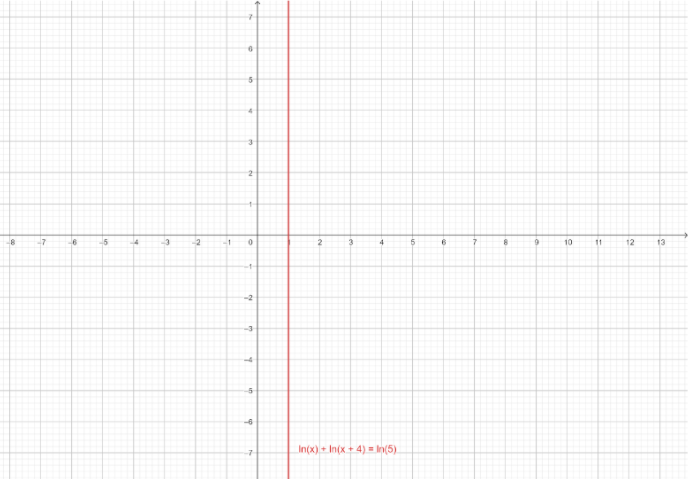
From the graph paper, we can see that $x = - 5$ is the only solution of $\ln x + \ln \left( {x + 4} \right) = \ln 5$.
Final solution: Therefore, $x = - 5$ is the only solution of $\ln x + \ln \left( {x + 4} \right) = \ln 5$.
Formula Used:
Properties of Logarithm function: Following are some useful properties of logarithm function:
${\log _a}\left( {xy} \right) = {\log _a}\left| x \right| + {\log _a}\left| y \right|$, where $a > 0,a \ne 1$ and $xy > 0$
${e^{\ln \left( x \right)}} = x$.
Complete step-by-step solution:
Given equation: $\ln x + \ln \left( {x + 4} \right) = \ln 5$
We have to find all possible values of $x$ satisfying a given equation.
Use the product property of logarithms, ${\log _a}\left( {xy} \right) = {\log _a}\left| x \right| + {\log _a}\left| y \right|$.
$\ln \left( {x\left( {x + 4} \right)} \right) = \ln \left( 5 \right)$
Rewrite both sides in terms of the base $e$.
${e^{\ln \left( {x\left( {x + 4} \right)} \right)}} = {e^{\ln \left( 5 \right)}}$
Use the exponential property of logarithm, ${e^{\ln \left( x \right)}} = x$.
$x\left( {x + 4} \right) = 5$
$ \Rightarrow {x^2} + 4x - 5 = 0$
We have to factor this quadratic equation.
To factor this quadratic equation, first we have to find the product of the first and last constant term of the expression.
Here, the first constant term in ${x^2} + 4x - 5 = 0$ is $1$, as it is the coefficient of ${x^2}$ and last constant term is $ - 5$, as it is a constant value.
Now, we have to multiply the coefficient of ${x^2}$ with the constant value in ${x^2} + 4x - 5 = 0$, i.e., multiply $1$ with $ - 5$.
Multiplying $1$ and $ - 5$, we get
$1 \times \left( { - 5} \right) = - 5$
Now, we have to find the factors of $ - 5$ in such a way that addition or subtraction of those factors is the middle constant term.
Middle constant term or coefficient of $x$ in ${x^2} + 4x - 5 = 0$ is $4$.
So, we have to find two factors of $ - 5$, which on multiplying gives $ - 5$ and in addition gives $4$.
We can do this by determining all factors of $5$.
Factors of $5$ are \[ \pm 1, \pm 5\].
Now among these values find two factors of $5$, which on multiplying gives $ - 5$ and in addition gives $4$.
After observing, we can see that
$\left( { - 1} \right) \times 5 = - 5$ and $\left( { - 1} \right) + 5 = 4$
So, these factors are suitable for factorising the given trinomial.
Now, the next step is to split the middle constant term or coefficient of $x$ in these factors.
That is, write $4x$ as $ - x + 5x$ in ${x^2} + 4x - 5 = 0$.
After writing $4x$ as $ - x + 5x$ in ${x^2} + 4x - 5 = 0$, we get
$ \Rightarrow {x^2} - x + 5x - 5 = 0$
Now, taking $x$ common in $\left( {{x^2} - x} \right)$ and putting in above equation, we get
$ \Rightarrow x\left( {x - 1} \right) + 5x - 5 = 0$
Now, taking $5$ common in $\left( {5x - 5} \right)$ and putting in above equation, we get
$ \Rightarrow x\left( {x - 1} \right) + 5\left( {x - 1} \right) = 0$
Now, taking $\left( {x - 1} \right)$common in $x\left( {x - 1} \right) + 5\left( {x - 1} \right)$ and putting in above equation, we get
$ \Rightarrow \left( {x - 1} \right)\left( {x + 5} \right) = 0$
Now, equate both factors to $0$ and determine the value of $x$.
So, $x - 1 = 0$ and $x + 5 = 0$
$ \Rightarrow x = 1$ and $x = - 5$
As logarithm can’t be negative.
$\therefore x = - 5$
Therefore, $x = - 5$ is the only solution of $\ln x + \ln \left( {x + 4} \right) = \ln 5$.
Note: In above question, we can find the solutions of given equation by plotting the equation, $\ln x + \ln \left( {x + 4} \right) = \ln 5$ on graph paper and determine all its solutions.
From the graph paper, we can see that $x = - 5$ is the only solution of $\ln x + \ln \left( {x + 4} \right) = \ln 5$.
Final solution: Therefore, $x = - 5$ is the only solution of $\ln x + \ln \left( {x + 4} \right) = \ln 5$.
Recently Updated Pages
Master Class 11 Economics: Engaging Questions & Answers for Success

Master Class 11 English: Engaging Questions & Answers for Success
Master Class 11 Maths: Engaging Questions & Answers for Success
Class 11 Question and Answer - Your Ultimate Solutions Guide
Master Class 11 Social Science: Engaging Questions & Answers for Success
Master Class 11 Business Studies: Engaging Questions & Answers for Success
Trending doubts
Differentiate between an exothermic and an endothermic class 11 chemistry CBSE
One Metric ton is equal to kg A 10000 B 1000 C 100 class 11 physics CBSE
There are 720 permutations of the digits 1 2 3 4 5 class 11 maths CBSE
In what year Guru Nanak Dev ji was born A15 April 1469 class 11 social science CBSE
Difference Between Prokaryotic Cells and Eukaryotic Cells
Draw a diagram of a plant cell and label at least eight class 11 biology CBSE