




Solve the linear inequalities: -
(i) \[\left| \dfrac{2}{x-4} \right|>1,x\ne 4\]
(ii) \[\left| x-1 \right|\le 5,\left| x \right|\ge 2\]
Answer
 Verified
602.7k+ views
Hint: For part (i) of the given inequalities apply the formula: - if \[\left| x \right|>a\] then x < -a or x > a. Form two cases, the first one having the relation x < -a and the second one having the relation x >a. Take all the terms to the L.H.S and simplify the expression to obtain them in the form \[\dfrac{x-q}{x-p}<0\] whose solution is minimum {p, q} < x < maximum {p, q}. Take the union of the solution set of x in both the cases and get the answer. For part (ii) of the given inequalities apply the formula: - if \[\left| x \right|\le a\] then \[-a\le x\le a\]. Take the intersection of the solution set obtained with the given condition \[\left| x \right|\ge 2\] and get the answer.
Complete step-by-step answer:
Here, we have been provided with two inequalities containing modulus sign and we have to find the solution set of x. So, let us check them one – by – one.
(i) \[\left| \dfrac{2}{x-4} \right|>1,x\ne 4\]
We know that if \[\left| x \right|>a\], then x < -a or x > a, so here on removing the modulus sign we get,
\[\Rightarrow \dfrac{2}{x-4}<-1\] or \[\dfrac{2}{x-4}>1\]
So, here two cases can be formed. Let us check them one – by – one.
(1). Case 1: - Considering \[\dfrac{2}{x-4}<-1\]
\[\begin{align}
& \Rightarrow \dfrac{2}{x-4}+1<0 \\
& \Rightarrow \dfrac{2+x-4}{x-4}<0 \\
& \Rightarrow \dfrac{x-2}{x-4}<0 \\
\end{align}\]
Now, we know that the solution set of the inequality of the form \[\dfrac{x-q}{x-p}<0\] is given as: - minimum {p, q} < x < maximum {p, q}. So, we have,
\[\Rightarrow \] minimum {2, 4} < x < maximum {2, 4}
\[\Rightarrow \] 2 < x < 4 – (1)
(2) Case 2: - Considering \[\dfrac{2}{x-4}>1\]
\[\begin{align}
& \Rightarrow \dfrac{2}{x-4}-1>0 \\
& \Rightarrow \dfrac{2-x+4}{x-4}>0 \\
& \Rightarrow \dfrac{6-x}{x-4}>0 \\
\end{align}\]
Multiplying both sides with (-1) and reversing the direction of inequality, we get,
\[\begin{align}
& \Rightarrow \left( -1 \right)\times \dfrac{6-x}{x-4}<\left( -1 \right)\times 0 \\
& \Rightarrow \dfrac{x-6}{x-4}<0 \\
\end{align}\]
\[\Rightarrow \] minimum {6, 4} < x < maximum {6, 4}
\[\Rightarrow \] 4 < x < 6 – (2)
Now, either of the two cases will satisfy the given inequality, so we have to take union of sets of values of x obtained. Therefore, we have,
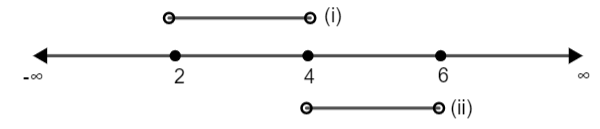
So, the solution set is given as: - \[x\in \left( 2,4 \right)\cup \left( 4,6 \right)\].
(ii) \[\left| x-1 \right|\le 5,\left| x \right|\ge 2\]
Here, we have to find the solution set of the inequality \[\left| x-1 \right|\le 5\] with the given condition \[\left| x \right|\ge 2\].
Now, we know that if \[\left| x \right|\le a\], then \[-a\le x\le a\], so here on removing the modulus sign we get,
\[\Rightarrow -5\le x-1\le 5\]
Adding 1 in all the terms, we get,
\[\Rightarrow -4\le x\le 6\] - (iii)
Now, the given condition is \[\left| x \right|\ge 2\], so applying the formula: - if \[\left| x \right|\ge a\] then \[x\le -a\] or \[x\ge a\], we get,
\[\Rightarrow x\le -2\] or \[x\ge 2\] - (iv)
Now, the situation set of x will be given as the intersection of sets of x obtained in equation (iii) and (iv) because we have to satisfy both the conditions. Therefore, we have,
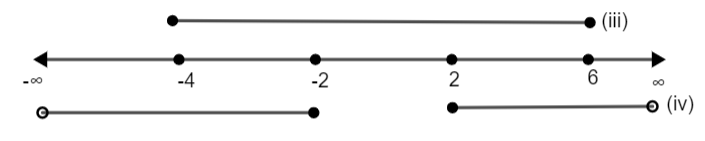
So, the solution set is given as: - \[x\in \left[ -4,-2 \right]\cup \left[ 2,6 \right]\].
Note: You must remember the properties and formulas of modulus to solve the above question. You may note that in the first inequality we have taken the union of the sets of values of x. This is because there we had to satisfy any of the two conditions. But in the second part we needed to satisfy both the conditions so we took the intersection of the sets.
Complete step-by-step answer:
Here, we have been provided with two inequalities containing modulus sign and we have to find the solution set of x. So, let us check them one – by – one.
(i) \[\left| \dfrac{2}{x-4} \right|>1,x\ne 4\]
We know that if \[\left| x \right|>a\], then x < -a or x > a, so here on removing the modulus sign we get,
\[\Rightarrow \dfrac{2}{x-4}<-1\] or \[\dfrac{2}{x-4}>1\]
So, here two cases can be formed. Let us check them one – by – one.
(1). Case 1: - Considering \[\dfrac{2}{x-4}<-1\]
\[\begin{align}
& \Rightarrow \dfrac{2}{x-4}+1<0 \\
& \Rightarrow \dfrac{2+x-4}{x-4}<0 \\
& \Rightarrow \dfrac{x-2}{x-4}<0 \\
\end{align}\]
Now, we know that the solution set of the inequality of the form \[\dfrac{x-q}{x-p}<0\] is given as: - minimum {p, q} < x < maximum {p, q}. So, we have,
\[\Rightarrow \] minimum {2, 4} < x < maximum {2, 4}
\[\Rightarrow \] 2 < x < 4 – (1)
(2) Case 2: - Considering \[\dfrac{2}{x-4}>1\]
\[\begin{align}
& \Rightarrow \dfrac{2}{x-4}-1>0 \\
& \Rightarrow \dfrac{2-x+4}{x-4}>0 \\
& \Rightarrow \dfrac{6-x}{x-4}>0 \\
\end{align}\]
Multiplying both sides with (-1) and reversing the direction of inequality, we get,
\[\begin{align}
& \Rightarrow \left( -1 \right)\times \dfrac{6-x}{x-4}<\left( -1 \right)\times 0 \\
& \Rightarrow \dfrac{x-6}{x-4}<0 \\
\end{align}\]
\[\Rightarrow \] minimum {6, 4} < x < maximum {6, 4}
\[\Rightarrow \] 4 < x < 6 – (2)
Now, either of the two cases will satisfy the given inequality, so we have to take union of sets of values of x obtained. Therefore, we have,
So, the solution set is given as: - \[x\in \left( 2,4 \right)\cup \left( 4,6 \right)\].
(ii) \[\left| x-1 \right|\le 5,\left| x \right|\ge 2\]
Here, we have to find the solution set of the inequality \[\left| x-1 \right|\le 5\] with the given condition \[\left| x \right|\ge 2\].
Now, we know that if \[\left| x \right|\le a\], then \[-a\le x\le a\], so here on removing the modulus sign we get,
\[\Rightarrow -5\le x-1\le 5\]
Adding 1 in all the terms, we get,
\[\Rightarrow -4\le x\le 6\] - (iii)
Now, the given condition is \[\left| x \right|\ge 2\], so applying the formula: - if \[\left| x \right|\ge a\] then \[x\le -a\] or \[x\ge a\], we get,
\[\Rightarrow x\le -2\] or \[x\ge 2\] - (iv)
Now, the situation set of x will be given as the intersection of sets of x obtained in equation (iii) and (iv) because we have to satisfy both the conditions. Therefore, we have,
So, the solution set is given as: - \[x\in \left[ -4,-2 \right]\cup \left[ 2,6 \right]\].
Note: You must remember the properties and formulas of modulus to solve the above question. You may note that in the first inequality we have taken the union of the sets of values of x. This is because there we had to satisfy any of the two conditions. But in the second part we needed to satisfy both the conditions so we took the intersection of the sets.
Recently Updated Pages
Master Class 12 Economics: Engaging Questions & Answers for Success

Master Class 12 English: Engaging Questions & Answers for Success
Master Class 12 Social Science: Engaging Questions & Answers for Success
Master Class 12 Maths: Engaging Questions & Answers for Success
Master Class 12 Physics: Engaging Questions & Answers for Success
Master Class 9 General Knowledge: Engaging Questions & Answers for Success
Trending doubts
One Metric ton is equal to kg A 10000 B 1000 C 100 class 11 physics CBSE
Difference Between Prokaryotic Cells and Eukaryotic Cells
Two of the body parts which do not appear in MRI are class 11 biology CBSE
1 ton equals to A 100 kg B 1000 kg C 10 kg D 10000 class 11 physics CBSE
Draw a diagram of nephron and explain its structur class 11 biology CBSE
10 examples of friction in our daily life