




Solve the inequality $x + y < 5$ graphically in a two-dimensional plane.
Answer
 Verified
506.4k+ views
Hint: In order to solve any inequality graphically, first we have to plot the graph of the equation corresponding to the inequality and then determine the region the given inequality satisfies. The solution to any inequality is the region that consists of all the points that would satisfy the given inequality. Generally, we perform the origin test to find the region that is satisfied by the inequality.
Complete step-by-step answer:
It is given that we need to solve the inequality $x + y < 5$ graphically in a two-dimensional plane.
To solve the inequality graphically we first plot the equation corresponding to the given inequality.
The equation corresponding to the inequality $x + y < 5$ is $x + y = 5$ .
We have to first plot the graph for the equation $x + y = 5$ in a two-dimensional plane.
To draw the line for equality we have to find two points through which the line passes.
To find the $x$ - intercept we put $y = 0$ in the equality.
Substituting $y = 0$ in the equation $x + y = 5$ we get
$x + y = 5$
$\Rightarrow x + 0 = 5$
$\Rightarrow x = 5 $
$\therefore $ The $x$ - intercept is $5$.
Similarly, to find the $y$ - intercept we put $x = 0$ in the equality.
Substituting $x = 0$ in the equation $x + y = 5$ we get
$x + y = 5 $
$\Rightarrow 0 + y = 5$
$\Rightarrow y = 5 $
$\therefore $ The $y$- intercept is $5$ .
$\therefore $ The required points used to plot the graph are $(0,5)$ and $(5,0)$ Therefore, to draw the graph we plot the points on the graph and join them to represent the equality.
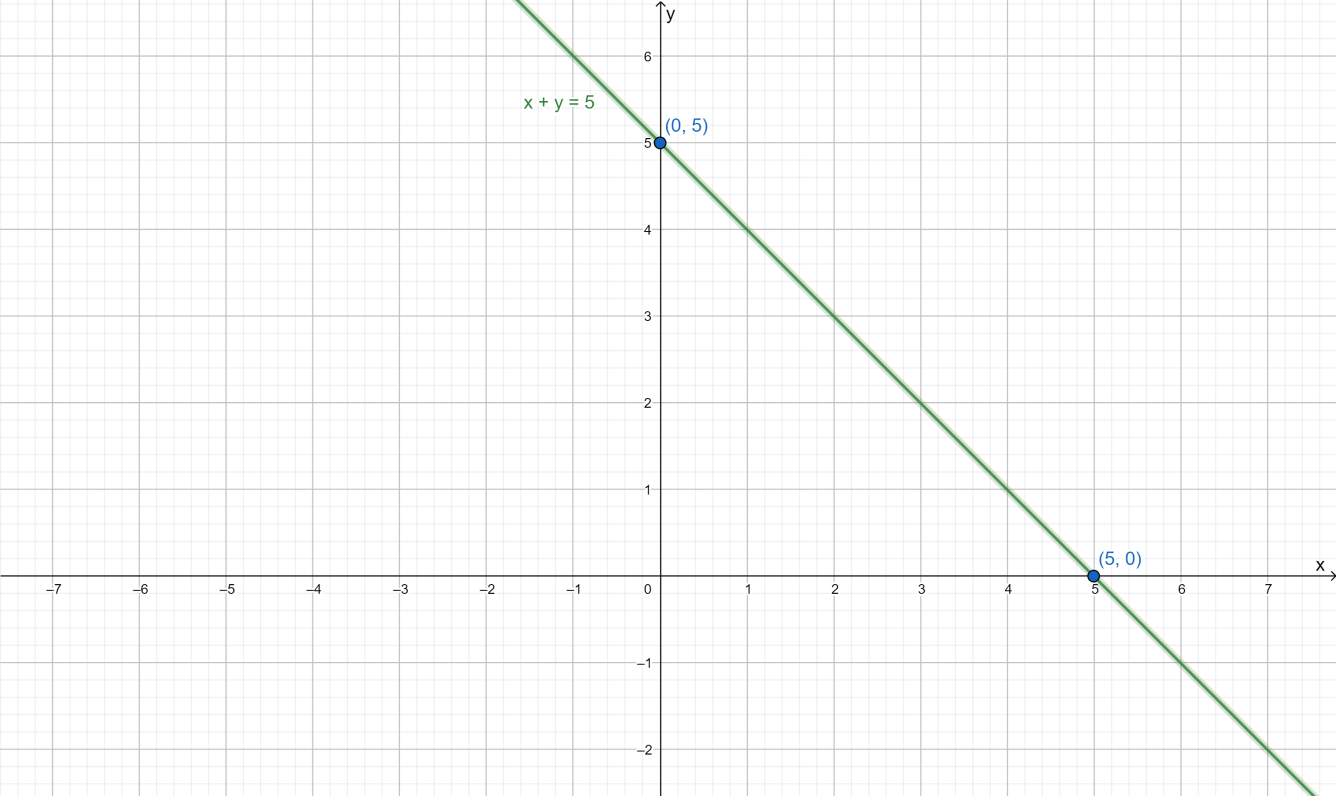
Now, we have to perform the origin test to find the region satisfied by the inequality. We can check that the point $(0,0)$ does not satisfy the equation $x + y = 5$ . We put the point $(0,0)$ in the inequality and verify if the point satisfies the inequality.
$\therefore x + y = 0 + 0 = 0 < 5$
So the origin satisfies the inequality.
$\therefore $ The region lying towards the origin is the solution to the inequality $x + y < 5$ .
From the graph, we can see that the shaded region is the solution for the inequality $x + y < 5$ in a two-dimensional plane.
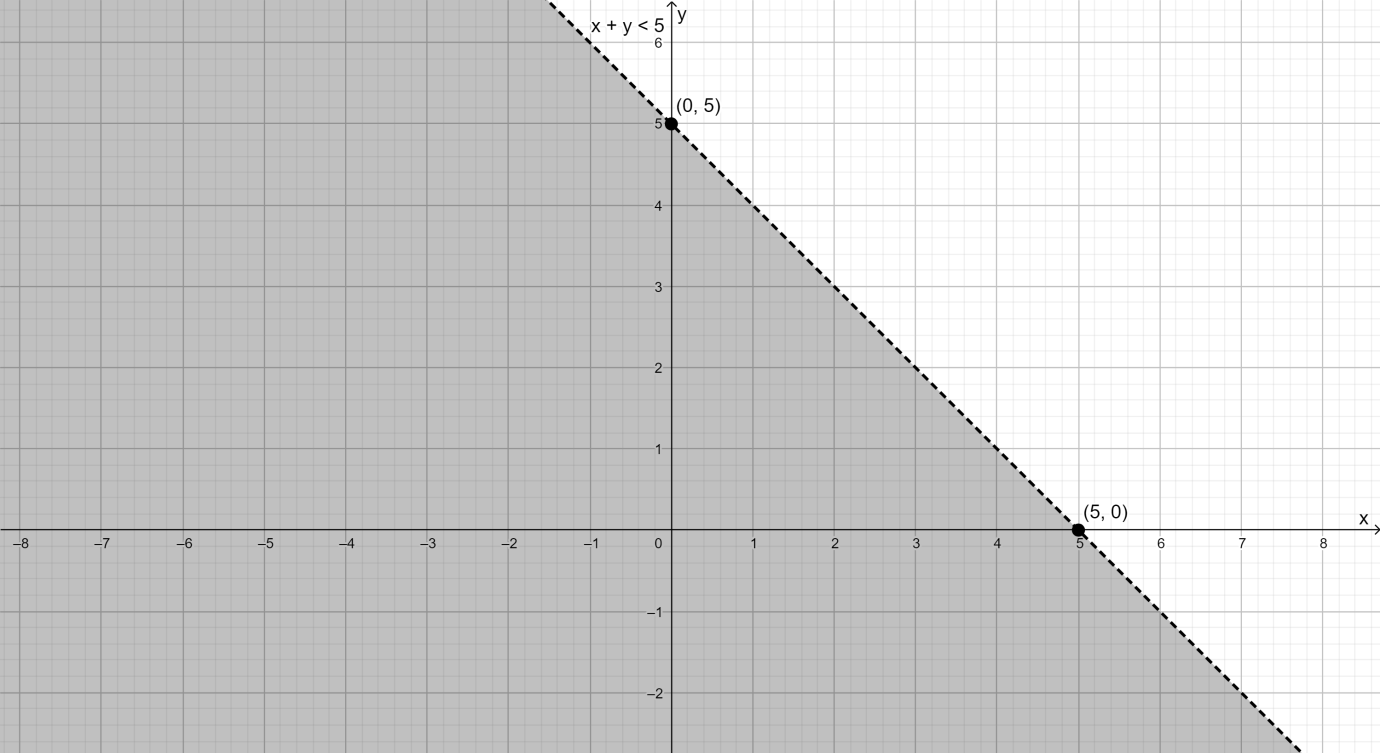
Note: We should keep in mind that in the origin test the point $(0,0)$ will not satisfy the equality. But depending on whether it will satisfy the inequality or not we will be able to verify the solution region of the inequality in the graph. To represent the solution region of the inequality there is the dotted line in the graph because it excludes the line $x + y = 5$ to represent it.
Complete step-by-step answer:
It is given that we need to solve the inequality $x + y < 5$ graphically in a two-dimensional plane.
To solve the inequality graphically we first plot the equation corresponding to the given inequality.
The equation corresponding to the inequality $x + y < 5$ is $x + y = 5$ .
We have to first plot the graph for the equation $x + y = 5$ in a two-dimensional plane.
To draw the line for equality we have to find two points through which the line passes.
To find the $x$ - intercept we put $y = 0$ in the equality.
Substituting $y = 0$ in the equation $x + y = 5$ we get
$x + y = 5$
$\Rightarrow x + 0 = 5$
$\Rightarrow x = 5 $
$\therefore $ The $x$ - intercept is $5$.
Similarly, to find the $y$ - intercept we put $x = 0$ in the equality.
Substituting $x = 0$ in the equation $x + y = 5$ we get
$x + y = 5 $
$\Rightarrow 0 + y = 5$
$\Rightarrow y = 5 $
$\therefore $ The $y$- intercept is $5$ .
$\therefore $ The required points used to plot the graph are $(0,5)$ and $(5,0)$ Therefore, to draw the graph we plot the points on the graph and join them to represent the equality.
Now, we have to perform the origin test to find the region satisfied by the inequality. We can check that the point $(0,0)$ does not satisfy the equation $x + y = 5$ . We put the point $(0,0)$ in the inequality and verify if the point satisfies the inequality.
$\therefore x + y = 0 + 0 = 0 < 5$
So the origin satisfies the inequality.
$\therefore $ The region lying towards the origin is the solution to the inequality $x + y < 5$ .
From the graph, we can see that the shaded region is the solution for the inequality $x + y < 5$ in a two-dimensional plane.
Note: We should keep in mind that in the origin test the point $(0,0)$ will not satisfy the equality. But depending on whether it will satisfy the inequality or not we will be able to verify the solution region of the inequality in the graph. To represent the solution region of the inequality there is the dotted line in the graph because it excludes the line $x + y = 5$ to represent it.
Recently Updated Pages
Master Class 11 Social Science: Engaging Questions & Answers for Success

Master Class 11 Physics: Engaging Questions & Answers for Success
Master Class 11 Maths: Engaging Questions & Answers for Success
Master Class 11 Economics: Engaging Questions & Answers for Success
Master Class 11 Computer Science: Engaging Questions & Answers for Success
Master Class 11 Chemistry: Engaging Questions & Answers for Success
Trending doubts
One Metric ton is equal to kg A 10000 B 1000 C 100 class 11 physics CBSE
There are 720 permutations of the digits 1 2 3 4 5 class 11 maths CBSE
1 Quintal is equal to a 110 kg b 10 kg c 100kg d 1000 class 11 physics CBSE
State and prove Bernoullis theorem class 11 physics CBSE
Difference Between Prokaryotic Cells and Eukaryotic Cells
Which among the following are examples of coming together class 11 social science CBSE