




Solve the given inequalities graphically:
$3x + 2y \leqslant 12,x \geqslant 1,y \geqslant 2$
Answer
 Verified
578.1k+ views
Hint: First, we will solve the inequality given in the question and from the solution of inequality, we will plot those points on a graph. After plotting the point, we will connect those points by a straight line. For each line, we will check whether it’s inequality at origin and accordingly shade that portion on the graph.
Complete step-by-step answer:
The given inequalities are $3x + 2y \leqslant 12,x \geqslant 1,y \geqslant 2$.
The solution for $3x + 2y \leqslant 12$ is
Let’s, x = 0, then
$2y = 12$
$\Rightarrow y=6$
Now, let’s y=0, then
$3x=12$
$\Rightarrow x=4$
i.e., $(0,6)$ and $(4,0)$.
Plotting all these points on a graph,
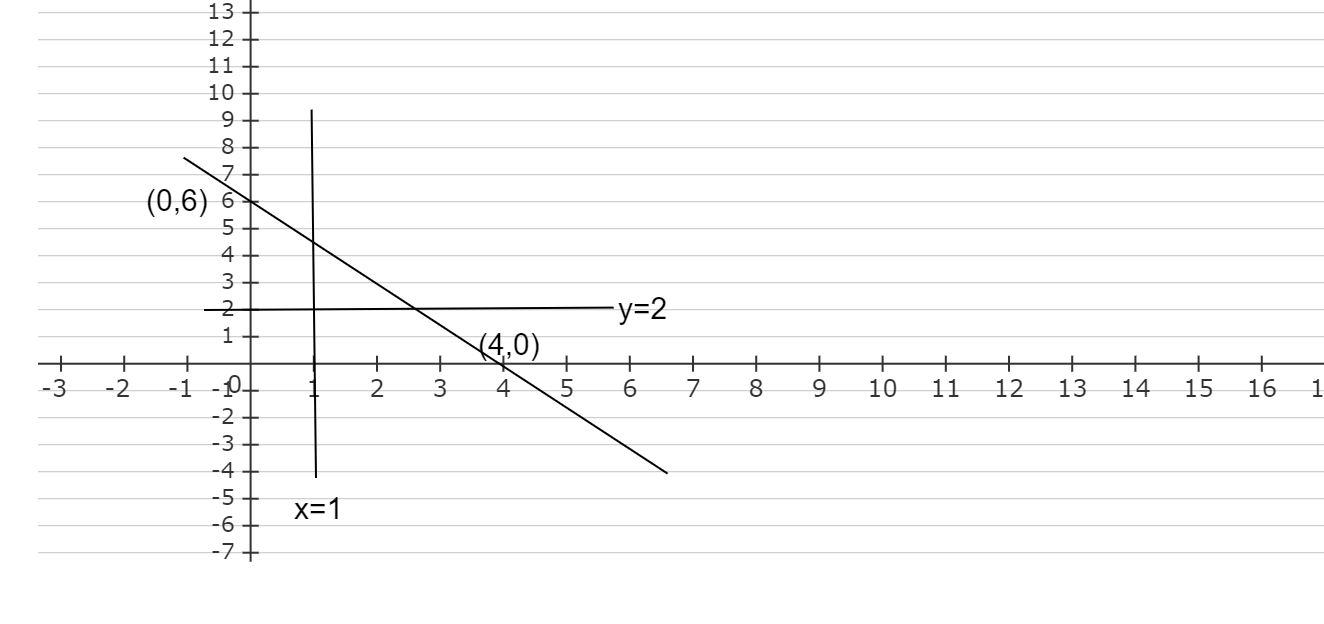
Now we will check the position of origin with respect to the inequalities,
For $3x + 2y \leqslant 12$ at $(0,0)$ , $3(0) + 2(0) \leqslant 12 < 0$. Hence $(0,0)$ lies in the inequality $3x + 2y \leqslant 12$.
For $x \geqslant 1$ at $(0,0)$ , $0 - 1 < 0$. Hence $(0,0)$ lies does not lie in the inequality $x \geqslant 1$.
For $y \geqslant 2$ at $(0,0)$ , $0 - 2 < 0$. Hence $(0,0)$ lies does not lie in the inequality $y \geqslant 2$.
The inequality $3x + 2y \leqslant 12$is towards the origin and $x \geqslant 1$ and $y \geqslant 2$ are away from the origin.
After shading the inequality part in the graph, we get the graph as,
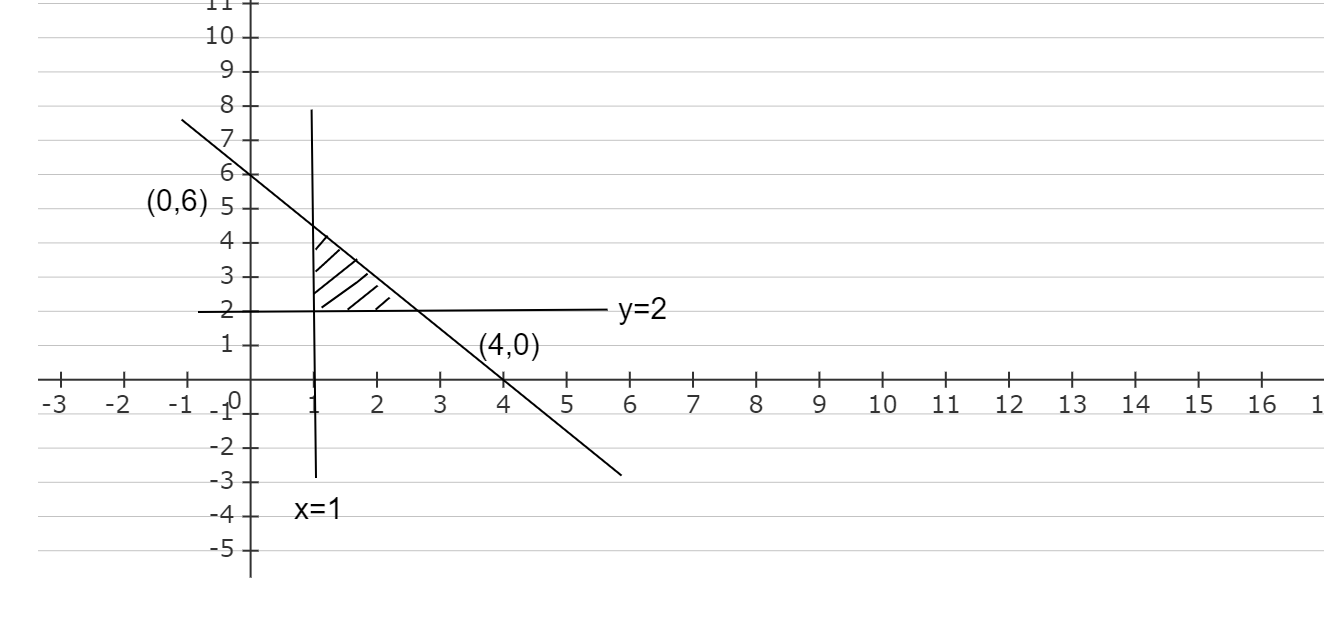
The shaded part in the above graph represents the solution of the given inequalities.
Note: Any solution to an inequality is the fee of that variable which makes inequality a true statement. For example, assume we've an inequality of $x < 5$ . In one of these cases, all the values of x which are much less than $5$ make this inequality a true inequality. While fixing inequalities we want to preserve a few policies in thought, identical numbers may be added or subtracted from both aspects of the inequality. Both facets of inequality may be extended (or divided) by the identical wonderful quantity. However, when both aspects are increased or divided by means of a bad quantity, then the sign of inequality is reversed. These operations do not affect inequality and may be used to simplify inequality for us.
Complete step-by-step answer:
The given inequalities are $3x + 2y \leqslant 12,x \geqslant 1,y \geqslant 2$.
The solution for $3x + 2y \leqslant 12$ is
Let’s, x = 0, then
$2y = 12$
$\Rightarrow y=6$
Now, let’s y=0, then
$3x=12$
$\Rightarrow x=4$
| $x$ | $0$ | $4$ |
| $y$ | $6$ | $0$ |
i.e., $(0,6)$ and $(4,0)$.
Plotting all these points on a graph,
Now we will check the position of origin with respect to the inequalities,
For $3x + 2y \leqslant 12$ at $(0,0)$ , $3(0) + 2(0) \leqslant 12 < 0$. Hence $(0,0)$ lies in the inequality $3x + 2y \leqslant 12$.
For $x \geqslant 1$ at $(0,0)$ , $0 - 1 < 0$. Hence $(0,0)$ lies does not lie in the inequality $x \geqslant 1$.
For $y \geqslant 2$ at $(0,0)$ , $0 - 2 < 0$. Hence $(0,0)$ lies does not lie in the inequality $y \geqslant 2$.
The inequality $3x + 2y \leqslant 12$is towards the origin and $x \geqslant 1$ and $y \geqslant 2$ are away from the origin.
After shading the inequality part in the graph, we get the graph as,
The shaded part in the above graph represents the solution of the given inequalities.
Note: Any solution to an inequality is the fee of that variable which makes inequality a true statement. For example, assume we've an inequality of $x < 5$ . In one of these cases, all the values of x which are much less than $5$ make this inequality a true inequality. While fixing inequalities we want to preserve a few policies in thought, identical numbers may be added or subtracted from both aspects of the inequality. Both facets of inequality may be extended (or divided) by the identical wonderful quantity. However, when both aspects are increased or divided by means of a bad quantity, then the sign of inequality is reversed. These operations do not affect inequality and may be used to simplify inequality for us.
Recently Updated Pages
Which will be the least stable resonating structure class 11 chemistry CBSE

How many 5 digit telephone numbers can be construc-class-11-maths-CBSE
How do you find the angle of the resultant vector class 11 physics CBSE
Draw labelled diagram of the following i Gram seed class 11 biology CBSE
1 Quintal is equal to a 110 kg b 10 kg c 100kg d 1000 class 11 physics CBSE
What is the need and importance of classification class 11 biology CBSE
Trending doubts
Find the value of the expression given below sin 30circ class 11 maths CBSE
One Metric ton is equal to kg A 10000 B 1000 C 100 class 11 physics CBSE
10 examples of friction in our daily life
Draw a diagram of a plant cell and label at least eight class 11 biology CBSE
Difference between physical and chemical change class 11 chemistry CBSE
Proton was discovered by A Thomson B Rutherford C Chadwick class 11 chemistry CBSE