




Solve the following system of equations graphically
$\begin{align}
& 2x-3y+6=0 \\
& 2x+3y-18=0 \\
\end{align}$
Also find the area of the region bounded by these two lines and y-axis.
Answer
 Verified
611.7k+ views
Hint: Here, first we should find two points to draw the lines corresponding to two equations. Also, we have to find the point of intersection of the lines. Then with the help of the points, we can draw the graph. Now, identify the region including the y-axis and the lines $2x-3y+6=0$, $2x+3y-18=0$. The region thus obtained will be a triangle. Then, we have to find the area, ‘A’, of the triangle by applying the formula:
$A=\dfrac{1}{2}\times Base\times Height$
Complete step-by-step answer:
Here, we are given with the equations:
$\begin{align}
& 2x-3y+6=0 \\
& 2x+3y-18=0 \\
\end{align}$
Now, we have to draw the graph of the above equations and then we have to find the area of the region between the two lines and the y-axis.
First consider the equation:
$2x-3y+6=0$
Now, we have to draw the line corresponding to the given equation. For that consider two points.
When $x=0$ we have:
$\begin{align}
& 2\times 0-3y+6=0 \\
& \Rightarrow -3y+6=0 \\
\end{align}$
Now, take 6 to the right side, 6 becomes -6, we get:
$-3y=-6$
Next, by cross multiplication, we obtain:
$y=\dfrac{-6}{-3}$
Now, by cancellation we get:
$y=2$
Now, consider the equation $2x-3y+6=0$ when $y=0$,
$\begin{align}
& \Rightarrow 2x-3\times 0+6=0 \\
& \Rightarrow 2x+6=0 \\
\end{align}$
Next, by taking 6 to the right side we get:
$2x=-6$
In the next step by cross multiplication we get:
$x=\dfrac{-6}{2}$
$\Rightarrow x=-3$
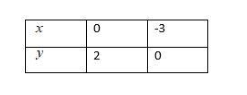
Next, consider the equation:
$2x+3y-18=0$
Now, we have to find two points to draw the graph of the equation.
For that take $x=0$,
$\begin{align}
& \Rightarrow 2\times 0+3y-18=0 \\
& \Rightarrow 3y-18=0 \\
\end{align}$
Next, take -18 to the right side and it becomes 18. Hence we will get:
$3y=18$
Now, by cross multiplication we get:
$\begin{align}
& y=\dfrac{18}{3} \\
& \Rightarrow y=6 \\
\end{align}$
Now, for $y=0$ we will obtain:
$\begin{align}
& 2x+3\times 0-18=0 \\
& \Rightarrow 2x-18=0 \\
\end{align}$
Next, by taking -18 to the right side it becomes 18. That is,
$\Rightarrow 2x=18$
Hence, by cross multiplication,
$\begin{align}
& \Rightarrow x=\dfrac{18}{2} \\
& \Rightarrow x=9 \\
\end{align}$
Therefore, the two points are:
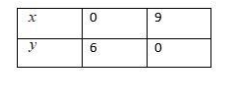
Next, we have to find the intersecting point of the two lines:
$\begin{align}
& 2x-3y+6=0 \\
& 2x+3y-18=0 \\
\end{align}$
By adding the above two equations we obtain:
$4x-12=0$
By taking -12 to the right side,
$\Rightarrow 4x=12$
Now, by cross multiplication,
$\Rightarrow x=\dfrac{12}{4}$
By cancellation,
$\Rightarrow x=3$
Now, put $x=3$ in the equation $2x-3y+6=0$,
$\begin{align}
& \Rightarrow 2\times 3-3y+6=0 \\
& \Rightarrow 6-3y+6=0 \\
& \Rightarrow 12-3y=0 \\
\end{align}$
By taking -12 to the right side,
$\Rightarrow -3y=-12$
Next, by cross multiplication,
$\begin{align}
& \Rightarrow y=\dfrac{-12}{-3} \\
& \Rightarrow y=4 \\
\end{align}$
Therefore, the point of intersection of the two lines is (3, 4).
Now, let us draw the graph of y-axis and the two lines:
$\begin{align}
& 2x-3y+6=0 \\
& 2x+3y-18=0 \\
\end{align}$
The graph is as follows:
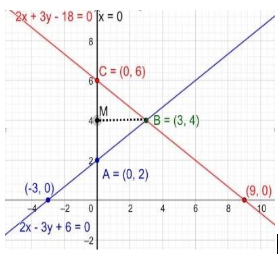
So, here the region bounded by two lines and y-axis is the triangle $\Delta ~CBA$.
Now, we have to find the area of the triangle, \[\Delta ~CBA\].
We know that the area of the triangle, ‘A’ is obtained by the formula:
$A=\dfrac{1}{2}\times Base\times Height$
From the above graph we can say that the base is CA and height is BM, we have:
$\begin{align}
& BM=3-0=3 \\
& CA=6-2=4 \\
\end{align}$
Therefore, we can write:
$\begin{align}
& A=\dfrac{1}{2}\times CA\times BM \\
& \Rightarrow A=\dfrac{1}{2}\times 4\times 3 \\
& \Rightarrow A=\dfrac{1}{2}\times 12 \\
& \Rightarrow A=6 \\
\end{align}$
Hence, the required area of the triangle$\Delta CBA$ is 6 square units.
Note: Here, y-axis refers to the line $x=0$, hence the region including the y-axis and the two lines will be a triangle. To calculate its area you should mark the vertices properly, and also you should draw an altitude perpendicular to the base. From the graph with the help of vertices, you can easily calculate the length of height and base.
$A=\dfrac{1}{2}\times Base\times Height$
Complete step-by-step answer:
Here, we are given with the equations:
$\begin{align}
& 2x-3y+6=0 \\
& 2x+3y-18=0 \\
\end{align}$
Now, we have to draw the graph of the above equations and then we have to find the area of the region between the two lines and the y-axis.
First consider the equation:
$2x-3y+6=0$
Now, we have to draw the line corresponding to the given equation. For that consider two points.
When $x=0$ we have:
$\begin{align}
& 2\times 0-3y+6=0 \\
& \Rightarrow -3y+6=0 \\
\end{align}$
Now, take 6 to the right side, 6 becomes -6, we get:
$-3y=-6$
Next, by cross multiplication, we obtain:
$y=\dfrac{-6}{-3}$
Now, by cancellation we get:
$y=2$
Now, consider the equation $2x-3y+6=0$ when $y=0$,
$\begin{align}
& \Rightarrow 2x-3\times 0+6=0 \\
& \Rightarrow 2x+6=0 \\
\end{align}$
Next, by taking 6 to the right side we get:
$2x=-6$
In the next step by cross multiplication we get:
$x=\dfrac{-6}{2}$
$\Rightarrow x=-3$
Next, consider the equation:
$2x+3y-18=0$
Now, we have to find two points to draw the graph of the equation.
For that take $x=0$,
$\begin{align}
& \Rightarrow 2\times 0+3y-18=0 \\
& \Rightarrow 3y-18=0 \\
\end{align}$
Next, take -18 to the right side and it becomes 18. Hence we will get:
$3y=18$
Now, by cross multiplication we get:
$\begin{align}
& y=\dfrac{18}{3} \\
& \Rightarrow y=6 \\
\end{align}$
Now, for $y=0$ we will obtain:
$\begin{align}
& 2x+3\times 0-18=0 \\
& \Rightarrow 2x-18=0 \\
\end{align}$
Next, by taking -18 to the right side it becomes 18. That is,
$\Rightarrow 2x=18$
Hence, by cross multiplication,
$\begin{align}
& \Rightarrow x=\dfrac{18}{2} \\
& \Rightarrow x=9 \\
\end{align}$
Therefore, the two points are:
Next, we have to find the intersecting point of the two lines:
$\begin{align}
& 2x-3y+6=0 \\
& 2x+3y-18=0 \\
\end{align}$
By adding the above two equations we obtain:
$4x-12=0$
By taking -12 to the right side,
$\Rightarrow 4x=12$
Now, by cross multiplication,
$\Rightarrow x=\dfrac{12}{4}$
By cancellation,
$\Rightarrow x=3$
Now, put $x=3$ in the equation $2x-3y+6=0$,
$\begin{align}
& \Rightarrow 2\times 3-3y+6=0 \\
& \Rightarrow 6-3y+6=0 \\
& \Rightarrow 12-3y=0 \\
\end{align}$
By taking -12 to the right side,
$\Rightarrow -3y=-12$
Next, by cross multiplication,
$\begin{align}
& \Rightarrow y=\dfrac{-12}{-3} \\
& \Rightarrow y=4 \\
\end{align}$
Therefore, the point of intersection of the two lines is (3, 4).
Now, let us draw the graph of y-axis and the two lines:
$\begin{align}
& 2x-3y+6=0 \\
& 2x+3y-18=0 \\
\end{align}$
The graph is as follows:
So, here the region bounded by two lines and y-axis is the triangle $\Delta ~CBA$.
Now, we have to find the area of the triangle, \[\Delta ~CBA\].
We know that the area of the triangle, ‘A’ is obtained by the formula:
$A=\dfrac{1}{2}\times Base\times Height$
From the above graph we can say that the base is CA and height is BM, we have:
$\begin{align}
& BM=3-0=3 \\
& CA=6-2=4 \\
\end{align}$
Therefore, we can write:
$\begin{align}
& A=\dfrac{1}{2}\times CA\times BM \\
& \Rightarrow A=\dfrac{1}{2}\times 4\times 3 \\
& \Rightarrow A=\dfrac{1}{2}\times 12 \\
& \Rightarrow A=6 \\
\end{align}$
Hence, the required area of the triangle$\Delta CBA$ is 6 square units.
Note: Here, y-axis refers to the line $x=0$, hence the region including the y-axis and the two lines will be a triangle. To calculate its area you should mark the vertices properly, and also you should draw an altitude perpendicular to the base. From the graph with the help of vertices, you can easily calculate the length of height and base.

Recently Updated Pages
Master Class 8 Social Science: Engaging Questions & Answers for Success

Master Class 8 English: Engaging Questions & Answers for Success
Class 8 Question and Answer - Your Ultimate Solutions Guide
Master Class 8 Maths: Engaging Questions & Answers for Success
Master Class 8 Science: Engaging Questions & Answers for Success
Master Class 7 English: Engaging Questions & Answers for Success
Trending doubts
Difference Between Plant Cell and Animal Cell
Fill the blanks with the suitable prepositions 1 The class 9 english CBSE
Who is eligible for RTE class 9 social science CBSE
Which places in India experience sunrise first and class 9 social science CBSE
What is pollution? How many types of pollution? Define it
Name 10 Living and Non living things class 9 biology CBSE