




Solve the following inequality. Express the answer in both inequality and interval notation, $\dfrac{{x + 4}}{{1 - x}} \leqslant 0$.
Answer
 Verified
558.3k+ views
Hint: Given function is a rational inequality. Steps to follow in order to solve a rational inequality are:
Step 1: Find the values of x by equating the numerator and denominator to zero. These values are called critical values.
Step 2: Draw a graph and mark these critical values on the graph.
Step 3: Check in which intervals the inequality is true.
Complete step by step answer:
The given rational inequality is $\dfrac{{x + 4}}{{1 - x}} \leqslant 0$
Step 1: Equate the numerator and denominator to zero.
This gives $x + 4 = 0$ and $1 - x = 0$
By solving, we get the values of x to be $x = - 4,x = 1$ and therefore the critical values are $ - 4,1$
Step 2: Let us make a graph or a sign analysis chart and divide the graph using calculated critical values.
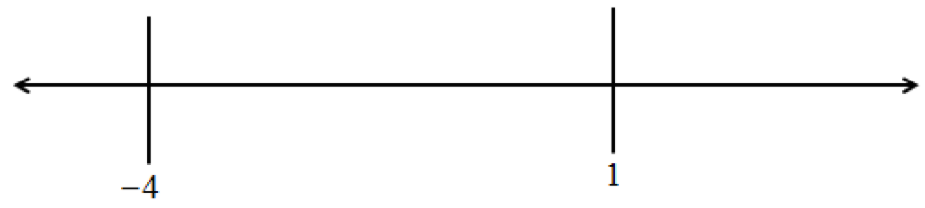
Step 3: Now, we have to check where in this graph the given inequality is true. In order to do this, we take one point from each interval and substitute in the function.
For the left side of $ - 4$ , let us substitute $ - 5$ in the function. This gives $\dfrac{{ - 5 + 4}}{{1 - \left( { - 5} \right)}} = \dfrac{{ - 1}}{{1 + 5}} = - \dfrac{1}{6}$
This shows that the inequality is true for values less than $ - 4$ so this interval would be $( - \infty , - 4]$
Similarly in between $ - 4$ and $1$ , let us substitute $ - 2$
This gives $\dfrac{{ - 2 + 4}}{{1 - \left( { - 2} \right)}} = \dfrac{2}{{1 + 2}} = \dfrac{2}{3}$
Therefore, the inequality is not true for values in between $ - 4$ and $1$
Similarly for the right side of $1$ let us substitute $3$
So this gives, $\dfrac{{3 + 4}}{{1 - 3}} = \dfrac{7}{{ - 2}} = - \dfrac{7}{2}$ and hence this equality is also true for values greater than one. Hence the interval for this will be $\left( {1,\infty } \right)$
Here, $1$ is not included in the interval because the function becomes infinity at $x = 1$
So the final interval will be the union of these two intervals i.e. $( - \infty , - 4]\bigcup {(1,\infty )} $
Note: This method of finding whether the inequality applies on parts of the graph is known as sign analysis. It should be noted that when a closed interval is used the final value will also be included in the interval whereas in an open interval the end values will not be included.
Step 1: Find the values of x by equating the numerator and denominator to zero. These values are called critical values.
Step 2: Draw a graph and mark these critical values on the graph.
Step 3: Check in which intervals the inequality is true.
Complete step by step answer:
The given rational inequality is $\dfrac{{x + 4}}{{1 - x}} \leqslant 0$
Step 1: Equate the numerator and denominator to zero.
This gives $x + 4 = 0$ and $1 - x = 0$
By solving, we get the values of x to be $x = - 4,x = 1$ and therefore the critical values are $ - 4,1$
Step 2: Let us make a graph or a sign analysis chart and divide the graph using calculated critical values.
Step 3: Now, we have to check where in this graph the given inequality is true. In order to do this, we take one point from each interval and substitute in the function.
For the left side of $ - 4$ , let us substitute $ - 5$ in the function. This gives $\dfrac{{ - 5 + 4}}{{1 - \left( { - 5} \right)}} = \dfrac{{ - 1}}{{1 + 5}} = - \dfrac{1}{6}$
This shows that the inequality is true for values less than $ - 4$ so this interval would be $( - \infty , - 4]$
Similarly in between $ - 4$ and $1$ , let us substitute $ - 2$
This gives $\dfrac{{ - 2 + 4}}{{1 - \left( { - 2} \right)}} = \dfrac{2}{{1 + 2}} = \dfrac{2}{3}$
Therefore, the inequality is not true for values in between $ - 4$ and $1$
Similarly for the right side of $1$ let us substitute $3$
So this gives, $\dfrac{{3 + 4}}{{1 - 3}} = \dfrac{7}{{ - 2}} = - \dfrac{7}{2}$ and hence this equality is also true for values greater than one. Hence the interval for this will be $\left( {1,\infty } \right)$
Here, $1$ is not included in the interval because the function becomes infinity at $x = 1$
So the final interval will be the union of these two intervals i.e. $( - \infty , - 4]\bigcup {(1,\infty )} $
Note: This method of finding whether the inequality applies on parts of the graph is known as sign analysis. It should be noted that when a closed interval is used the final value will also be included in the interval whereas in an open interval the end values will not be included.
Recently Updated Pages
Master Class 11 English: Engaging Questions & Answers for Success

Master Class 11 Maths: Engaging Questions & Answers for Success
Master Class 11 Biology: Engaging Questions & Answers for Success
Master Class 11 Physics: Engaging Questions & Answers for Success
Master Class 11 Accountancy: Engaging Questions & Answers for Success
Class 11 Question and Answer - Your Ultimate Solutions Guide
Trending doubts
One Metric ton is equal to kg A 10000 B 1000 C 100 class 11 physics CBSE
Discuss the various forms of bacteria class 11 biology CBSE
Draw a diagram of a plant cell and label at least eight class 11 biology CBSE
State the laws of reflection of light
Explain zero factorial class 11 maths CBSE
10 examples of friction in our daily life