




How do you solve $\sin x\left( \sin x+1 \right)=0$?
Answer
 Verified
610.5k+ views
Hint: We know that if ab=0 then either a is equal to 0 or b is equal to 0 both will be the solution. So we can find 2 value of sin x and solve them separately to find the solution of the equation
Complete step by step answer;
The given equation is $\sin x\left( \sin x+1 \right)=0$
We know if a product of 2 numbers is 0 then at least one of them is 0. So if product of $\sin x$ and $\sin x+1$ is 0 then
$\sin x=0$ is one solution and $\sin x+1=0$ is another solution of the equation
First lets evaluate all possible x for $\sin x=0$ from graph
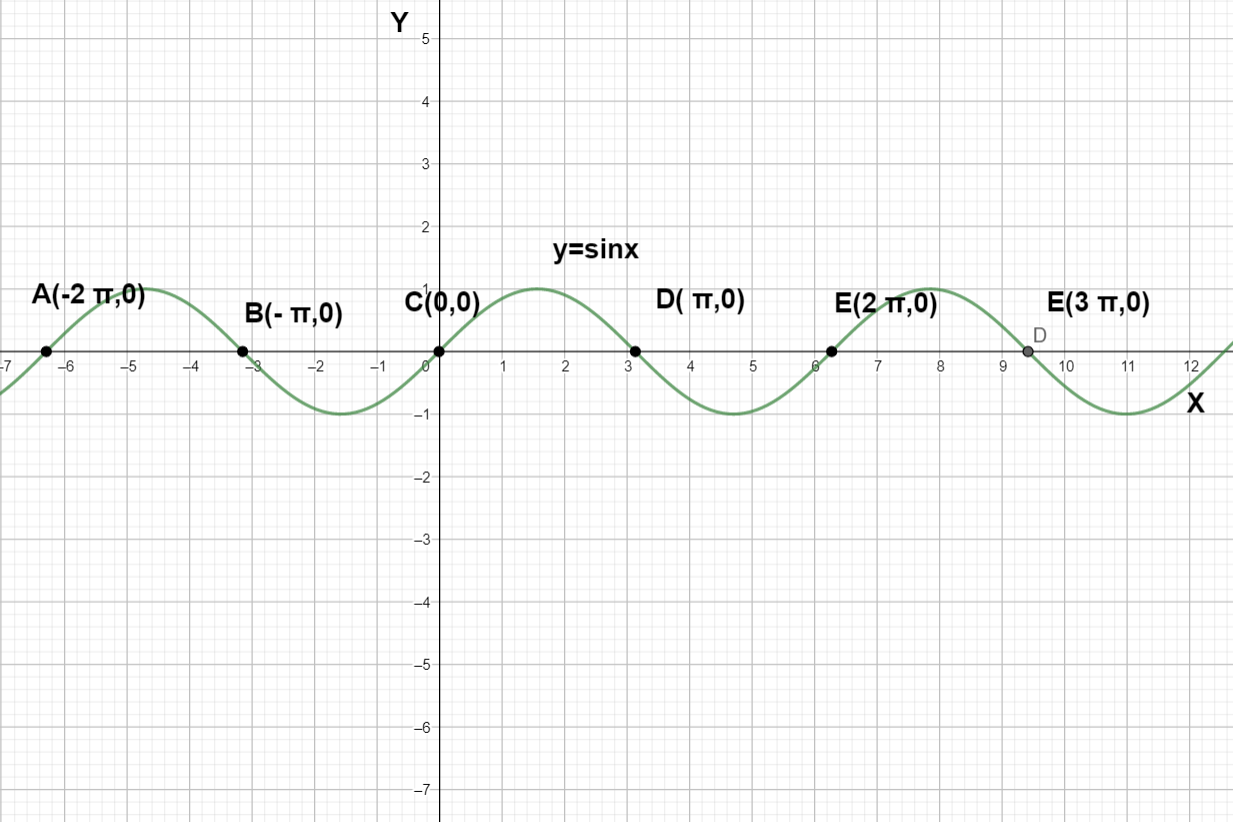
We can see that the solution for $\sin x=0$ is $x=n\pi $ where n is an integer n= …-1, 0, 1, 2, …..
Similarly we can find the solution the solution of $\sin x+1=0$ or sin x is equal to -1 form the graph
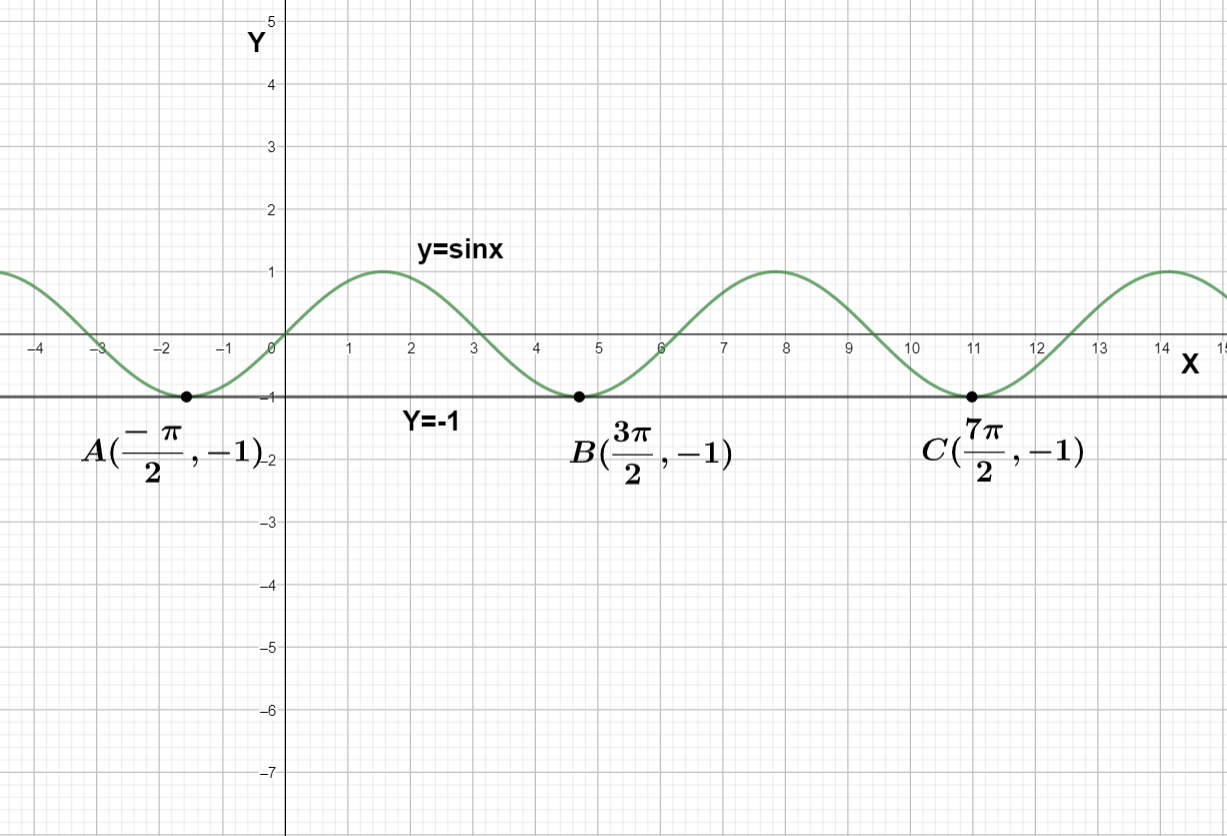
We can see that the solutions are $-\dfrac{\pi }{2}$ , $\dfrac{3\pi }{2}$ , $\dfrac{7\pi }{2}$
So we can generalize it by $\dfrac{\left( 4n+3 \right)\pi }{2}$ where n is an integer n= …-1, 0, 1, 2, ….
Note:
While solving these type of question where the variable in the polynomial equation is a trigonometric function or exponential function, do check the roots of the equation comes in the range of the function for example in the above question if one root sin x would 2 then we will not consider 2 as a root because we know sin x can never be equal to 2. Similarly in exponential function do check all roots are positive because range of exponential is positive real number.
Complete step by step answer;
The given equation is $\sin x\left( \sin x+1 \right)=0$
We know if a product of 2 numbers is 0 then at least one of them is 0. So if product of $\sin x$ and $\sin x+1$ is 0 then
$\sin x=0$ is one solution and $\sin x+1=0$ is another solution of the equation
First lets evaluate all possible x for $\sin x=0$ from graph
We can see that the solution for $\sin x=0$ is $x=n\pi $ where n is an integer n= …-1, 0, 1, 2, …..
Similarly we can find the solution the solution of $\sin x+1=0$ or sin x is equal to -1 form the graph
We can see that the solutions are $-\dfrac{\pi }{2}$ , $\dfrac{3\pi }{2}$ , $\dfrac{7\pi }{2}$
So we can generalize it by $\dfrac{\left( 4n+3 \right)\pi }{2}$ where n is an integer n= …-1, 0, 1, 2, ….
Note:
While solving these type of question where the variable in the polynomial equation is a trigonometric function or exponential function, do check the roots of the equation comes in the range of the function for example in the above question if one root sin x would 2 then we will not consider 2 as a root because we know sin x can never be equal to 2. Similarly in exponential function do check all roots are positive because range of exponential is positive real number.
Recently Updated Pages
Basicity of sulphurous acid and sulphuric acid are

Master Class 11 English: Engaging Questions & Answers for Success
Master Class 11 Physics: Engaging Questions & Answers for Success
Master Class 11 Computer Science: Engaging Questions & Answers for Success
Master Class 11 Chemistry: Engaging Questions & Answers for Success
Master Class 11 Social Science: Engaging Questions & Answers for Success
Trending doubts
Difference Between Prokaryotic Cells and Eukaryotic Cells
Two of the body parts which do not appear in MRI are class 11 biology CBSE
One Metric ton is equal to kg A 10000 B 1000 C 100 class 11 physics CBSE
10 examples of friction in our daily life
Draw a diagram of nephron and explain its structur class 11 biology CBSE
What will happen if the mucus is not secreted by the class 11 biology CBSE