




Solve: \[\sin \left( {{\tan }^{-1}}x \right),\left| x \right|<1\] is equal to
A. \[\dfrac{x}{\sqrt{1-{{x}^{2}}}}\]
B. \[\dfrac{1}{\sqrt{1-{{x}^{2}}}}\]
C. \[\dfrac{1}{\sqrt{1+{{x}^{2}}}}\]
D. \[\dfrac{x}{\sqrt{1+{{x}^{2}}}}\]
Answer
 Verified
608.4k+ views
Hint: To solve the question, we need to assume that the value of \[{{\tan }^{-1}}x\] is \[\text{ }\!\!\theta\!\!\text{ }\] and then place the value in place of \[{{\tan }^{-1}}x\] to find the value of \[\sin \text{ }\!\!\theta\!\!\text{ }\] and remove \[\text{ }\!\!\theta\!\!\text{ }\] by the trigonometric value of \[{{\tan }^{-1}}x\] . The formula for \[\tan \text{ }\!\!\theta\!\!\text{ }\] is
\[\tan \text{ }\!\!\theta\!\!\text{ }=\dfrac{\text{height}}{\text{base}}\] of an assumed triangle and then find the value of \[\text{ }\!\!\theta\!\!\text{ }\] and place it with \[\sin \text{ }\!\!\theta\!\!\text{ }\] to find the value of \[\sin \text{ }\!\!\theta\!\!\text{ }\] in terms of \[x\] .
Complete step-by-step answer:
Let us first draw a triangle based on the question with \[\text{ }\!\!\theta\!\!\text{ }\] as angle at point A.
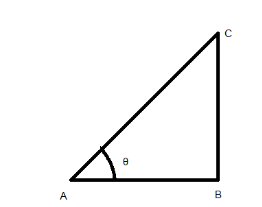
where \[{{\tan }^{-1}}x\] which means if we equate the value of \[x\] in terms of \[\text{ }\!\!\theta\!\!\text{ }\] , we get the value of \[x\] as:
\[\Rightarrow {{\tan }^{-1}}x=\text{ }\!\!\theta\!\!\text{ }\]
\[\Rightarrow x=\tan \text{ }\!\!\theta\!\!\text{ }\]
Now according to the trigonometric formula, the value of the \[\text{tangent}\] is given as:
\[\tan \text{ }\!\!\theta\!\!\text{ }=\dfrac{\text{height}}{\text{base}}\]
Equating the value of \[\tan \text{ }\!\!\theta\!\!\text{ }=x\] with \[\tan \text{ }\!\!\theta\!\!\text{ }=\dfrac{\text{height}}{\text{base}}\] , we get the value of the ratio of \[\dfrac{\text{height}}{\text{base}}\] as \[\dfrac{x}{1}\] .
Therefore, we can say that the height of the triangle is \[x\] and the base is \[1\] . Using Pythagoras theorem we can find the value of the hypotenuse of the triangle as:
Hypotenuse \[=\sqrt{\text{heigh}{{\text{t}}^{2}}+\text{bas}{{\text{e}}^{2}}}\]
\[\Rightarrow \sqrt{{{x}^{2}}+{{\text{1}}^{2}}}\]
Now as we have all the values i.e. height, base and hypotenuse we can find the value of \[\sin \left( {{\tan }^{-1}}x \right)\] by replacing it with \[\sin \text{ }\!\!\theta\!\!\text{ }\] and after that we find the value of \[\sin \text{ }\!\!\theta\!\!\text{ }\] as:
\[\sin \text{ }\!\!\theta\!\!\text{ }=\dfrac{\text{height}}{\text{hypotenuse}}\]
Placing the values of height and hypotenuse in the above formula, we get the value of \[\sin \text{ }\!\!\theta\!\!\text{ }\] as:
\[\Rightarrow \sin \text{ }\!\!\theta\!\!\text{ }=\dfrac{x}{\sqrt{{{x}^{2}}+1}}\]
Now on the L.H.S, the value of \[\sin \text{ }\!\!\theta\!\!\text{ }\] can be replaced by \[\sin \left( {{\tan }^{-1}}x \right)\] with \[{{\tan }^{-1}}x=\text{ }\!\!\theta\!\!\text{ }\] . Hence, the value of \[\sin \left( {{\tan }^{-1}}x \right)\] is \[\dfrac{x}{\sqrt{{{x}^{2}}+1}}\] .
So, the correct answer is “ \[\dfrac{x}{\sqrt{{{x}^{2}}+1}}\] ”.
Note: Student may make mistake as the value of inverse is such as \[{{\tan }^{-1}}x=\dfrac{1}{\tan x}\] , but \[{{\left( \tan x \right)}^{-1}}=\dfrac{1}{\tan x}\] . Hence such mistakes should be avoided and the angle should be taken in any one point of the triangle like A for both \[\tan \text{ }\!\!\theta\!\!\text{ }\] and \[\sin \text{ }\!\!\theta\!\!\text{ }\] .
\[\tan \text{ }\!\!\theta\!\!\text{ }=\dfrac{\text{height}}{\text{base}}\] of an assumed triangle and then find the value of \[\text{ }\!\!\theta\!\!\text{ }\] and place it with \[\sin \text{ }\!\!\theta\!\!\text{ }\] to find the value of \[\sin \text{ }\!\!\theta\!\!\text{ }\] in terms of \[x\] .
Complete step-by-step answer:
Let us first draw a triangle based on the question with \[\text{ }\!\!\theta\!\!\text{ }\] as angle at point A.
where \[{{\tan }^{-1}}x\] which means if we equate the value of \[x\] in terms of \[\text{ }\!\!\theta\!\!\text{ }\] , we get the value of \[x\] as:
\[\Rightarrow {{\tan }^{-1}}x=\text{ }\!\!\theta\!\!\text{ }\]
\[\Rightarrow x=\tan \text{ }\!\!\theta\!\!\text{ }\]
Now according to the trigonometric formula, the value of the \[\text{tangent}\] is given as:
\[\tan \text{ }\!\!\theta\!\!\text{ }=\dfrac{\text{height}}{\text{base}}\]
Equating the value of \[\tan \text{ }\!\!\theta\!\!\text{ }=x\] with \[\tan \text{ }\!\!\theta\!\!\text{ }=\dfrac{\text{height}}{\text{base}}\] , we get the value of the ratio of \[\dfrac{\text{height}}{\text{base}}\] as \[\dfrac{x}{1}\] .
Therefore, we can say that the height of the triangle is \[x\] and the base is \[1\] . Using Pythagoras theorem we can find the value of the hypotenuse of the triangle as:
Hypotenuse \[=\sqrt{\text{heigh}{{\text{t}}^{2}}+\text{bas}{{\text{e}}^{2}}}\]
\[\Rightarrow \sqrt{{{x}^{2}}+{{\text{1}}^{2}}}\]
Now as we have all the values i.e. height, base and hypotenuse we can find the value of \[\sin \left( {{\tan }^{-1}}x \right)\] by replacing it with \[\sin \text{ }\!\!\theta\!\!\text{ }\] and after that we find the value of \[\sin \text{ }\!\!\theta\!\!\text{ }\] as:
\[\sin \text{ }\!\!\theta\!\!\text{ }=\dfrac{\text{height}}{\text{hypotenuse}}\]
Placing the values of height and hypotenuse in the above formula, we get the value of \[\sin \text{ }\!\!\theta\!\!\text{ }\] as:
\[\Rightarrow \sin \text{ }\!\!\theta\!\!\text{ }=\dfrac{x}{\sqrt{{{x}^{2}}+1}}\]
Now on the L.H.S, the value of \[\sin \text{ }\!\!\theta\!\!\text{ }\] can be replaced by \[\sin \left( {{\tan }^{-1}}x \right)\] with \[{{\tan }^{-1}}x=\text{ }\!\!\theta\!\!\text{ }\] . Hence, the value of \[\sin \left( {{\tan }^{-1}}x \right)\] is \[\dfrac{x}{\sqrt{{{x}^{2}}+1}}\] .
So, the correct answer is “ \[\dfrac{x}{\sqrt{{{x}^{2}}+1}}\] ”.
Note: Student may make mistake as the value of inverse is such as \[{{\tan }^{-1}}x=\dfrac{1}{\tan x}\] , but \[{{\left( \tan x \right)}^{-1}}=\dfrac{1}{\tan x}\] . Hence such mistakes should be avoided and the angle should be taken in any one point of the triangle like A for both \[\tan \text{ }\!\!\theta\!\!\text{ }\] and \[\sin \text{ }\!\!\theta\!\!\text{ }\] .
Recently Updated Pages
Master Class 11 English: Engaging Questions & Answers for Success

Master Class 11 Social Science: Engaging Questions & Answers for Success
Master Class 11 Maths: Engaging Questions & Answers for Success
Master Class 11 Biology: Engaging Questions & Answers for Success
Master Class 11 Physics: Engaging Questions & Answers for Success
Master Class 11 Chemistry: Engaging Questions & Answers for Success
Trending doubts
One Metric ton is equal to kg A 10000 B 1000 C 100 class 11 physics CBSE
Difference Between Prokaryotic Cells and Eukaryotic Cells
Find the value of the expression given below sin 30circ class 11 maths CBSE
Difference between physical and chemical change class 11 chemistry CBSE
Two of the body parts which do not appear in MRI are class 11 biology CBSE
Draw a diagram of a plant cell and label at least eight class 11 biology CBSE