




How do you solve ${\sin ^2}x - 5\cos x = 5$ and find all solutions in the interval $\left[ {0,2\pi } \right)$?
Answer
 Verified
586.2k+ views
Hint: irst, move $5$ to the left side of the equation. Then, replace ${\sin ^2}x$ with $1 - {\cos ^2}x$ and factor it by grouping. Set the first and second factor equal to $0$ and solve using trigonometric properties. Next, find all values of $x$ in the interval $\left[ {0,2\pi } \right)$. Then, we will get all the solutions of the given equation in the given interval.
Complete step by step solution:
Given equation: ${\sin ^2}x - 5\cos x = 5$
We have to find all possible values of $x$ in the interval $\left[ {0,2\pi } \right)$.
First, move $5$ to the left side of the equation.
${\sin ^2}x - 5\cos x - 5 = 0$
Replace ${\sin ^2}x$ with $1 - {\cos ^2}x$.
$1 - {\cos ^2}x - 5\cos x - 5 = 0$
Reorder terms.
$ - {\cos ^2}x - 5\cos x - 4 = 0$
It can be written as
${\cos ^2}x + 5\cos x + 4 = 0$
Now, factor by grouping.
For a polynomial of the form $a{x^2} + bx + c$, rewrite the middle term as a sum of two terms whose product is $a \times c = 1 \times 4 = 4$ and whose sum is $b = 5$.
Rewrite $5$ as $4$ plus $1$.
${\cos ^2}x + \left( {4 + 1} \right)\cos x + 4 = 0$
Apply the distributive property.
${\cos ^2}x + \cos x + 4\cos x + 4 = 0$
Factor out the greatest common factor from each group.
Group the first two terms and the last two terms.
$\left( {{{\cos }^2}x + \cos x} \right) + \left( {4\cos x + 4} \right) = 0$
Factor out the greatest common factor (GCF) from each group.
$\cos x\left( {\cos x + 1} \right) + 4\left( {\cos x + 1} \right) = 0$
Factor the polynomial by factoring out the greatest common factor, $\cos x + 1$.
$\left( {\cos x + 1} \right)\left( {\cos x + 4} \right) = 0$
If any individual factor on the left side of the equation is equal to $0$, the entire expression will be equal to $0$.
$\cos x + 1 = 0$
$\cos x + 4 = 0$
Set the first factor equal to $0$ and solve.
$\cos x + 1 = 0$
Subtract $1$ from both sides of the equation.
$\cos x = - 1$…(i)
Now, using the property $\cos \left( {\pi - x} \right) = - \cos x$ and $\cos 0 = 1$ in equation (i).
$ \Rightarrow \cos x = - \cos 0$
$ \Rightarrow \cos x = \cos \left( {\pi - 0} \right)$
$ \Rightarrow x = \pi $
Since, the period of the $\cos x$ function is $2\pi $ so values will repeat every $2\pi $ radians in both directions.
$x = \pi + 2n\pi $, for any integer $n$.
Now, set second factor equal to $0$ and solve.
$\cos x + 4 = 0$
Subtract $4$ from both sides of the equation.
$\cos x = - 4$
The range of cosine is $ - 1 \leqslant y \leqslant 1$. Since $ - 4$ does not fall in this range, there is no solution.
No solution
Thus, $x = \pi + 2n\pi $
Where, $n$ is any integer, i.e., $n = 0, \pm 1, \pm 2, \pm 3,......$
Now, find all values of $x$ in the interval $\left[ {0,2\pi } \right)$.
Since, it is given that $x \in \left[ {0,2\pi } \right)$, hence put $n = 0$ in the general solution.
So, putting $n = 0$ in the general solution, $x = \pi + 2n\pi $, we get
$x = \pi $
Hence, $x = \pi $ is the only solution of the given equation in the given interval.
Note: In above question, we can find the solutions of given equation by plotting the equation, ${\sin ^2}x - 5\cos x = 5$ on graph paper and determine all solutions which lie in the interval, $\left[ {0,2\pi } \right)$.
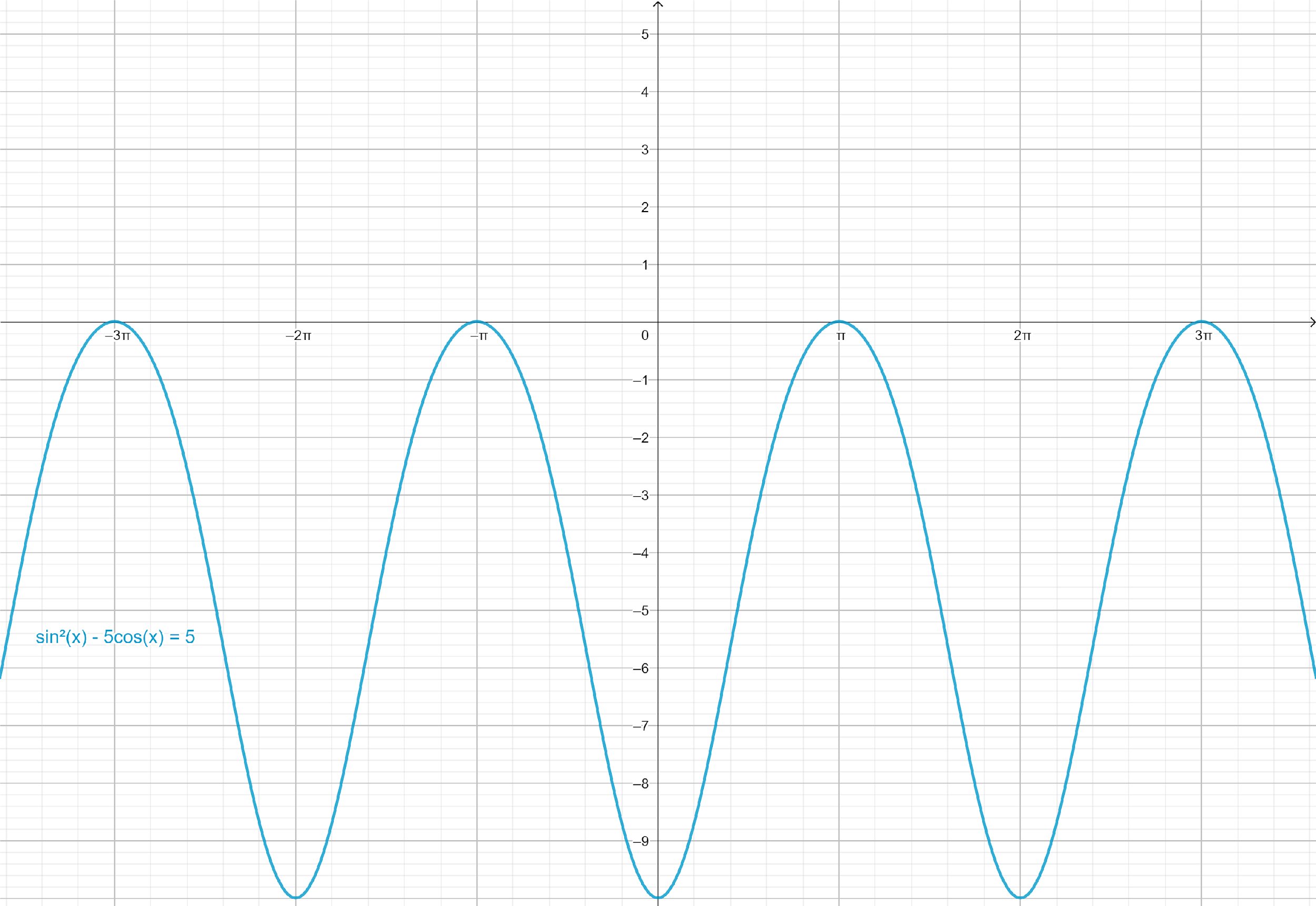
From the graph paper, we can see that there is only one value of $x$ in the interval $\left[ {0,2\pi } \right)$.
Complete step by step solution:
Given equation: ${\sin ^2}x - 5\cos x = 5$
We have to find all possible values of $x$ in the interval $\left[ {0,2\pi } \right)$.
First, move $5$ to the left side of the equation.
${\sin ^2}x - 5\cos x - 5 = 0$
Replace ${\sin ^2}x$ with $1 - {\cos ^2}x$.
$1 - {\cos ^2}x - 5\cos x - 5 = 0$
Reorder terms.
$ - {\cos ^2}x - 5\cos x - 4 = 0$
It can be written as
${\cos ^2}x + 5\cos x + 4 = 0$
Now, factor by grouping.
For a polynomial of the form $a{x^2} + bx + c$, rewrite the middle term as a sum of two terms whose product is $a \times c = 1 \times 4 = 4$ and whose sum is $b = 5$.
Rewrite $5$ as $4$ plus $1$.
${\cos ^2}x + \left( {4 + 1} \right)\cos x + 4 = 0$
Apply the distributive property.
${\cos ^2}x + \cos x + 4\cos x + 4 = 0$
Factor out the greatest common factor from each group.
Group the first two terms and the last two terms.
$\left( {{{\cos }^2}x + \cos x} \right) + \left( {4\cos x + 4} \right) = 0$
Factor out the greatest common factor (GCF) from each group.
$\cos x\left( {\cos x + 1} \right) + 4\left( {\cos x + 1} \right) = 0$
Factor the polynomial by factoring out the greatest common factor, $\cos x + 1$.
$\left( {\cos x + 1} \right)\left( {\cos x + 4} \right) = 0$
If any individual factor on the left side of the equation is equal to $0$, the entire expression will be equal to $0$.
$\cos x + 1 = 0$
$\cos x + 4 = 0$
Set the first factor equal to $0$ and solve.
$\cos x + 1 = 0$
Subtract $1$ from both sides of the equation.
$\cos x = - 1$…(i)
Now, using the property $\cos \left( {\pi - x} \right) = - \cos x$ and $\cos 0 = 1$ in equation (i).
$ \Rightarrow \cos x = - \cos 0$
$ \Rightarrow \cos x = \cos \left( {\pi - 0} \right)$
$ \Rightarrow x = \pi $
Since, the period of the $\cos x$ function is $2\pi $ so values will repeat every $2\pi $ radians in both directions.
$x = \pi + 2n\pi $, for any integer $n$.
Now, set second factor equal to $0$ and solve.
$\cos x + 4 = 0$
Subtract $4$ from both sides of the equation.
$\cos x = - 4$
The range of cosine is $ - 1 \leqslant y \leqslant 1$. Since $ - 4$ does not fall in this range, there is no solution.
No solution
Thus, $x = \pi + 2n\pi $
Where, $n$ is any integer, i.e., $n = 0, \pm 1, \pm 2, \pm 3,......$
Now, find all values of $x$ in the interval $\left[ {0,2\pi } \right)$.
Since, it is given that $x \in \left[ {0,2\pi } \right)$, hence put $n = 0$ in the general solution.
So, putting $n = 0$ in the general solution, $x = \pi + 2n\pi $, we get
$x = \pi $
Hence, $x = \pi $ is the only solution of the given equation in the given interval.
Note: In above question, we can find the solutions of given equation by plotting the equation, ${\sin ^2}x - 5\cos x = 5$ on graph paper and determine all solutions which lie in the interval, $\left[ {0,2\pi } \right)$.
From the graph paper, we can see that there is only one value of $x$ in the interval $\left[ {0,2\pi } \right)$.
Recently Updated Pages
Master Class 11 English: Engaging Questions & Answers for Success

Master Class 11 Physics: Engaging Questions & Answers for Success
Master Class 11 Computer Science: Engaging Questions & Answers for Success
Master Class 11 Chemistry: Engaging Questions & Answers for Success
Master Class 11 Social Science: Engaging Questions & Answers for Success
Master Class 11 Accountancy: Engaging Questions & Answers for Success
Trending doubts
Difference Between Prokaryotic Cells and Eukaryotic Cells
Two of the body parts which do not appear in MRI are class 11 biology CBSE
One Metric ton is equal to kg A 10000 B 1000 C 100 class 11 physics CBSE
10 examples of friction in our daily life
Draw a diagram of nephron and explain its structur class 11 biology CBSE
Draw a diagram of a plant cell and label at least eight class 11 biology CBSE