




How do you solve \[\ln (x - 6) - \ln (5) = \ln (7) + \ln (x - 2)\] ?
Answer
 Verified
524.4k+ views
Hint: In order to simplify the natural log equation with the formula is \[\ln (x \cdot z) = \ln x + \ln z\] and \[\ln \dfrac{x}{z} = \ln x - \ln z\] .The natural logarithm of a number is its logarithm to the base of the mathematical constant. The natural logarithm of \[x\] is generally written as \[\ln x,{\log _e}x\] or sometimes, if the base \[e\] is implicit, simply \[\log x\] . We get the required solution by comparing the formula.
Formula:
\[\ln (x \cdot z) = \ln x + \ln z\]
\[\ln \dfrac{x}{z} = \ln x - \ln z\] .
Complete step-by-step answer:
In this problem,
The natural logarithm of the equation is \[\ln (x - 6) - \ln (5) = \ln (7) + \ln (x - 2)\] . First, we compare the equation with the formula is \[\ln (x \cdot z) = \ln x + \ln z\] and \[\ln \dfrac{x}{z} = \ln x - \ln z\] .
LHS \[ = \] RHS
\[\ln (x - 6) - \ln (5) = \ln (7) + \ln (x - 2)\]
Comparing LHS equation, \[\ln (x - 6) - \ln (5)\] with the formula \[\ln \dfrac{x}{z} = \ln x - \ln z\] , Subtraction of the log is the result of the source values being divided, where \[x = (x - 6),z = 5\]
LHS: \[\ln (x - 6) - \ln (5) = \ln \left( {\dfrac{{x - 6}}{5}} \right)\]
and Comparing RHS equation, \[\ln (7) + \ln (x - 2)\] with the formula \[\ln (x \cdot z) = \ln x + \ln z\] ,Addition of logs is the consequence of the source values being multiplied. So
RHS: \[\ln (7) + \ln (x - 2) = \ln (7(x - 2))\] .
Combining all this equation together, we can get
\[\ln \left( {\dfrac{{x - 6}}{5}} \right) = \ln (7(x - 2)\]
By remove the inverse of log on both side, we get
\[\left( {\dfrac{{x - 6}}{5}} \right) = (7(x - 2)\]
Expanding the bracket on RHS and multiply by \[5\] on both sides, we have
\[\
x - 6 = 35(x - 2) \\
x - 6 = 35x - 70 \;
\ \]
By simplify the equation to get the value of \[x\] , we get
\[x - 35x = 6 - 70 \Rightarrow - 34x = - 54\]
\[x = \dfrac{{54}}{{34}} = \dfrac{{27}}{{17}} = 1.588\]
Therefore the required solution, \[x = 1.588\] .
So, the correct answer is “\[x = 1.588\] ”.
Note: First we have to plot a graph with respect to the problem is shown below.
The graph of the red curve represent the equation \[\ln (x - 6) - \ln (5)\]
The graph of the blue curve represent the equation \[\ln (x - 6) - \ln (5)\]
The graph of the green line is \[x = 1.588\]
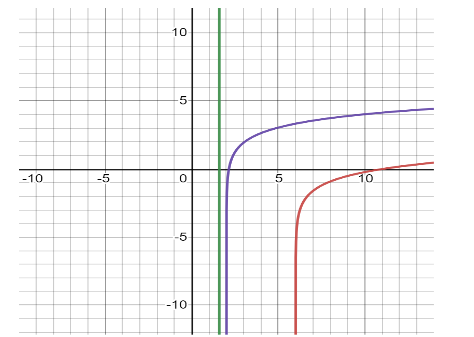
In this problem, we have to remember the natural logarithm formula \[\ln (x \cdot z) = \ln x + \ln z\] and \[\ln \dfrac{x}{z} = \ln x - \ln z\] on comparing with the given equation to get the required value \[x\] .
Formula:
\[\ln (x \cdot z) = \ln x + \ln z\]
\[\ln \dfrac{x}{z} = \ln x - \ln z\] .
Complete step-by-step answer:
In this problem,
The natural logarithm of the equation is \[\ln (x - 6) - \ln (5) = \ln (7) + \ln (x - 2)\] . First, we compare the equation with the formula is \[\ln (x \cdot z) = \ln x + \ln z\] and \[\ln \dfrac{x}{z} = \ln x - \ln z\] .
LHS \[ = \] RHS
\[\ln (x - 6) - \ln (5) = \ln (7) + \ln (x - 2)\]
Comparing LHS equation, \[\ln (x - 6) - \ln (5)\] with the formula \[\ln \dfrac{x}{z} = \ln x - \ln z\] , Subtraction of the log is the result of the source values being divided, where \[x = (x - 6),z = 5\]
LHS: \[\ln (x - 6) - \ln (5) = \ln \left( {\dfrac{{x - 6}}{5}} \right)\]
and Comparing RHS equation, \[\ln (7) + \ln (x - 2)\] with the formula \[\ln (x \cdot z) = \ln x + \ln z\] ,Addition of logs is the consequence of the source values being multiplied. So
RHS: \[\ln (7) + \ln (x - 2) = \ln (7(x - 2))\] .
Combining all this equation together, we can get
\[\ln \left( {\dfrac{{x - 6}}{5}} \right) = \ln (7(x - 2)\]
By remove the inverse of log on both side, we get
\[\left( {\dfrac{{x - 6}}{5}} \right) = (7(x - 2)\]
Expanding the bracket on RHS and multiply by \[5\] on both sides, we have
\[\
x - 6 = 35(x - 2) \\
x - 6 = 35x - 70 \;
\ \]
By simplify the equation to get the value of \[x\] , we get
\[x - 35x = 6 - 70 \Rightarrow - 34x = - 54\]
\[x = \dfrac{{54}}{{34}} = \dfrac{{27}}{{17}} = 1.588\]
Therefore the required solution, \[x = 1.588\] .
So, the correct answer is “\[x = 1.588\] ”.
Note: First we have to plot a graph with respect to the problem is shown below.
The graph of the red curve represent the equation \[\ln (x - 6) - \ln (5)\]
The graph of the blue curve represent the equation \[\ln (x - 6) - \ln (5)\]
The graph of the green line is \[x = 1.588\]
In this problem, we have to remember the natural logarithm formula \[\ln (x \cdot z) = \ln x + \ln z\] and \[\ln \dfrac{x}{z} = \ln x - \ln z\] on comparing with the given equation to get the required value \[x\] .
Recently Updated Pages
Master Class 11 English: Engaging Questions & Answers for Success

Master Class 11 Maths: Engaging Questions & Answers for Success
Master Class 11 Biology: Engaging Questions & Answers for Success
Master Class 11 Physics: Engaging Questions & Answers for Success
Master Class 11 Accountancy: Engaging Questions & Answers for Success
Class 11 Question and Answer - Your Ultimate Solutions Guide
Trending doubts
One Metric ton is equal to kg A 10000 B 1000 C 100 class 11 physics CBSE
Discuss the various forms of bacteria class 11 biology CBSE
Draw a diagram of a plant cell and label at least eight class 11 biology CBSE
State the laws of reflection of light
Explain zero factorial class 11 maths CBSE
10 examples of friction in our daily life