




How do I solve for a right triangle?
Answer
 Verified
589.8k+ views
Hint: We figure out the underlying concept behind the problem. This particular problem is under the topic of the solution of triangles and to some extent of trigonometry. For solving this problem first of all we need to understand the given problem statement clearly. To solve for a right triangle, we need to find the values of all the sides of the triangle as well as all the angles of the triangle. What we can do is find the ratio of the sides and then assume that the length of one of the sides is \[1\] m and then with respect to this side we can find the value of the other sides of the triangle.
Complete step by step solution:
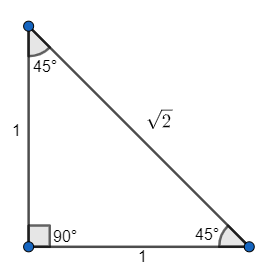
Now we start off with the solution to the given problem by writing that the two sides of the right triangle are equal which also refers that their opposite angles are also equal. One of the sides of a right triangle is \[{{90}^{\circ }}\] and therefore the other two angles of the triangle is \[{{45}^{\circ }}\] each as we know the sum of the angles of a right triangle is \[{{180}^{\circ }}\] .
Now if we assume the length of the base of the given triangle is \[1\] m, then the length of the perpendicular will also be equal to \[1\] m as these two sides are equal. The length of the hypotenuse of the right triangle will therefore be equal to \[\sqrt{{{1}^{2}}+{{1}^{2}}}=\sqrt{2}\] m.
Note: These kinds of problems require an in-depth understanding of the different properties of triangles as well as to some extent trigonometry. This particular problem can also be solved using pure trigonometry by applying sine, cosine or tangent to any of the angles to find the required side length. This method however is a bit lengthy as we need to dive a little bit into trigonometry, but it is quite easy to remember and apply. One important thing to remember is that we have to assume one of the sides of the triangle and the rest can be found out accordingly.
Complete step by step solution:
Now we start off with the solution to the given problem by writing that the two sides of the right triangle are equal which also refers that their opposite angles are also equal. One of the sides of a right triangle is \[{{90}^{\circ }}\] and therefore the other two angles of the triangle is \[{{45}^{\circ }}\] each as we know the sum of the angles of a right triangle is \[{{180}^{\circ }}\] .
Now if we assume the length of the base of the given triangle is \[1\] m, then the length of the perpendicular will also be equal to \[1\] m as these two sides are equal. The length of the hypotenuse of the right triangle will therefore be equal to \[\sqrt{{{1}^{2}}+{{1}^{2}}}=\sqrt{2}\] m.
Note: These kinds of problems require an in-depth understanding of the different properties of triangles as well as to some extent trigonometry. This particular problem can also be solved using pure trigonometry by applying sine, cosine or tangent to any of the angles to find the required side length. This method however is a bit lengthy as we need to dive a little bit into trigonometry, but it is quite easy to remember and apply. One important thing to remember is that we have to assume one of the sides of the triangle and the rest can be found out accordingly.
Recently Updated Pages
Basicity of sulphurous acid and sulphuric acid are

Master Class 10 Computer Science: Engaging Questions & Answers for Success
Master Class 10 Social Science: Engaging Questions & Answers for Success
Master Class 10 Science: Engaging Questions & Answers for Success
Class 10 Question and Answer - Your Ultimate Solutions Guide
Master Class 10 Maths: Engaging Questions & Answers for Success
Trending doubts
What is the Total Duration of Football Match?
Explain the Treaty of Vienna of 1815 class 10 social science CBSE
In football, which nation is called "La Roja"?
Why is there a time difference of about 5 hours between class 10 social science CBSE
10 examples of evaporation in daily life with explanations
What is the full form of POSCO class 10 social science CBSE