




What is the solubility of cerium sulfate at \[10{}^\circ C\] ? What is the solubility of cerium sulfate at \[50{}^\circ C\] ?
Answer
 Verified
570.6k+ views
Hint: We know that the solubility product of a salt is basically the product of the solubility’s or concentration of the products (ionic species) of the reaction, where the concentration of each ion is raised to the power respective to their stoichiometric coefficients in a balanced chemical equation. Sometimes, solubility of a compound gets lower with increase in temperature, cerium sulfate is one of those compounds in which its solubility decreases with increase in temperature.
Complete answer:
As we know that the solubility of cerium sulfate at \[10\] degree C is \[14g/100ml\] and its solubility at \[50\] degree C is \[6g/100ml.\] It means that only \[14\] gram of cerium sulphate will dissolve in \[100\] ml of water at \[10\] degree Celsius and only \[6\] gram of cerium sulphate will dissolve in \[100\] ml of water at $50$ degree Celsius. This shows that the solubility of cerium sulphate decreases with the increase in temperature rather. Generally, solubility of any element or compound increases with increase in temperature of the solution, but it does not happen here. Cerium sulphate is one salt whose solubility decreases with increase in temperature of the solution. The reason why the solubility of cerium sulphate decrease with increase in temperature is because the highly charged \[C{{e}^{+3}}\] and \[SO_{4}^{-2}\] ions become surrounded by a uniquely ordered sphere of water molecules, which increases the order of the system. And thus, its solubility decreases.
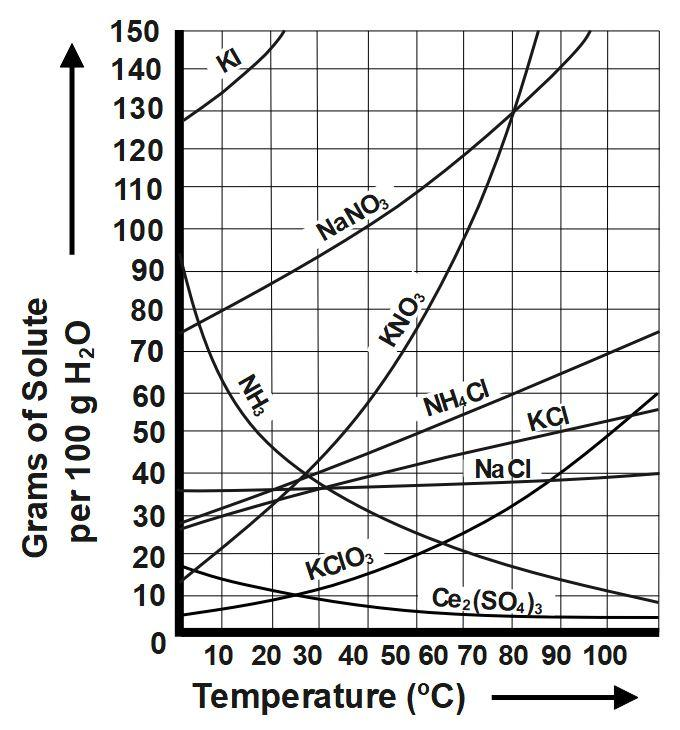
The below graph indicates solubility of cerium sulphate. The chemical formula of cerium sulphate is \[C{{e}_{2}}{{\left( S{{O}_{4}} \right)}_{3}}.\] Solubility of most of the salts increase with increase in temperature of the solution. But, there are a few salts and compounds where the solubility of them decreases with increase in temperature of the solution.
Therefore, Cerium \[(III)\] sulfate is one of the few solids that is less soluble in water at higher temperatures as it appears that \[100\] g of water will dissolve \[14\] g of the salt at \[10\text{ }{}^\circ C\] and only \[6\] g at \[50\text{ }{}^\circ C.\]
Note:
Remember that there can be different reasons for the decrease in solubility of any element or compound with increase in temperature of the solution; in this case it was due to more orderly arrangement occurring with increase in temperature. The formula of solubility product constant depends upon the number of ions produced by the ionic compounds in the water.
Complete answer:
As we know that the solubility of cerium sulfate at \[10\] degree C is \[14g/100ml\] and its solubility at \[50\] degree C is \[6g/100ml.\] It means that only \[14\] gram of cerium sulphate will dissolve in \[100\] ml of water at \[10\] degree Celsius and only \[6\] gram of cerium sulphate will dissolve in \[100\] ml of water at $50$ degree Celsius. This shows that the solubility of cerium sulphate decreases with the increase in temperature rather. Generally, solubility of any element or compound increases with increase in temperature of the solution, but it does not happen here. Cerium sulphate is one salt whose solubility decreases with increase in temperature of the solution. The reason why the solubility of cerium sulphate decrease with increase in temperature is because the highly charged \[C{{e}^{+3}}\] and \[SO_{4}^{-2}\] ions become surrounded by a uniquely ordered sphere of water molecules, which increases the order of the system. And thus, its solubility decreases.
The below graph indicates solubility of cerium sulphate. The chemical formula of cerium sulphate is \[C{{e}_{2}}{{\left( S{{O}_{4}} \right)}_{3}}.\] Solubility of most of the salts increase with increase in temperature of the solution. But, there are a few salts and compounds where the solubility of them decreases with increase in temperature of the solution.
Therefore, Cerium \[(III)\] sulfate is one of the few solids that is less soluble in water at higher temperatures as it appears that \[100\] g of water will dissolve \[14\] g of the salt at \[10\text{ }{}^\circ C\] and only \[6\] g at \[50\text{ }{}^\circ C.\]
Note:
Remember that there can be different reasons for the decrease in solubility of any element or compound with increase in temperature of the solution; in this case it was due to more orderly arrangement occurring with increase in temperature. The formula of solubility product constant depends upon the number of ions produced by the ionic compounds in the water.
Recently Updated Pages
Which will be the least stable resonating structure class 11 chemistry CBSE

How many 5 digit telephone numbers can be construc-class-11-maths-CBSE
How do you find the angle of the resultant vector class 11 physics CBSE
Draw labelled diagram of the following i Gram seed class 11 biology CBSE
What is the need and importance of classification class 11 biology CBSE
The way in which the sparrows expressed their sorrow class 11 english CBSE
Trending doubts
One Metric ton is equal to kg A 10000 B 1000 C 100 class 11 physics CBSE
1 Quintal is equal to a 110 kg b 10 kg c 100kg d 1000 class 11 physics CBSE
Draw a diagram of nephron and explain its structur class 11 biology CBSE
10 examples of friction in our daily life
Proton was discovered by A Thomson B Rutherford C Chadwick class 11 chemistry CBSE
Bond order ofO2 O2+ O2 and O22 is in order A O2 langle class 11 chemistry CBSE