




Solder is used for joining two metal surfaces together. Solder is a mixture of lead and tin. Can two metals be separated by distillation?
Answer
 Verified
664.2k+ views
Hint:
Distillation is a separation technique that can be used to either increase the concentration of a particular component in the mixture or to obtain (almost) pure components from the mixture. With this in mind, try to work out whether this process could be used in the separation of metals.
Step-by-Step Solution:
Let us first understand the concepts of metal refinery and distillation separately before moving onto analysing whether there can be any overlap between the two.
Refining is a method of removing impurities in order to obtain metals of high purity. The impurities are removed from crude metal by various methods based on the properties of the metal and the properties of impurities.
It is to be distinguished from other processes such as smelting and calcining in that those two involve a chemical change to the raw material, whereas in refining, the final material is usually identical chemically to the original one, only it is purer. The processes used are of many types, including pyrometallurgical and hydrometallurgical techniques.
The process of distillation exploits the difference in the boiling points of the components in the liquid mixture by forcing one of them into a gaseous state. It is important to note that distillation is not a chemical reaction but it can be considered as a physical separation process.
Now, let us try and understand if two metals can possibly be separated by the process of distillation.
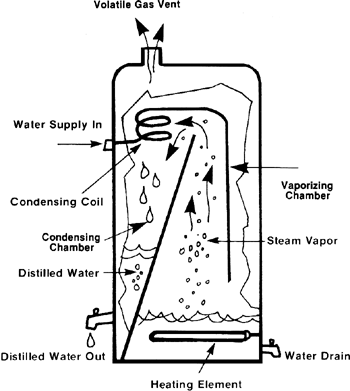
Distillation of metals is used for the purification of metals which possess a low boiling point such as mercury and zinc. In this process the impure metal is heated above its boiling point so that it can form vapours. The impurities do not vaporize and hence they are separated. The vapours of the pure metal are then condensed leaving the impurities behind.
An illustration of the same is as follows:
Note:
For metals that have a particularly low boiling point, such as mercury and zinc, they can be distilled to remove the impurities. So, if you heat up a sample of impure mercury, the mercury will vaporize but nothing else around it will. The vapor can be collected, and when it condenses back you are left with pure mercury.
Distillation is a separation technique that can be used to either increase the concentration of a particular component in the mixture or to obtain (almost) pure components from the mixture. With this in mind, try to work out whether this process could be used in the separation of metals.
Step-by-Step Solution:
Let us first understand the concepts of metal refinery and distillation separately before moving onto analysing whether there can be any overlap between the two.
Refining is a method of removing impurities in order to obtain metals of high purity. The impurities are removed from crude metal by various methods based on the properties of the metal and the properties of impurities.
It is to be distinguished from other processes such as smelting and calcining in that those two involve a chemical change to the raw material, whereas in refining, the final material is usually identical chemically to the original one, only it is purer. The processes used are of many types, including pyrometallurgical and hydrometallurgical techniques.
The process of distillation exploits the difference in the boiling points of the components in the liquid mixture by forcing one of them into a gaseous state. It is important to note that distillation is not a chemical reaction but it can be considered as a physical separation process.
Now, let us try and understand if two metals can possibly be separated by the process of distillation.
Distillation of metals is used for the purification of metals which possess a low boiling point such as mercury and zinc. In this process the impure metal is heated above its boiling point so that it can form vapours. The impurities do not vaporize and hence they are separated. The vapours of the pure metal are then condensed leaving the impurities behind.
An illustration of the same is as follows:
Note:
For metals that have a particularly low boiling point, such as mercury and zinc, they can be distilled to remove the impurities. So, if you heat up a sample of impure mercury, the mercury will vaporize but nothing else around it will. The vapor can be collected, and when it condenses back you are left with pure mercury.
Recently Updated Pages
If x a + bt + ct2 where x is in meters and t is in class 11 physics CBSE

A car covers the first half distance between two places class 11 physics CBSE
The resultant of two vectors overrightarrow P and overrightarrow class 11 physics CBSE
Find the value of cos 135 class 11 maths CBSE
A mass M is held in place by an applied force F and class 11 physics CBSE
A solution of glucose in water is labelled as 10 dfracwv class 11 chemistry CBSE
Trending doubts
Find the value of the expression given below sin 30circ class 11 maths CBSE
One Metric ton is equal to kg A 10000 B 1000 C 100 class 11 physics CBSE
Draw a diagram of nephron and explain its structur class 11 biology CBSE
10 examples of friction in our daily life
Proton was discovered by A Thomson B Rutherford C Chadwick class 11 chemistry CBSE
Bond order ofO2 O2+ O2 and O22 is in order A O2 langle class 11 chemistry CBSE