




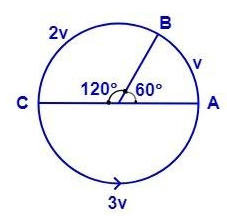
Sohail cycles on a circular track in anticlockwise direction as shown in the figure. He travels with a speed ‘v’ to cover the path AB, next with speed ‘2v’ from B to C and with a speed of ‘3v’ from C to A. What is the average speed for the total journey?
Answer
 Verified
576.9k+ views
Hint: Use the distance formula of circle i.e.
$ d=2\pi r\dfrac{\theta }{360{}^\circ } $
Where d is the distance travelled in $ \theta $ angle and r is the radius of the circle.
When the distance travelled in each segment of the circle is found use the given velocities to calculate the time taken to travel each segment.
After that use the average speed formula:
$ \text{Average speed}=\dfrac{\text{Total distance}}{\text{Total time}} $
Or
$ {{v}_{avg}}=\dfrac{D}{T} $
Where D is the total distance travelled and T is the total time taken to travel the same distance.
Complete step by step solution
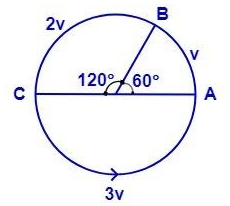
Distance travelled from A to B
$ \begin{align}
& {{d}_{1}}=2\pi r\dfrac{60{}^\circ }{360{}^\circ } \\
& {{d}_{1}}=\dfrac{2\pi r}{6} \\
\end{align} $
Time taken from A to B
$ \begin{align}
& {{t}_{1}}=\dfrac{{{d}_{1}}}{{{v}_{1}}} \\
& {{t}_{1}}=\dfrac{2\pi r}{6v} \\
& {{t}_{1}}=\dfrac{\pi r}{3v} \\
\end{align} $
Distance travelled from B to C
$ \begin{align}
& {{d}_{2}}=2\pi r\dfrac{120{}^\circ }{360{}^\circ } \\
& {{d}_{2}}=\dfrac{2\pi r}{3} \\
\end{align} $
Time taken from B to C
$ \begin{align}
& {{t}_{2}}=\dfrac{{{d}_{2}}}{{{v}_{2}}} \\
& {{t}_{2}}=\dfrac{2\pi r}{3(2v)} \\
& {{t}_{2}}=\dfrac{\pi r}{3v} \\
\end{align} $
Distance travelled from C to A
$ \begin{align}
& {{d}_{3}}=2\pi r\dfrac{180{}^\circ }{360{}^\circ } \\
& {{d}_{3}}=\dfrac{2\pi r}{2} \\
& {{d}_{3}}=\pi r \\
\end{align} $
Time taken from C to A
$ \begin{align}
& {{t}_{3}}=\dfrac{{{d}_{3}}}{{{v}_{3}}} \\
& {{t}_{3}}=\dfrac{\pi r}{3v} \\
\end{align} $
Average speed of the total journey:
$ \text{Average speed}=\dfrac{\text{Total distance}}{\text{Total time}} $
$ \begin{align}
& {{v}_{avg}}=\dfrac{{{d}_{1}}+{{d}_{2}}+{{d}_{3}}}{{{t}_{1}}+{{t}_{2}}+{{t}_{3}}} \\
& =\dfrac{2\pi r}{\dfrac{\pi r}{3v}+\dfrac{\pi r}{3v}+\dfrac{\pi r}{3v}} \\
& =\dfrac{2\pi r}{\dfrac{3\pi r}{3v}} \\
& {{v}_{avg}}=2v \\
\end{align} $
Therefore, the average speed of the total journey is 2v.
Note
Always remember to calculate the time of each segment separately to avoid the confusion during the calculation of average speed collectively at last. Distance travelled during motion and displacement can be different. So while calculating distance we have to consider the full path of journey.
$ d=2\pi r\dfrac{\theta }{360{}^\circ } $
Where d is the distance travelled in $ \theta $ angle and r is the radius of the circle.
When the distance travelled in each segment of the circle is found use the given velocities to calculate the time taken to travel each segment.
After that use the average speed formula:
$ \text{Average speed}=\dfrac{\text{Total distance}}{\text{Total time}} $
Or
$ {{v}_{avg}}=\dfrac{D}{T} $
Where D is the total distance travelled and T is the total time taken to travel the same distance.
Complete step by step solution
Distance travelled from A to B
$ \begin{align}
& {{d}_{1}}=2\pi r\dfrac{60{}^\circ }{360{}^\circ } \\
& {{d}_{1}}=\dfrac{2\pi r}{6} \\
\end{align} $
Time taken from A to B
$ \begin{align}
& {{t}_{1}}=\dfrac{{{d}_{1}}}{{{v}_{1}}} \\
& {{t}_{1}}=\dfrac{2\pi r}{6v} \\
& {{t}_{1}}=\dfrac{\pi r}{3v} \\
\end{align} $
Distance travelled from B to C
$ \begin{align}
& {{d}_{2}}=2\pi r\dfrac{120{}^\circ }{360{}^\circ } \\
& {{d}_{2}}=\dfrac{2\pi r}{3} \\
\end{align} $
Time taken from B to C
$ \begin{align}
& {{t}_{2}}=\dfrac{{{d}_{2}}}{{{v}_{2}}} \\
& {{t}_{2}}=\dfrac{2\pi r}{3(2v)} \\
& {{t}_{2}}=\dfrac{\pi r}{3v} \\
\end{align} $
Distance travelled from C to A
$ \begin{align}
& {{d}_{3}}=2\pi r\dfrac{180{}^\circ }{360{}^\circ } \\
& {{d}_{3}}=\dfrac{2\pi r}{2} \\
& {{d}_{3}}=\pi r \\
\end{align} $
Time taken from C to A
$ \begin{align}
& {{t}_{3}}=\dfrac{{{d}_{3}}}{{{v}_{3}}} \\
& {{t}_{3}}=\dfrac{\pi r}{3v} \\
\end{align} $
Average speed of the total journey:
$ \text{Average speed}=\dfrac{\text{Total distance}}{\text{Total time}} $
$ \begin{align}
& {{v}_{avg}}=\dfrac{{{d}_{1}}+{{d}_{2}}+{{d}_{3}}}{{{t}_{1}}+{{t}_{2}}+{{t}_{3}}} \\
& =\dfrac{2\pi r}{\dfrac{\pi r}{3v}+\dfrac{\pi r}{3v}+\dfrac{\pi r}{3v}} \\
& =\dfrac{2\pi r}{\dfrac{3\pi r}{3v}} \\
& {{v}_{avg}}=2v \\
\end{align} $
Therefore, the average speed of the total journey is 2v.
Note
Always remember to calculate the time of each segment separately to avoid the confusion during the calculation of average speed collectively at last. Distance travelled during motion and displacement can be different. So while calculating distance we have to consider the full path of journey.
Recently Updated Pages
The magnetic field in a plane electromagnetic wave class 11 physics CBSE

In a plane electromagnetic wave the electric field class 12 physics CBSE
A plane electromagnetic wave travels in vacuum along class 12 physics CBSE
Basicity of sulphurous acid and sulphuric acid are
Master Class 11 Business Studies: Engaging Questions & Answers for Success
Master Class 11 Computer Science: Engaging Questions & Answers for Success
Trending doubts
One Metric ton is equal to kg A 10000 B 1000 C 100 class 11 physics CBSE
What are the examples of C3 and C4 plants class 11 biology CBSE
State and prove Bernoullis theorem class 11 physics CBSE
10 examples of friction in our daily life
A body is said to be in dynamic equilibrium if A When class 11 physics CBSE
Difference Between Prokaryotic Cells and Eukaryotic Cells