




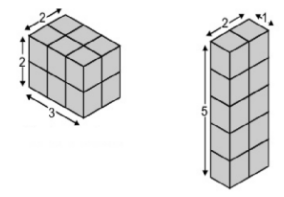
How many small cubes are there in each cuboid respectively.
Answer
 Verified
614.1k+ views
Hint: Here we will use the formula for finding the small cubes in any cuboid which states that the number of cubes in a cuboid is equal to the volume of the cuboid divided by the volume of the cube, as shown below:
\[{\text{Number of cube}} = \dfrac{{{\text{Volume of cuboid}}}}{{{\text{Volume of cube}}}}\]
Where the volume of the cuboid will be equal to the product of its length, breadth, and height, and the volume of the cube will be equal to the product of its all three sides.
Complete step-by-step answer:
Step 1: Now, as we can see from the above-given figure number (1), the sides of the cuboid are given as below:
\[l = 2\] , \[b = 2\] and \[h = 3\].
So, the volume of the cuboid = \[l \times b \times h\] cubic units.
By substituting the values of length, height, and breadth in the formula, we get:
\[ \Rightarrow {\text{Volume of cuboid = 2}} \times {\text{2}} \times {\text{3}}\]
By doing multiplication, we get:
\[ \Rightarrow {\text{Volume of cuboid = 12 cubic units}}\]
Now, for figure number (1), we need to find a small number of cubes. So, we can see that side of the smallest cube possible is equal to \[1\]. So, the volume of the cube will be equals to as below:
\[ \Rightarrow {\text{Volume of cube = }}{\left( {{\text{side}}} \right)^3}\]
By substituting the value of the side of the cube, we get:
\[ \Rightarrow {\text{Volume of cube = }}{\left( 1 \right)^3}\]
\[ \Rightarrow {\text{Volume of cube = 1 cubic units}}\]
Now, by applying the formula for calculating a small number of cubes, we get:
\[ \Rightarrow {\text{Number of cube}} = \dfrac{{12{\text{ cubic units}}}}{{1{\text{ cubic units}}}}\]
By dividing into the RHS side, we get:
\[ \Rightarrow {\text{Number of cubes}} = 12\] in figure number (1).
Step 2: Similarly, we will repeat the same as step (1), for calculating the number of cubes in figure (2).
The sides of the cuboid are given as below:
\[l = 2\] , \[b = 1\] and \[h = 5\].
So, the volume of the cuboid = \[l \times b \times h\] cubic units.
By substituting the values of length, height, and breadth in the formula, we get:
\[ \Rightarrow {\text{Volume of cuboid = 2}} \times 1 \times 5\]
By doing multiplication, we get:
\[ \Rightarrow {\text{Volume of cuboid = 10 cubic units}}\]
Now, for figure number (2), the volume of the cube will be equals to as below:
\[ \Rightarrow {\text{Volume of cube = }}{\left( {{\text{side}}} \right)^3}\]
By substituting the value of the side of the cube, we get:
\[ \Rightarrow {\text{Volume of cube = }}{\left( 1 \right)^3}\]
\[ \Rightarrow {\text{Volume of cube = 1 cubic units}}\]
Now, by applying the formula for calculating a small number of cubes, we get:
\[ \Rightarrow {\text{Number of cube}} = \dfrac{{10{\text{ cubic units}}}}{{1{\text{ cubic units}}}}\]
By dividing into the RHS side, we get:
\[ \Rightarrow {\text{Number of cubes}} = 10\] in figure number (2).
The number of cubes in figure (1) and (2) are \[12\] and \[10\] respectively.
Note: In these types of questions students need to take care while calculating the volume of the cube. Because in this question we need to find only the smallest cubes possible in the cuboid that is why we have taken the smallest side of the cube possible which is one. Otherwise, we need to calculate it for every side possible.
\[{\text{Number of cube}} = \dfrac{{{\text{Volume of cuboid}}}}{{{\text{Volume of cube}}}}\]
Where the volume of the cuboid will be equal to the product of its length, breadth, and height, and the volume of the cube will be equal to the product of its all three sides.
Complete step-by-step answer:
Step 1: Now, as we can see from the above-given figure number (1), the sides of the cuboid are given as below:
\[l = 2\] , \[b = 2\] and \[h = 3\].
So, the volume of the cuboid = \[l \times b \times h\] cubic units.
By substituting the values of length, height, and breadth in the formula, we get:
\[ \Rightarrow {\text{Volume of cuboid = 2}} \times {\text{2}} \times {\text{3}}\]
By doing multiplication, we get:
\[ \Rightarrow {\text{Volume of cuboid = 12 cubic units}}\]
Now, for figure number (1), we need to find a small number of cubes. So, we can see that side of the smallest cube possible is equal to \[1\]. So, the volume of the cube will be equals to as below:
\[ \Rightarrow {\text{Volume of cube = }}{\left( {{\text{side}}} \right)^3}\]
By substituting the value of the side of the cube, we get:
\[ \Rightarrow {\text{Volume of cube = }}{\left( 1 \right)^3}\]
\[ \Rightarrow {\text{Volume of cube = 1 cubic units}}\]
Now, by applying the formula for calculating a small number of cubes, we get:
\[ \Rightarrow {\text{Number of cube}} = \dfrac{{12{\text{ cubic units}}}}{{1{\text{ cubic units}}}}\]
By dividing into the RHS side, we get:
\[ \Rightarrow {\text{Number of cubes}} = 12\] in figure number (1).
Step 2: Similarly, we will repeat the same as step (1), for calculating the number of cubes in figure (2).
The sides of the cuboid are given as below:
\[l = 2\] , \[b = 1\] and \[h = 5\].
So, the volume of the cuboid = \[l \times b \times h\] cubic units.
By substituting the values of length, height, and breadth in the formula, we get:
\[ \Rightarrow {\text{Volume of cuboid = 2}} \times 1 \times 5\]
By doing multiplication, we get:
\[ \Rightarrow {\text{Volume of cuboid = 10 cubic units}}\]
Now, for figure number (2), the volume of the cube will be equals to as below:
\[ \Rightarrow {\text{Volume of cube = }}{\left( {{\text{side}}} \right)^3}\]
By substituting the value of the side of the cube, we get:
\[ \Rightarrow {\text{Volume of cube = }}{\left( 1 \right)^3}\]
\[ \Rightarrow {\text{Volume of cube = 1 cubic units}}\]
Now, by applying the formula for calculating a small number of cubes, we get:
\[ \Rightarrow {\text{Number of cube}} = \dfrac{{10{\text{ cubic units}}}}{{1{\text{ cubic units}}}}\]
By dividing into the RHS side, we get:
\[ \Rightarrow {\text{Number of cubes}} = 10\] in figure number (2).
The number of cubes in figure (1) and (2) are \[12\] and \[10\] respectively.
Note: In these types of questions students need to take care while calculating the volume of the cube. Because in this question we need to find only the smallest cubes possible in the cuboid that is why we have taken the smallest side of the cube possible which is one. Otherwise, we need to calculate it for every side possible.
Recently Updated Pages
Master Class 11 English: Engaging Questions & Answers for Success

Master Class 11 Social Science: Engaging Questions & Answers for Success
Master Class 11 Maths: Engaging Questions & Answers for Success
Master Class 11 Biology: Engaging Questions & Answers for Success
Master Class 11 Physics: Engaging Questions & Answers for Success
Master Class 11 Chemistry: Engaging Questions & Answers for Success
Trending doubts