




What is the slope and intercept for $ 2x + 3y = 9 $ and how would you graph it?
Answer
 Verified
597k+ views
Hint: Change of the form of equation will give us the slope of the line $ 2x + 3y = 9 $ . We have to change it to the form $ y = mx + c $ to find the slope $ m $ . Then, as we know that there are two kinds of intercepts which are $ x $ -intercept and $ y $ -intercept. So, $ x $ -intercept is the point where the line intersects the $ x $ -axis and $ y $ -intercept is the point where the line intersects the $ y $ -axis. So, to calculate the intercepts, we will put $ x $ and $ y $ as zero one by one. Lastly, to draw a graph, we will use the coordinates of the intercepts and draw the line.
Complete step-by-step answer:
(i)
We are given the line equation:
$ 2x + 3y = 9 $
In order to find the slope of the line we will have to convert this equation into slope-intercept form i.e.,
$ y = mx + c $
Therefore, we will subtract $ 2x $ from both the sides of the equation:
$ 2x + 3y - 2x = 9 - 2x $
On simplifying, it will become:
$ 3y = 9 - 2x $
Now, we will divide both the sides of the equation by $ 3 $ :
$ \dfrac{{3y}}{3} = \dfrac{{9 - 2x}}{3} $
On simplifying, we will get:
$
y = \dfrac{9}{3} - \dfrac{{2x}}{3} \\
y = 3 - \dfrac{2}{3}x \\
$
Writing the equation in slope intercept form, it will look like:
$ y = - \dfrac{2}{3}x + 3 $
Now, since we have our equation in the slope-intercept form, we will compare the above equation with $ y = mx + c $ to find the value of $ m $ .
As we can see that the coefficient of $ x $ is $ m $ , in our equation the coefficient of $ x $ is $ - \dfrac{2}{3} $ .
i.e.,
$ m = - \dfrac{2}{3} $
Therefore, the slope of the equation $ 2x + 3y = 9 $ is $ - \dfrac{2}{3} $
(ii)
Now, as we know that $ x $ -intercept is the point where the line crosses the $ x $ -axis and we also know that on $ x $ -axis, $ y = 0 $ . Therefore, to find the $ x $ -intercept, we will put $ y $ as $ 0 $ in the equation of line given to us. Therefore,
$
2x + 3\left( 0 \right) = 9 \\
2x = 9 \\
x = \dfrac{9}{2} \\
$
Therefore, the $ x $ -intercept of the equation $ 2x + 3y = 9 $ is $ \dfrac{9}{2} $
(iii)
Similar to $ x $ -intercept, $ y $ -intercept is the point where the line crosses the $ y $ -axis and we also know that on $ y $ -axis, $ x $ =0. Therefore, to find $ y $ -intercept, we will put $ x $ as $ 0 $ in the equation of the line given to us. Therefore,
$
2\left( 0 \right) + 3y = 9 \\
3y = 9 \\
y = \dfrac{9}{3} \\
y = 3 \\
$
Therefore, the $ y $ -intercept of the equation $ 2x + 3y = 9 $ is $ 3 $
(iv)
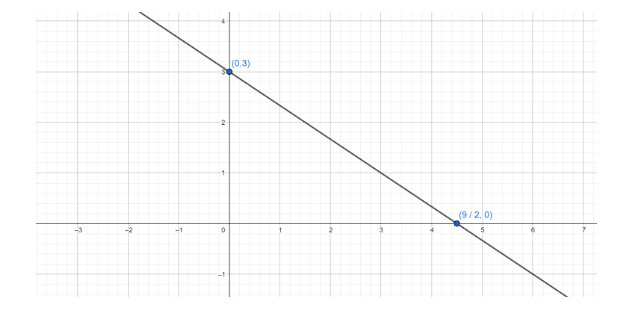
Now, to draw a graph we need two points which lie on the line. As we have calculated both the intercepts, we can say that the line crosses the $ x $ -axis when $ x = \dfrac{9}{2} $ as the $ x $ -intercept of the given line is $ \dfrac{9}{2} $ and we also know that on the $ x $ -axis, $ y = 0 $ . So, we have a point $ \left( {\dfrac{9}{2},0} \right) $ which lies on the line.
Similarly, the line crosses the $ y $ -axis when $ y = 3 $ as the $ y $ -intercept of the given line is $ 3 $ and we also know that on the $ y $ -axis, $ x = 0 $ . So, we have another point which lies on the line as $ \left( {0,3} \right) $ .
Marking these two points on a graph and then joining the points through a line will give us the graphical representation of the line $ 2x + 3y = 9 $ .
Note: A line parallel to $ x $ -axis, does not intersect the $ x $ -axis at any finite distance and hence, we cannot get any finite $ x $ -intercept of such a line. Slope of such a line is $ 0 $ . Similarly, lines parallel to the $ y $ -axis, do not intersect $ y $ -axis at any finite distance and hence, we cannot get any finite $ y $ -intercept of such a line. Slope of such a line is $ \infty $ .
In an equation of the form $ y = mx + c $ , $ m $ represents the slope of the line and $ c $ represents the vertical intercept or $ y $ -intercept of the line as it is the value of $ y $ when $ x = 0 $ . Also, there is an alternative method to find the intercepts of a line equation. Convert the given line equation into intercept form of a line i.e., $ \dfrac{x}{a} + \dfrac{y}{b} = 1 $ , where $ a $ is the $ x $ -intercept and $ b $ is the $ y $ -intercept.
Complete step-by-step answer:
(i)
We are given the line equation:
$ 2x + 3y = 9 $
In order to find the slope of the line we will have to convert this equation into slope-intercept form i.e.,
$ y = mx + c $
Therefore, we will subtract $ 2x $ from both the sides of the equation:
$ 2x + 3y - 2x = 9 - 2x $
On simplifying, it will become:
$ 3y = 9 - 2x $
Now, we will divide both the sides of the equation by $ 3 $ :
$ \dfrac{{3y}}{3} = \dfrac{{9 - 2x}}{3} $
On simplifying, we will get:
$
y = \dfrac{9}{3} - \dfrac{{2x}}{3} \\
y = 3 - \dfrac{2}{3}x \\
$
Writing the equation in slope intercept form, it will look like:
$ y = - \dfrac{2}{3}x + 3 $
Now, since we have our equation in the slope-intercept form, we will compare the above equation with $ y = mx + c $ to find the value of $ m $ .
As we can see that the coefficient of $ x $ is $ m $ , in our equation the coefficient of $ x $ is $ - \dfrac{2}{3} $ .
i.e.,
$ m = - \dfrac{2}{3} $
Therefore, the slope of the equation $ 2x + 3y = 9 $ is $ - \dfrac{2}{3} $
(ii)
Now, as we know that $ x $ -intercept is the point where the line crosses the $ x $ -axis and we also know that on $ x $ -axis, $ y = 0 $ . Therefore, to find the $ x $ -intercept, we will put $ y $ as $ 0 $ in the equation of line given to us. Therefore,
$
2x + 3\left( 0 \right) = 9 \\
2x = 9 \\
x = \dfrac{9}{2} \\
$
Therefore, the $ x $ -intercept of the equation $ 2x + 3y = 9 $ is $ \dfrac{9}{2} $
(iii)
Similar to $ x $ -intercept, $ y $ -intercept is the point where the line crosses the $ y $ -axis and we also know that on $ y $ -axis, $ x $ =0. Therefore, to find $ y $ -intercept, we will put $ x $ as $ 0 $ in the equation of the line given to us. Therefore,
$
2\left( 0 \right) + 3y = 9 \\
3y = 9 \\
y = \dfrac{9}{3} \\
y = 3 \\
$
Therefore, the $ y $ -intercept of the equation $ 2x + 3y = 9 $ is $ 3 $
(iv)
Now, to draw a graph we need two points which lie on the line. As we have calculated both the intercepts, we can say that the line crosses the $ x $ -axis when $ x = \dfrac{9}{2} $ as the $ x $ -intercept of the given line is $ \dfrac{9}{2} $ and we also know that on the $ x $ -axis, $ y = 0 $ . So, we have a point $ \left( {\dfrac{9}{2},0} \right) $ which lies on the line.
Similarly, the line crosses the $ y $ -axis when $ y = 3 $ as the $ y $ -intercept of the given line is $ 3 $ and we also know that on the $ y $ -axis, $ x = 0 $ . So, we have another point which lies on the line as $ \left( {0,3} \right) $ .
Marking these two points on a graph and then joining the points through a line will give us the graphical representation of the line $ 2x + 3y = 9 $ .
Note: A line parallel to $ x $ -axis, does not intersect the $ x $ -axis at any finite distance and hence, we cannot get any finite $ x $ -intercept of such a line. Slope of such a line is $ 0 $ . Similarly, lines parallel to the $ y $ -axis, do not intersect $ y $ -axis at any finite distance and hence, we cannot get any finite $ y $ -intercept of such a line. Slope of such a line is $ \infty $ .
In an equation of the form $ y = mx + c $ , $ m $ represents the slope of the line and $ c $ represents the vertical intercept or $ y $ -intercept of the line as it is the value of $ y $ when $ x = 0 $ . Also, there is an alternative method to find the intercepts of a line equation. Convert the given line equation into intercept form of a line i.e., $ \dfrac{x}{a} + \dfrac{y}{b} = 1 $ , where $ a $ is the $ x $ -intercept and $ b $ is the $ y $ -intercept.
Recently Updated Pages
Master Class 11 English: Engaging Questions & Answers for Success

Master Class 11 Social Science: Engaging Questions & Answers for Success
Master Class 11 Maths: Engaging Questions & Answers for Success
Master Class 11 Chemistry: Engaging Questions & Answers for Success
Master Class 11 Biology: Engaging Questions & Answers for Success
Master Class 11 Physics: Engaging Questions & Answers for Success
Trending doubts
One Metric ton is equal to kg A 10000 B 1000 C 100 class 11 physics CBSE
Difference Between Prokaryotic Cells and Eukaryotic Cells
Find the value of the expression given below sin 30circ class 11 maths CBSE
1 ton equals to A 100 kg B 1000 kg C 10 kg D 10000 class 11 physics CBSE
Two of the body parts which do not appear in MRI are class 11 biology CBSE
What are hard magnetic materials class 11 physics CBSE