




Slab A is resting on a frictionless floor, its mass is 35 kg. Another block of mass 7 kg is resting on it as shown in the diagram. The coefficient of static friction between the block and slab is 0.5, while kinetic is 0.4. If a force of F N is applied to ${{m}_{2}}$ :( $g=10\text{ m}{{\text{s}}^{-1}}$)
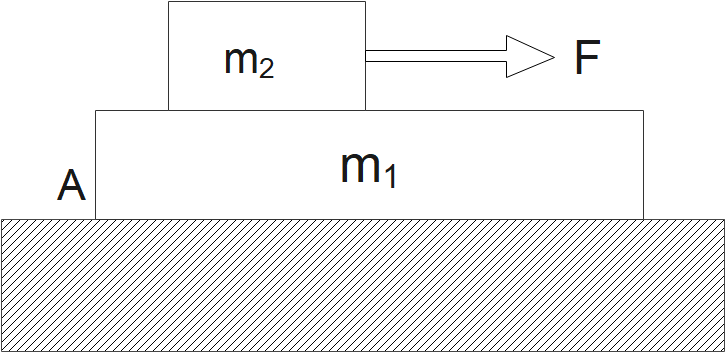
The minimum value of force to cause ${{m}_{2}}$ to move with respect to ${{m}_{1}}$ is:
1.) 72 N
2.) 42 N
3.) 35 N
4.) 45 N
Answer
 Verified
600.9k+ views
Hint: The force of friction is a contact force and it acts between two bodies or surface when there is a physical contact in between them. Force of friction or frictional force always oppose the motion irrespective of the direction. To start moving a body we need to overcome the force of friction and hence we need to apply more force than the force of friction.
Complete step-by-step solution:
In this question, we have been given that there are two blocks and the block one which is named as ${{m}_{1}}$ is lying on a frictionless floor or surface. This means that there is no force of friction acting in between the block ${{m}_{1}}$and the bottom surface.
Now, the other thing given in the question is that, there is another block which is placed above the block ${{m}_{1}}$ and the second block is named as ${{m}_{2}}$, shown in the figure.
We have been given that,
Mass of the block ${{m}_{2}}$ = 7 Kg
Mass of the block ${{m}_{1}}$ = 35 Kg
Coefficient of static friction $({{\mu }_{s}})=0.5$
Coefficient of kinetic friction $({{\mu }_{k}})=0.4$
Now, we need to find the minimum force required to move the block ${{m}_{2}}$
We know that the minimum force required to move the block is always equal or greater than the force of static friction
Force of static friction can be given as ${{F}_{s}}={{\mu }_{s}}N$
The Normal Force (N) will act in upward direction of block ${{m}_{2}}$
$N={{m}_{2}}g$
Putting the values, we get
${{F}_{s}}={{\mu }_{s}}({{m}_{2}}g)$
Putting the values, in this equation, we get
${{F}_{s}}=(0.5)[(7)(10)]$
${{F}_{s}}=35N$
Hence, we can say that the minimum force required to move the block will be 35 N
Therefore, Option (3) will be the correct answer.
Note: The minimum amount of force which is required to just move any object is always equal to the force of static friction in between the block and the surface. Static friction means the maximum force that the friction will apply in order to stop the object from moving or we can say that the minimum force that the friction will apply to keep the object at rest.
Complete step-by-step solution:
In this question, we have been given that there are two blocks and the block one which is named as ${{m}_{1}}$ is lying on a frictionless floor or surface. This means that there is no force of friction acting in between the block ${{m}_{1}}$and the bottom surface.
Now, the other thing given in the question is that, there is another block which is placed above the block ${{m}_{1}}$ and the second block is named as ${{m}_{2}}$, shown in the figure.
We have been given that,
Mass of the block ${{m}_{2}}$ = 7 Kg
Mass of the block ${{m}_{1}}$ = 35 Kg
Coefficient of static friction $({{\mu }_{s}})=0.5$
Coefficient of kinetic friction $({{\mu }_{k}})=0.4$
Now, we need to find the minimum force required to move the block ${{m}_{2}}$
We know that the minimum force required to move the block is always equal or greater than the force of static friction
Force of static friction can be given as ${{F}_{s}}={{\mu }_{s}}N$
The Normal Force (N) will act in upward direction of block ${{m}_{2}}$
$N={{m}_{2}}g$
Putting the values, we get
${{F}_{s}}={{\mu }_{s}}({{m}_{2}}g)$
Putting the values, in this equation, we get
${{F}_{s}}=(0.5)[(7)(10)]$
${{F}_{s}}=35N$
Hence, we can say that the minimum force required to move the block will be 35 N
Therefore, Option (3) will be the correct answer.
Note: The minimum amount of force which is required to just move any object is always equal to the force of static friction in between the block and the surface. Static friction means the maximum force that the friction will apply in order to stop the object from moving or we can say that the minimum force that the friction will apply to keep the object at rest.
Recently Updated Pages
If x a + bt + ct2 where x is in meters and t is in class 11 physics CBSE

A car covers the first half distance between two places class 11 physics CBSE
The resultant of two vectors overrightarrow P and overrightarrow class 11 physics CBSE
Find the value of cos 135 class 11 maths CBSE
A mass M is held in place by an applied force F and class 11 physics CBSE
A solution of glucose in water is labelled as 10 dfracwv class 11 chemistry CBSE
Trending doubts
One Metric ton is equal to kg A 10000 B 1000 C 100 class 11 physics CBSE
Find the value of the expression given below sin 30circ class 11 maths CBSE
Draw a diagram of nephron and explain its structur class 11 biology CBSE
10 examples of friction in our daily life
Proton was discovered by A Thomson B Rutherford C Chadwick class 11 chemistry CBSE
Bond order ofO2 O2+ O2 and O22 is in order A O2 langle class 11 chemistry CBSE