




Sketch the region common to the circle \[{{x}^{2}}+{{y}^{2}}=25\] and the parabola \[{{y}^{2}}=8x\]. Also find the area of the region, using integration.
Answer
 Verified
621k+ views
Hint: First, from the given expression / conditions, find 2 curves which we need to find the area. Next by using elimination method find the points of intersection of the curves. By looking at their equations, use normal co – ordinate geometry knowledge to find their shapes. Draw the curves together on a graph. By using their diagrams mark the area which is common in both of them. Now, integrate the curves to find the area and subtract the extra area to get the area which is in common to both curves.
Complete step-by-step answer:
Elimination method:
First write 2 curve equations which we need to solve to find intersection points. Then try to convert one variable in terms of another variable by using any one of the equations. Now substitute this variable in terms of others into the remaining equation. Now the remaining equation turns into an equation of one variable. By normal geometry find the variable. Using previous relations, find the other variable. Thus, you get the intersection point(s).
Given expressions in the question can be written as follows:
\[\Rightarrow {{x}^{2}}+{{y}^{2}}=25\] - (1)
\[\Rightarrow {{y}^{2}}=8x\] - (2)
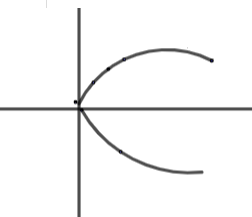
By basic knowledge of co – ordinate geometry we can say \[{{y}^{2}}=8x\] is a side ward parabola with vertex at origin (0, 0).
We know \[{{\left( x-g \right)}^{2}}+{{\left( y-h \right)}^{2}}={{a}^{2}}\] is circle with radius a, center at (g, h).
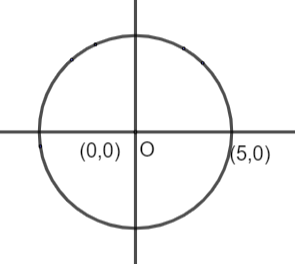
So, by this \[{{x}^{2}}+{{y}^{2}}=25\] is a circle with radius 5 and center at (0, 0).
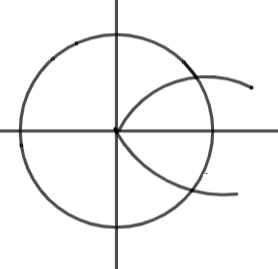
So, we can sketch them as follows: -
Curves: -
\[{{x}^{2}}+{{y}^{2}}=25\]
\[{{y}^{2}}=8x\]
Combining: -
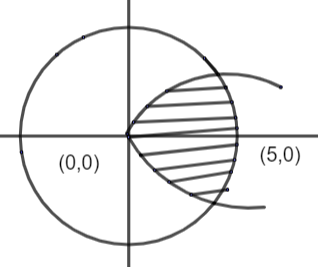
Common area shading gives,
For intersection, by substituting equation (2) in equation (1), we get:
\[\Rightarrow {{x}^{2}}+8x=25\]
By subtracting 25 on both sides, we get: \[{{x}^{2}}+8x-25=0\].
We know roots of \[a{{x}^{2}}+bx+c=0\] are given as, \[x=\dfrac{-b\pm \sqrt{{{b}^{2}}-4ac}}{2a}\].
Here, we have a = 1, b = 8, c = -25 as above.
By substituting these into x, we get,
\[\Rightarrow x=\dfrac{-8\pm \sqrt{64-4\left( -25 \right)\left( 1 \right)}}{2}\]
By simplifying the root term, we get values of x as:
\[\Rightarrow x=\dfrac{-8\pm \sqrt{164}}{2}=-4\pm \sqrt{41}\]
By removing the negative root because from equation (2) we can say x must not be negative as the square of a number cannot be negative.
\[\Rightarrow x=-4+\sqrt{41}\]
We know x – coordinates of intersection points are \[-4+\sqrt{41}\].
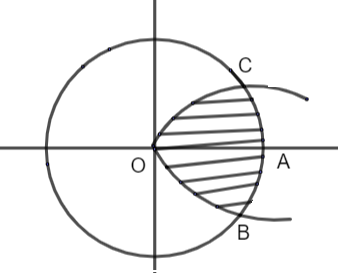
Area can be drawn as x – coordinates of C, B are \[-4+\sqrt{41}\] as required area OBAC is symmetric along x – axis we can write it as:
Area of OBAC = \[2\times \] [area of OAC with x - axis].
As, area of OAC is sum of area of parabola from O to C and area of circle from C to A it can be written as:
Area of OBAC = \[2\times \] (area of parabola from O to C + area of circle from C to A)
We know that area of curve f (x) as the x varies from \[{{x}_{1}}\] to \[{{x}_{2}}\] is given by,
\[\Rightarrow \int\limits_{{{x}_{1}}}^{{{x}_{2}}}{f\left( x \right)dx}\]
By using this we can write our area term as,
Area of OBAC = \[2\times \] \[\int\limits_{O}^{C}{\left( parabola \right)dx}+\int\limits_{C}^{A}{\left( circle \right)dx}\]
We know parabola: - \[{{y}^{2}}=8x\]
By applying square root on both sides of equation we get:
\[\Rightarrow y=\sqrt{8x}=f\left( x \right)\]
We know circle: - \[{{x}^{2}}+{{y}^{2}}=25\]
By subtracting \[{{x}^{2}}\] and applying square root on both sides, we get:
\[\Rightarrow y=\sqrt{25-{{x}^{2}}}=f\left( x \right)\]
We know O (0, 0), x – coordinate of C = \[-4+\sqrt{41}\], A = (5, 0).
By substituting these all we can write area as:
Area of OBAC = \[2\times \left( \int\limits_{0}^{-4+\sqrt{41}}{\sqrt{8x}dx}+\int\limits_{-4+\sqrt{41}}^{5}{\sqrt{25-{{x}^{2}}}dx} \right)\]
Let \[-4+\sqrt{41}\] = a. By basic integration, we know the formula:
\[\begin{align}
& \Rightarrow \int{\sqrt{kx}dx}=\sqrt{k}\dfrac{{{x}^{\dfrac{3}{2}}}}{\dfrac{3}{2}}+C \\
& \Rightarrow \int{\sqrt{{{a}^{2}}-{{x}^{2}}}dx}=\dfrac{x}{2}\sqrt{{{a}^{2}}-{{x}^{2}}}-\dfrac{{{a}^{2}}}{2}{{\sin }^{-1}}\dfrac{x}{a}+C \\
\end{align}\]
By using these are our area expression can be written as:
Area of OBAC = \[2\times \left[ \left[ \dfrac{2\sqrt{8}}{3}{{x}^{\dfrac{3}{2}}} \right]_{0}^{a}+\left[ \dfrac{x}{2}\sqrt{25-{{x}^{2}}}+\dfrac{25}{2}{{\sin }^{-1}}\dfrac{x}{a} \right]_{a}^{5} \right]\]
By substituting the limits we get expression as:
Area of OBAC = \[2\times \left[ \dfrac{4\sqrt{2}}{3}{{a}^{\dfrac{3}{2}}}-0+\dfrac{5}{2}\sqrt{25-25}+\dfrac{25}{2}{{\sin }^{-1}}\dfrac{5}{5}-\dfrac{a}{2}\sqrt{25-{{a}^{2}}}-\dfrac{25}{2}{{\sin }^{-1}}\dfrac{a}{5} \right]\]
By using \[{{\sin }^{-1}}1=\dfrac{\pi }{2}\] and then simplify more, we get:
Area of OBAC = \[2\times \left[ \dfrac{4\sqrt{2}}{3}{{a}^{\dfrac{3}{2}}}+\dfrac{25}{4}\pi -\dfrac{a}{2}\sqrt{25-{{a}^{2}}}-\dfrac{25}{2}{{\sin }^{-1}}\dfrac{a}{5} \right]\]
By multiplying 2 inside the bracket, we get area as:
Area of OBAC = \[\dfrac{8\sqrt{2}}{3}{{a}^{\dfrac{3}{2}}}-\dfrac{25\pi }{2}-a\sqrt{25-{{a}^{2}}}-25{{\sin }^{-1}}\dfrac{a}{5}\]
Therefore, area bounded by 2 curves is given by, \[\left( \dfrac{8\sqrt{2}}{3}{{a}^{\dfrac{3}{2}}}-\dfrac{25\pi }{2}-a\sqrt{25-{{a}^{2}}}-25{{\sin }^{-1}}\dfrac{a}{5} \right)\] square units. (where, a = \[-4+\sqrt{41}\]).
Note: We left the final expression in terms of a so that it looks simple. You can substitute it to solve but you will get a large expression. Don’t forget that the both x – values are the same because the distance of both intersection points from y – axis is the same. It is said by symmetry. Students generally confuse and take circles from points O to C but be careful you must take parabola from O to C.
Complete step-by-step answer:
Elimination method:
First write 2 curve equations which we need to solve to find intersection points. Then try to convert one variable in terms of another variable by using any one of the equations. Now substitute this variable in terms of others into the remaining equation. Now the remaining equation turns into an equation of one variable. By normal geometry find the variable. Using previous relations, find the other variable. Thus, you get the intersection point(s).
Given expressions in the question can be written as follows:
\[\Rightarrow {{x}^{2}}+{{y}^{2}}=25\] - (1)
\[\Rightarrow {{y}^{2}}=8x\] - (2)
By basic knowledge of co – ordinate geometry we can say \[{{y}^{2}}=8x\] is a side ward parabola with vertex at origin (0, 0).
We know \[{{\left( x-g \right)}^{2}}+{{\left( y-h \right)}^{2}}={{a}^{2}}\] is circle with radius a, center at (g, h).
So, by this \[{{x}^{2}}+{{y}^{2}}=25\] is a circle with radius 5 and center at (0, 0).
So, we can sketch them as follows: -
Curves: -
\[{{x}^{2}}+{{y}^{2}}=25\]
\[{{y}^{2}}=8x\]
Combining: -
Common area shading gives,
For intersection, by substituting equation (2) in equation (1), we get:
\[\Rightarrow {{x}^{2}}+8x=25\]
By subtracting 25 on both sides, we get: \[{{x}^{2}}+8x-25=0\].
We know roots of \[a{{x}^{2}}+bx+c=0\] are given as, \[x=\dfrac{-b\pm \sqrt{{{b}^{2}}-4ac}}{2a}\].
Here, we have a = 1, b = 8, c = -25 as above.
By substituting these into x, we get,
\[\Rightarrow x=\dfrac{-8\pm \sqrt{64-4\left( -25 \right)\left( 1 \right)}}{2}\]
By simplifying the root term, we get values of x as:
\[\Rightarrow x=\dfrac{-8\pm \sqrt{164}}{2}=-4\pm \sqrt{41}\]
By removing the negative root because from equation (2) we can say x must not be negative as the square of a number cannot be negative.
\[\Rightarrow x=-4+\sqrt{41}\]
We know x – coordinates of intersection points are \[-4+\sqrt{41}\].
Area can be drawn as x – coordinates of C, B are \[-4+\sqrt{41}\] as required area OBAC is symmetric along x – axis we can write it as:
Area of OBAC = \[2\times \] [area of OAC with x - axis].
As, area of OAC is sum of area of parabola from O to C and area of circle from C to A it can be written as:
Area of OBAC = \[2\times \] (area of parabola from O to C + area of circle from C to A)
We know that area of curve f (x) as the x varies from \[{{x}_{1}}\] to \[{{x}_{2}}\] is given by,
\[\Rightarrow \int\limits_{{{x}_{1}}}^{{{x}_{2}}}{f\left( x \right)dx}\]
By using this we can write our area term as,
Area of OBAC = \[2\times \] \[\int\limits_{O}^{C}{\left( parabola \right)dx}+\int\limits_{C}^{A}{\left( circle \right)dx}\]
We know parabola: - \[{{y}^{2}}=8x\]
By applying square root on both sides of equation we get:
\[\Rightarrow y=\sqrt{8x}=f\left( x \right)\]
We know circle: - \[{{x}^{2}}+{{y}^{2}}=25\]
By subtracting \[{{x}^{2}}\] and applying square root on both sides, we get:
\[\Rightarrow y=\sqrt{25-{{x}^{2}}}=f\left( x \right)\]
We know O (0, 0), x – coordinate of C = \[-4+\sqrt{41}\], A = (5, 0).
By substituting these all we can write area as:
Area of OBAC = \[2\times \left( \int\limits_{0}^{-4+\sqrt{41}}{\sqrt{8x}dx}+\int\limits_{-4+\sqrt{41}}^{5}{\sqrt{25-{{x}^{2}}}dx} \right)\]
Let \[-4+\sqrt{41}\] = a. By basic integration, we know the formula:
\[\begin{align}
& \Rightarrow \int{\sqrt{kx}dx}=\sqrt{k}\dfrac{{{x}^{\dfrac{3}{2}}}}{\dfrac{3}{2}}+C \\
& \Rightarrow \int{\sqrt{{{a}^{2}}-{{x}^{2}}}dx}=\dfrac{x}{2}\sqrt{{{a}^{2}}-{{x}^{2}}}-\dfrac{{{a}^{2}}}{2}{{\sin }^{-1}}\dfrac{x}{a}+C \\
\end{align}\]
By using these are our area expression can be written as:
Area of OBAC = \[2\times \left[ \left[ \dfrac{2\sqrt{8}}{3}{{x}^{\dfrac{3}{2}}} \right]_{0}^{a}+\left[ \dfrac{x}{2}\sqrt{25-{{x}^{2}}}+\dfrac{25}{2}{{\sin }^{-1}}\dfrac{x}{a} \right]_{a}^{5} \right]\]
By substituting the limits we get expression as:
Area of OBAC = \[2\times \left[ \dfrac{4\sqrt{2}}{3}{{a}^{\dfrac{3}{2}}}-0+\dfrac{5}{2}\sqrt{25-25}+\dfrac{25}{2}{{\sin }^{-1}}\dfrac{5}{5}-\dfrac{a}{2}\sqrt{25-{{a}^{2}}}-\dfrac{25}{2}{{\sin }^{-1}}\dfrac{a}{5} \right]\]
By using \[{{\sin }^{-1}}1=\dfrac{\pi }{2}\] and then simplify more, we get:
Area of OBAC = \[2\times \left[ \dfrac{4\sqrt{2}}{3}{{a}^{\dfrac{3}{2}}}+\dfrac{25}{4}\pi -\dfrac{a}{2}\sqrt{25-{{a}^{2}}}-\dfrac{25}{2}{{\sin }^{-1}}\dfrac{a}{5} \right]\]
By multiplying 2 inside the bracket, we get area as:
Area of OBAC = \[\dfrac{8\sqrt{2}}{3}{{a}^{\dfrac{3}{2}}}-\dfrac{25\pi }{2}-a\sqrt{25-{{a}^{2}}}-25{{\sin }^{-1}}\dfrac{a}{5}\]
Therefore, area bounded by 2 curves is given by, \[\left( \dfrac{8\sqrt{2}}{3}{{a}^{\dfrac{3}{2}}}-\dfrac{25\pi }{2}-a\sqrt{25-{{a}^{2}}}-25{{\sin }^{-1}}\dfrac{a}{5} \right)\] square units. (where, a = \[-4+\sqrt{41}\]).
Note: We left the final expression in terms of a so that it looks simple. You can substitute it to solve but you will get a large expression. Don’t forget that the both x – values are the same because the distance of both intersection points from y – axis is the same. It is said by symmetry. Students generally confuse and take circles from points O to C but be careful you must take parabola from O to C.
Recently Updated Pages
Master Class 12 Social Science: Engaging Questions & Answers for Success

Master Class 12 Physics: Engaging Questions & Answers for Success
Master Class 12 Maths: Engaging Questions & Answers for Success
Master Class 12 Economics: Engaging Questions & Answers for Success
Master Class 12 Chemistry: Engaging Questions & Answers for Success
Master Class 12 Business Studies: Engaging Questions & Answers for Success
Trending doubts
Which are the Top 10 Largest Countries of the World?
Draw a labelled sketch of the human eye class 12 physics CBSE
Explain the structure of megasporangium class 12 biology CBSE
What are the major means of transport Explain each class 12 social science CBSE
How many chromosomes are found in human ovum a 46 b class 12 biology CBSE
The diagram of the section of a maize grain is given class 12 biology CBSE