




How do you sketch the graph \[y={{x}^{3}}-4{{x}^{2}}\] using the first and second derivatives?
Answer
 Verified
609.9k+ views
Hint: To graph the function using its equation and derivative, we need to follow some steps. First, find the value of the roots that can be found using the equation. Differentiate the function to find the increasing and decreasing intervals for the function. Again, differentiate the function to find the points where the curve is concave upward or concave downward. Using the roots, increasing decreasing intervals, and concavity conditions, we can graph the equation.
Complete step by step solution:
The given equation is \[y={{x}^{3}}-4{{x}^{2}}\]. We know the steps to follow to graph an equation using its derivatives. First, let’s find the roots of the equation. As the constant term of the equation is zero, one root must be \[x=0\]. Factoring the equation, we get \[y=x\left( {{x}^{2}}-4x \right)\]. We can factorize this quadratic equation to further factorize equation as \[y={{x}^{2}}\left( x-4 \right)\]
We can say that this cubic equation has three roots, one of them is a repeated root. So together the given equation has two real roots.
Differentiating the equation, we get
\[\dfrac{dy}{dx}=\dfrac{d\left( {{x}^{3}}-4{{x}^{2}} \right)}{dx}=\dfrac{d\left( {{x}^{3}} \right)}{dx}-\dfrac{d\left( 4{{x}^{2}} \right)}{dx}\]
\[\dfrac{dy}{dx}=3{{x}^{2}}-8x\]
We can easily find the roots of the above quadratic equation as \[x=0\And x=\dfrac{8}{3}\].
Further factoring the derivative to get second derivative, we get \[\dfrac{{{d}^{2}}y}{d{{x}^{2}}}=6x-8\]. This linear equation has only one real root, \[x=\dfrac{8}{6}=\dfrac{4}{3}\].
Now, we have the first and second derivative of the function, and their roots. We can use this information to plot the given equation as follows,
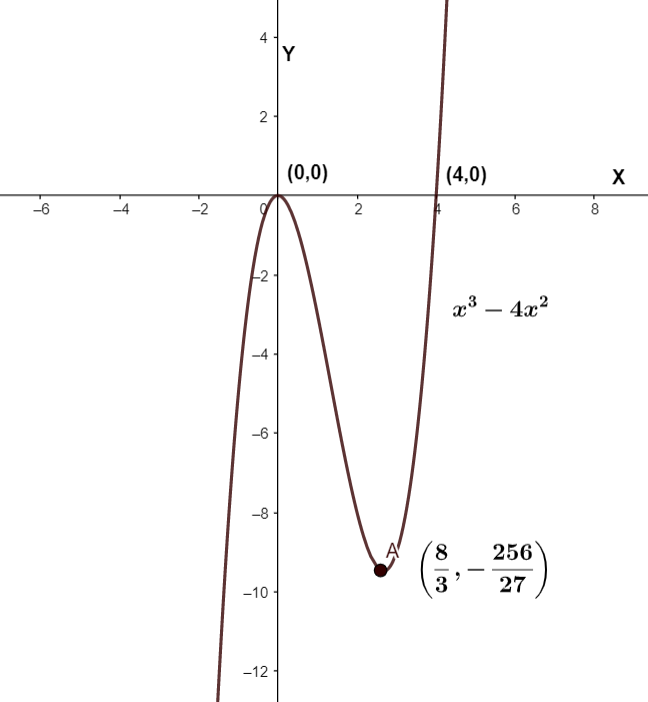
Note: The method to graph the function using their first and second derivative is very useful. We can describe the nature of a function in a range by looking at its graph. The graph of the function also tells us about the local and global maxima or minima, also the roots of the function.
Complete step by step solution:
The given equation is \[y={{x}^{3}}-4{{x}^{2}}\]. We know the steps to follow to graph an equation using its derivatives. First, let’s find the roots of the equation. As the constant term of the equation is zero, one root must be \[x=0\]. Factoring the equation, we get \[y=x\left( {{x}^{2}}-4x \right)\]. We can factorize this quadratic equation to further factorize equation as \[y={{x}^{2}}\left( x-4 \right)\]
We can say that this cubic equation has three roots, one of them is a repeated root. So together the given equation has two real roots.
Differentiating the equation, we get
\[\dfrac{dy}{dx}=\dfrac{d\left( {{x}^{3}}-4{{x}^{2}} \right)}{dx}=\dfrac{d\left( {{x}^{3}} \right)}{dx}-\dfrac{d\left( 4{{x}^{2}} \right)}{dx}\]
\[\dfrac{dy}{dx}=3{{x}^{2}}-8x\]
We can easily find the roots of the above quadratic equation as \[x=0\And x=\dfrac{8}{3}\].
Further factoring the derivative to get second derivative, we get \[\dfrac{{{d}^{2}}y}{d{{x}^{2}}}=6x-8\]. This linear equation has only one real root, \[x=\dfrac{8}{6}=\dfrac{4}{3}\].
Now, we have the first and second derivative of the function, and their roots. We can use this information to plot the given equation as follows,
Note: The method to graph the function using their first and second derivative is very useful. We can describe the nature of a function in a range by looking at its graph. The graph of the function also tells us about the local and global maxima or minima, also the roots of the function.
Recently Updated Pages
Which will be the least stable resonating structure class 11 chemistry CBSE

How many 5 digit telephone numbers can be construc-class-11-maths-CBSE
How do you find the angle of the resultant vector class 11 physics CBSE
Draw labelled diagram of the following i Gram seed class 11 biology CBSE
1 Quintal is equal to a 110 kg b 10 kg c 100kg d 1000 class 11 physics CBSE
What is the need and importance of classification class 11 biology CBSE
Trending doubts
One Metric ton is equal to kg A 10000 B 1000 C 100 class 11 physics CBSE
Find the value of the expression given below sin 30circ class 11 maths CBSE
Draw a diagram of nephron and explain its structur class 11 biology CBSE
10 examples of friction in our daily life
Proton was discovered by A Thomson B Rutherford C Chadwick class 11 chemistry CBSE
The teeth used for biting and cutting food are called class 11 biology CBSE