




How do you sketch the graph of \[y=\sin \left( \pi \right)x\] ?
Answer
 Verified
575.4k+ views
Hint: These types of problems are pretty straight forward and are very simple to solve. For plotting of graphs, we first need to be very proficient in graph theory. We need to analyse the domain and range of the given function. After that we first need to check all the possible asymptotes the graph has and then we find all the zeros or roots of the graph. From trigonometry and basics of graph theory, we know that the above function is an even function, which means that the graph is symmetric about the y-axis and further we also know that the function is a periodic function, which means that the graph repeats itself after a certain interval.
Complete step by step solution:
Now, we start off with the solution by noting down the various things in this function,
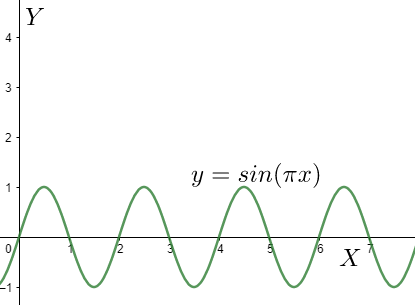
The function \[y=\sin \left( \pi \right)x\] is an even function, which means it is symmetric about the y-axis. It is also periodic, with a period of 2, which means after an interval of 2 units on the x-axis, the graph repeats itself. There are no asymptotes to this graph as there are no such points for which the function may tend to infinity. The roots of this equation are for any integers, i.e. \[x\in \mathbb{Z}\] , because at these points the value of the function becomes zero. We should also remember that for every \[x\in \left( p\pi ,q\pi \right)\] the graph is positive and concave down and for every \[x\in \left( m\pi ,n\pi \right)\] the graph is negative and concave up (where p, n are any even integers and q, m are any odd integers).
With all these knowledge, we plot the graph as,
Note: Since this problem is purely based on graphs, we need to have an in-depth knowledge of graph theory and functions. We should also have a clear cut idea of how graphs of general functions look like, failing which, we will not be able to solve the problem. We further need to have a fair conception about functions as well as their properties. For checking the curvature of the various types of graphs we need to go through differential calculus as well.
Complete step by step solution:
Now, we start off with the solution by noting down the various things in this function,
The function \[y=\sin \left( \pi \right)x\] is an even function, which means it is symmetric about the y-axis. It is also periodic, with a period of 2, which means after an interval of 2 units on the x-axis, the graph repeats itself. There are no asymptotes to this graph as there are no such points for which the function may tend to infinity. The roots of this equation are for any integers, i.e. \[x\in \mathbb{Z}\] , because at these points the value of the function becomes zero. We should also remember that for every \[x\in \left( p\pi ,q\pi \right)\] the graph is positive and concave down and for every \[x\in \left( m\pi ,n\pi \right)\] the graph is negative and concave up (where p, n are any even integers and q, m are any odd integers).
With all these knowledge, we plot the graph as,
Note: Since this problem is purely based on graphs, we need to have an in-depth knowledge of graph theory and functions. We should also have a clear cut idea of how graphs of general functions look like, failing which, we will not be able to solve the problem. We further need to have a fair conception about functions as well as their properties. For checking the curvature of the various types of graphs we need to go through differential calculus as well.
Recently Updated Pages
Master Class 11 Social Science: Engaging Questions & Answers for Success

Master Class 11 English: Engaging Questions & Answers for Success
Master Class 11 Maths: Engaging Questions & Answers for Success
Master Class 11 Chemistry: Engaging Questions & Answers for Success
Master Class 11 Biology: Engaging Questions & Answers for Success
Master Class 11 Physics: Engaging Questions & Answers for Success
Trending doubts
Differentiate between an exothermic and an endothermic class 11 chemistry CBSE
One Metric ton is equal to kg A 10000 B 1000 C 100 class 11 physics CBSE
Difference Between Prokaryotic Cells and Eukaryotic Cells
There are 720 permutations of the digits 1 2 3 4 5 class 11 maths CBSE
Draw a diagram of a plant cell and label at least eight class 11 biology CBSE
Which chemical is known as king of chemicals A H 2 class 11 chemistry CBSE