




How do you sketch the graph of $y={{\log }_{2}}x+3$ ?
Answer
 Verified
582k+ views
Hint: At first, we convert the base $2$ to some standard base like $e$ or $10$ using the formula ${{\log }_{a}}m=\dfrac{{{\log }_{b}}m}{{{\log }_{b}}a}$ . After that, we perform some basic arithmetic operations and get an equation of the form $y=m\ln x+c$ . This can easily be plotted.
Complete step by step solution:
The given equation that we have is,
$y={{\log }_{2}}x+3....\left( 1 \right)$
At first, it may seem easy to plot the graph of the equation. But, if we observe carefully, we see that the base of the logarithm used here is $2$ . The standard bases of logarithms that we can plot using a graphing calculator are $e$ and $10$ . So, we first need to change the base $2$ to some standard base to plot the graph. For this problem, we choose the base $e$ .
Now, we know the formula of logarithms that ${{\log }_{a}}m=\dfrac{{{\log }_{b}}m}{{{\log }_{b}}a}$ . In our problem, we need to transform the logarithm ${{\log }_{2}}x$ so, we have, $m=x,a=2,b=e$ . Thus putting the values in the formula, we get,
$\Rightarrow {{\log }_{2}}x=\dfrac{{{\log }_{e}}x}{{{\log }_{e}}2}$
Now, we know that logarithm with base $e$ can be written as $\ln $ instead of ${{\log }_{e}}$ . So, implementing the said in the above equation, we get,
$\Rightarrow {{\log }_{2}}x=\dfrac{\ln x}{\ln 2}$
Putting the above value of ${{\log }_{2}}x$ in equation $\left( 1 \right)$ , we get,
$\Rightarrow y=\dfrac{\ln x}{\ln 2}+3$
Multiplying both sides of the above equation by $\ln 2$ , we get,
$\Rightarrow y\times \ln 2=\left( \dfrac{\ln x}{\ln 2}+3 \right)\times \ln 2$
This upon simplification gives,
\[\Rightarrow y\times \ln 2=\left( \ln x+3\ln 2 \right)\]
The value of $\ln 2$ is $0.693$ . Putting this value in the above equation, we get,
\[\Rightarrow y\times 0.693=\ln x+3\times 0.693\]
Simplifying, we get,
\[\Rightarrow 0.693y=\ln x+2.079\]
Dividing both sides by $0.693$ ,
\[\Rightarrow y=1.443\ln x+3....\left( 2 \right)\]
This is of the standard form $y=m\ln x+c$ . Thus, the graph is,
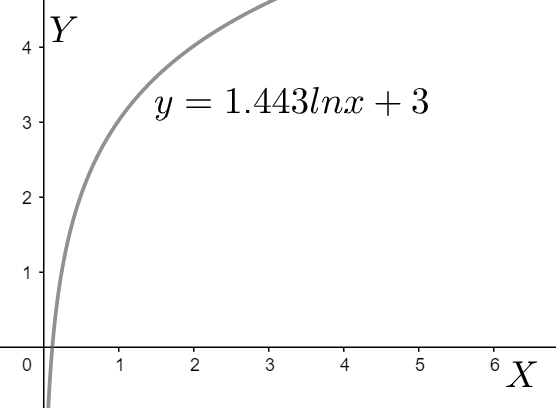
Note: We must be careful to notice the base as $2$ and should not blindly take it as $e$ or $10$ . Also, if we convert the base to $10$ or $e$ , we should stick to it. We can also solve by expression equation $\left( 2 \right)$ as $x={{e}^{\dfrac{y-3}{1.443}}}$ which will also give the same result.
Complete step by step solution:
The given equation that we have is,
$y={{\log }_{2}}x+3....\left( 1 \right)$
At first, it may seem easy to plot the graph of the equation. But, if we observe carefully, we see that the base of the logarithm used here is $2$ . The standard bases of logarithms that we can plot using a graphing calculator are $e$ and $10$ . So, we first need to change the base $2$ to some standard base to plot the graph. For this problem, we choose the base $e$ .
Now, we know the formula of logarithms that ${{\log }_{a}}m=\dfrac{{{\log }_{b}}m}{{{\log }_{b}}a}$ . In our problem, we need to transform the logarithm ${{\log }_{2}}x$ so, we have, $m=x,a=2,b=e$ . Thus putting the values in the formula, we get,
$\Rightarrow {{\log }_{2}}x=\dfrac{{{\log }_{e}}x}{{{\log }_{e}}2}$
Now, we know that logarithm with base $e$ can be written as $\ln $ instead of ${{\log }_{e}}$ . So, implementing the said in the above equation, we get,
$\Rightarrow {{\log }_{2}}x=\dfrac{\ln x}{\ln 2}$
Putting the above value of ${{\log }_{2}}x$ in equation $\left( 1 \right)$ , we get,
$\Rightarrow y=\dfrac{\ln x}{\ln 2}+3$
Multiplying both sides of the above equation by $\ln 2$ , we get,
$\Rightarrow y\times \ln 2=\left( \dfrac{\ln x}{\ln 2}+3 \right)\times \ln 2$
This upon simplification gives,
\[\Rightarrow y\times \ln 2=\left( \ln x+3\ln 2 \right)\]
The value of $\ln 2$ is $0.693$ . Putting this value in the above equation, we get,
\[\Rightarrow y\times 0.693=\ln x+3\times 0.693\]
Simplifying, we get,
\[\Rightarrow 0.693y=\ln x+2.079\]
Dividing both sides by $0.693$ ,
\[\Rightarrow y=1.443\ln x+3....\left( 2 \right)\]
This is of the standard form $y=m\ln x+c$ . Thus, the graph is,
Note: We must be careful to notice the base as $2$ and should not blindly take it as $e$ or $10$ . Also, if we convert the base to $10$ or $e$ , we should stick to it. We can also solve by expression equation $\left( 2 \right)$ as $x={{e}^{\dfrac{y-3}{1.443}}}$ which will also give the same result.
Recently Updated Pages
Master Class 12 Economics: Engaging Questions & Answers for Success

Master Class 12 English: Engaging Questions & Answers for Success
Master Class 12 Social Science: Engaging Questions & Answers for Success
Master Class 12 Maths: Engaging Questions & Answers for Success
Master Class 12 Physics: Engaging Questions & Answers for Success
Master Class 12 Business Studies: Engaging Questions & Answers for Success
Trending doubts
Which are the Top 10 Largest Countries of the World?
Draw a labelled sketch of the human eye class 12 physics CBSE
Differentiate between homogeneous and heterogeneous class 12 chemistry CBSE
Why is the cell called the structural and functional class 12 biology CBSE
Draw ray diagrams each showing i myopic eye and ii class 12 physics CBSE
Which is the correct genotypic ratio of mendel dihybrid class 12 biology CBSE