




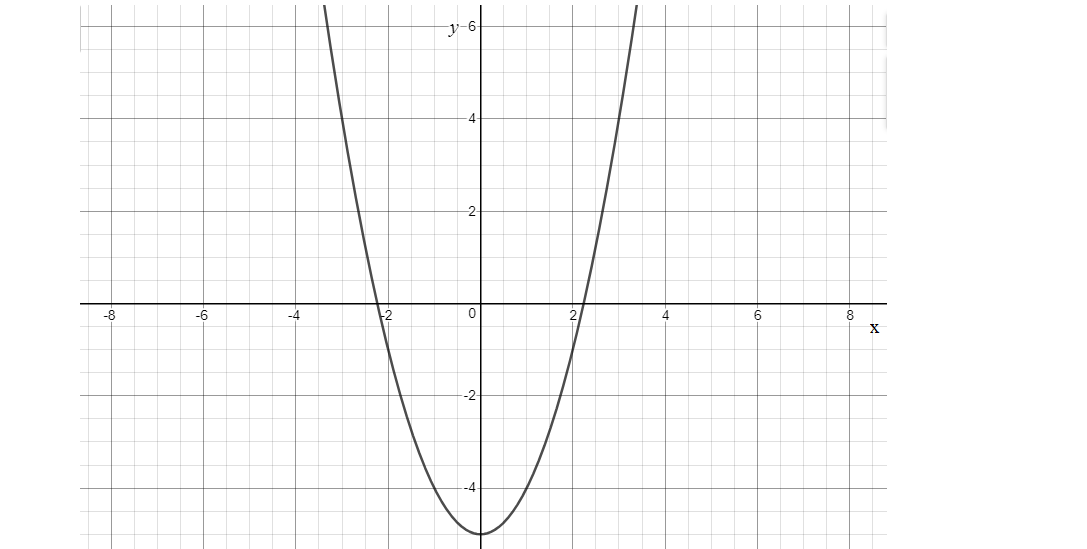
How do you sketch the graph of \[y = {x^2} - 5\] and describe the transformation?
Answer
 Verified
567.3k+ views
Hint: The basic equation of parabola is \[y = a{x^2} + c\], in which the vertical movement along a parabola’s line of symmetry is called a vertical shift. A vertical shift is when the graph literally moves vertically, up or down. As the given equation is a quadratic equation, the graph of a quadratic function is represented using a parabola. Vertex of a quadratic equation is its minimum or lowest point if the parabola is opening upwards or its highest or maximum point if it opens downwards.
Complete step by step solution:
Given,
\[y = {x^2} - 5\]
If you know the graph of a function \[y = f\left( x \right)\], then you can have four kind of transformations: the most general expression is:
\[Af\left( {wx + h} \right) + v\]
Where:
\[ \to \]\[A\]multiplies the whole function, thus stretching it vertically (expansion if \[\left| A \right| > 1\], contraction otherwise)
\[ \to \]\[w\]multiplies the input variable, thus stretching it horizontally (expansion if \[\left| w \right| > 1\], contraction otherwise)
\[ \to \]h and v are, respectively, horizontal and vertical translations.
In this given function, starting from \[f\left( x \right) = {x^2}\], you have \[A = 1\]and \[w = 1\]. Being multiplicative factors, they have non-effect.
Moreover, \[h = 0\]. Being ad additive factor, it has non-effect.
Finally, you have \[v = - 5\]. This means that, if you start from the "standard" parabola \[f\left( x \right) = {x^2}\], to describe the transformation going on the graph of \[f\left( x \right) = {x^2} - 5\] is the same, just translated 5 units down.
The graph is shown as:
Note: We know that the basic equation of parabola is \[y = a{x^2} + c\], here given function we have a=1, if a is positive the parabola opens upwards as a is greater than 1, the parabola is narrow about its line of symmetry. The movement is all based on the y-value of the graph. The y-axis of a coordinate plane is the vertical axis. When a function shifts vertically, the y-value changes. Adding or subtracting a positive constant k to \[f\left( x \right)\] is called a vertical shift. Adding or subtracting a positive constant h to x is called a horizontal shift.
Complete step by step solution:
Given,
\[y = {x^2} - 5\]
If you know the graph of a function \[y = f\left( x \right)\], then you can have four kind of transformations: the most general expression is:
\[Af\left( {wx + h} \right) + v\]
Where:
\[ \to \]\[A\]multiplies the whole function, thus stretching it vertically (expansion if \[\left| A \right| > 1\], contraction otherwise)
\[ \to \]\[w\]multiplies the input variable, thus stretching it horizontally (expansion if \[\left| w \right| > 1\], contraction otherwise)
\[ \to \]h and v are, respectively, horizontal and vertical translations.
In this given function, starting from \[f\left( x \right) = {x^2}\], you have \[A = 1\]and \[w = 1\]. Being multiplicative factors, they have non-effect.
Moreover, \[h = 0\]. Being ad additive factor, it has non-effect.
Finally, you have \[v = - 5\]. This means that, if you start from the "standard" parabola \[f\left( x \right) = {x^2}\], to describe the transformation going on the graph of \[f\left( x \right) = {x^2} - 5\] is the same, just translated 5 units down.
The graph is shown as:
Note: We know that the basic equation of parabola is \[y = a{x^2} + c\], here given function we have a=1, if a is positive the parabola opens upwards as a is greater than 1, the parabola is narrow about its line of symmetry. The movement is all based on the y-value of the graph. The y-axis of a coordinate plane is the vertical axis. When a function shifts vertically, the y-value changes. Adding or subtracting a positive constant k to \[f\left( x \right)\] is called a vertical shift. Adding or subtracting a positive constant h to x is called a horizontal shift.
Recently Updated Pages
Master Class 11 Social Science: Engaging Questions & Answers for Success

Master Class 11 Chemistry: Engaging Questions & Answers for Success
Master Class 9 General Knowledge: Engaging Questions & Answers for Success
Master Class 9 Maths: Engaging Questions & Answers for Success
Master Class 9 Science: Engaging Questions & Answers for Success
Master Class 9 English: Engaging Questions & Answers for Success
Trending doubts
One Metric ton is equal to kg A 10000 B 1000 C 100 class 11 physics CBSE
Difference Between Prokaryotic Cells and Eukaryotic Cells
Two of the body parts which do not appear in MRI are class 11 biology CBSE
1 ton equals to A 100 kg B 1000 kg C 10 kg D 10000 class 11 physics CBSE
Explain zero factorial class 11 maths CBSE
10 examples of friction in our daily life