




Sketch the graph for \[y = {\tan ^{ - 1}}\left( {\tan x} \right)\] .
Answer
 Verified
637.2k+ views
Hint: Here, we have to sketch a graph of inverse tangent function. We will plot the graph with the polar coordinates. The tangent function is a periodic function. A periodic function repeats its values at regular intervals or periods of time, for example,all the trigonometric functions repeat at intervals of \[2\pi \] radians. Periodic functions are also used in the science field to describe waves, oscillations, and other phenomena that exhibit periodicity.
Complete step-by-step answer:
We have to sketch a graph for \[y = {\tan ^{ - 1}}\left( {\tan x} \right)\].
We know that \[\tan x\] is periodic at period \[\pi \], \[\tan x\] lies between 0 to \[\infty \].
Therefore, \[x\] lies between \[ - \dfrac{\pi }{2}\] to \[\dfrac{\pi }{2}\].
The curve has been defined well for \[2n\pi \] but is not well defined for \[\left( {2n + 1} \right)\pi \] .
Therefore, the graph is plotted as \[\tan x\] tends to \[\infty \].
Thus the graph of \[y = {\tan ^{ - 1}}\left( {\tan x} \right)\] is shown as below:
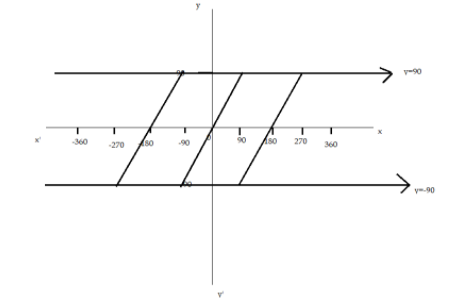
Note: A common mistake made since \[{\tan ^{ - 1}}\] and \[\tan \] are reciprocal functions, we tend to cancel each other and make that \[y = x\] . To sketch the graphs of the trigonometric functions we need to know the period, phase, amplitude, maximum and minimum turning points.
These graphs are used in many areas of engineering and science. Few of the examples are the growth of plants and animals, waves, etc. The tangent will be zero whenever the numerator (the sine) is equal to zero. This happens at \[0,\pi ,2\pi \] etc, and at\[ - \pi , - 2\pi \] etc.
Let's just consider the region from \[ - \pi \] to \[2\pi \] , for now. So the tangent will be zero (that is, it will cross the x-axis) at \[ - \pi ,0,\pi ,2\pi \] .The tangent will be undefined whenever its denominator (the cosine) is zero.
Complete step-by-step answer:
We have to sketch a graph for \[y = {\tan ^{ - 1}}\left( {\tan x} \right)\].
We know that \[\tan x\] is periodic at period \[\pi \], \[\tan x\] lies between 0 to \[\infty \].
Therefore, \[x\] lies between \[ - \dfrac{\pi }{2}\] to \[\dfrac{\pi }{2}\].
The curve has been defined well for \[2n\pi \] but is not well defined for \[\left( {2n + 1} \right)\pi \] .
Therefore, the graph is plotted as \[\tan x\] tends to \[\infty \].
Thus the graph of \[y = {\tan ^{ - 1}}\left( {\tan x} \right)\] is shown as below:
Note: A common mistake made since \[{\tan ^{ - 1}}\] and \[\tan \] are reciprocal functions, we tend to cancel each other and make that \[y = x\] . To sketch the graphs of the trigonometric functions we need to know the period, phase, amplitude, maximum and minimum turning points.
These graphs are used in many areas of engineering and science. Few of the examples are the growth of plants and animals, waves, etc. The tangent will be zero whenever the numerator (the sine) is equal to zero. This happens at \[0,\pi ,2\pi \] etc, and at\[ - \pi , - 2\pi \] etc.
Let's just consider the region from \[ - \pi \] to \[2\pi \] , for now. So the tangent will be zero (that is, it will cross the x-axis) at \[ - \pi ,0,\pi ,2\pi \] .The tangent will be undefined whenever its denominator (the cosine) is zero.
Recently Updated Pages
If x a + bt + ct2 where x is in meters and t is in class 11 physics CBSE

A car covers the first half distance between two places class 11 physics CBSE
The resultant of two vectors overrightarrow P and overrightarrow class 11 physics CBSE
Find the value of cos 135 class 11 maths CBSE
A mass M is held in place by an applied force F and class 11 physics CBSE
A solution of glucose in water is labelled as 10 dfracwv class 11 chemistry CBSE
Trending doubts
One Metric ton is equal to kg A 10000 B 1000 C 100 class 11 physics CBSE
Find the value of the expression given below sin 30circ class 11 maths CBSE
What do you mean by retardation What is its SI uni class 11 physics CBSE
Draw a diagram of nephron and explain its structur class 11 biology CBSE
10 examples of friction in our daily life
Difference between physical and chemical change class 11 chemistry CBSE