




Sketch and label T.S. of a leaf showing Kranz anatomy.
Answer
 Verified
600.9k+ views
Hint: Kranz anatomy is shown by C4plants. The leaves have vascular bundles that are surrounded by bundle sheath cells and mesophyll cells. Bundle sheath cells are thick-walled cylindrical cells. Chloroplasts of bundle sheath cells are bigger and without grana while chloroplasts of mesophyll cells are tinier and possess grana.
Complete answer:
The especially large cells around the vascular bundles of the C4 plants are named bundle sheath cells and the leaves have such anatomy meant to have Kranz anatomy. Kranz formulates a wreath and is a reflection of the structure of cells. The bundle sheath cells may create various layers around the vascular bundles depicted by a large number of chloroplasts, thick walls for gaseous swap, and no intercellular spaces. For example, maize.
Key Concepts
C4 photosynthesis is a carbon concentration mechanism utilized by some plants to enhance the efficiency of photosynthetic carbon fixation.
1.C4 photosynthesis encompasses modified leaf morphology, separation of carboxylation and decarboxylation/refixation steps of carbon assimilation, and specialized patterns of cell‐type‐specific gene expression.
2.The leaves of most C4 plants possess Kranz‐type anatomy consisting of bundle sheath and mesophyll cells. A further rare form of this pathway, called single‐cell C4 uses partitioning of dimorphic chloroplasts to distinct numerous sets of reactions within a single leaf cell type.
3.In C4 leaves, Rubisco is localized only within internalized bundle sheath cells, or internalized chloroplasts, to protect from atmospheric O2 and limit the oxygenase activity of this enzyme. 2.The first carbon assimilation enzyme in these leaves is PEPCase, which integrates CO2 but not O2.
4.Reactions of the C4 pathway work as a pump to concentrate CO2 in the vicinity of the internalized Rubisco enzyme. These decrease or abolish photorespiration, thereby improving photosynthetic efficiency.
5.C4 plants are more beneficial than C3 plants under arid conditions, comprising high temperatures and water stress. C4 plants show increased efficiency of water and nitrogen use, allowing them to outcompete C4 plants in marginal environments.
6.C4 characteristics into C3 species have the potential to enhance photosynthetic efficiency in crop plants employed for food and biofuel.
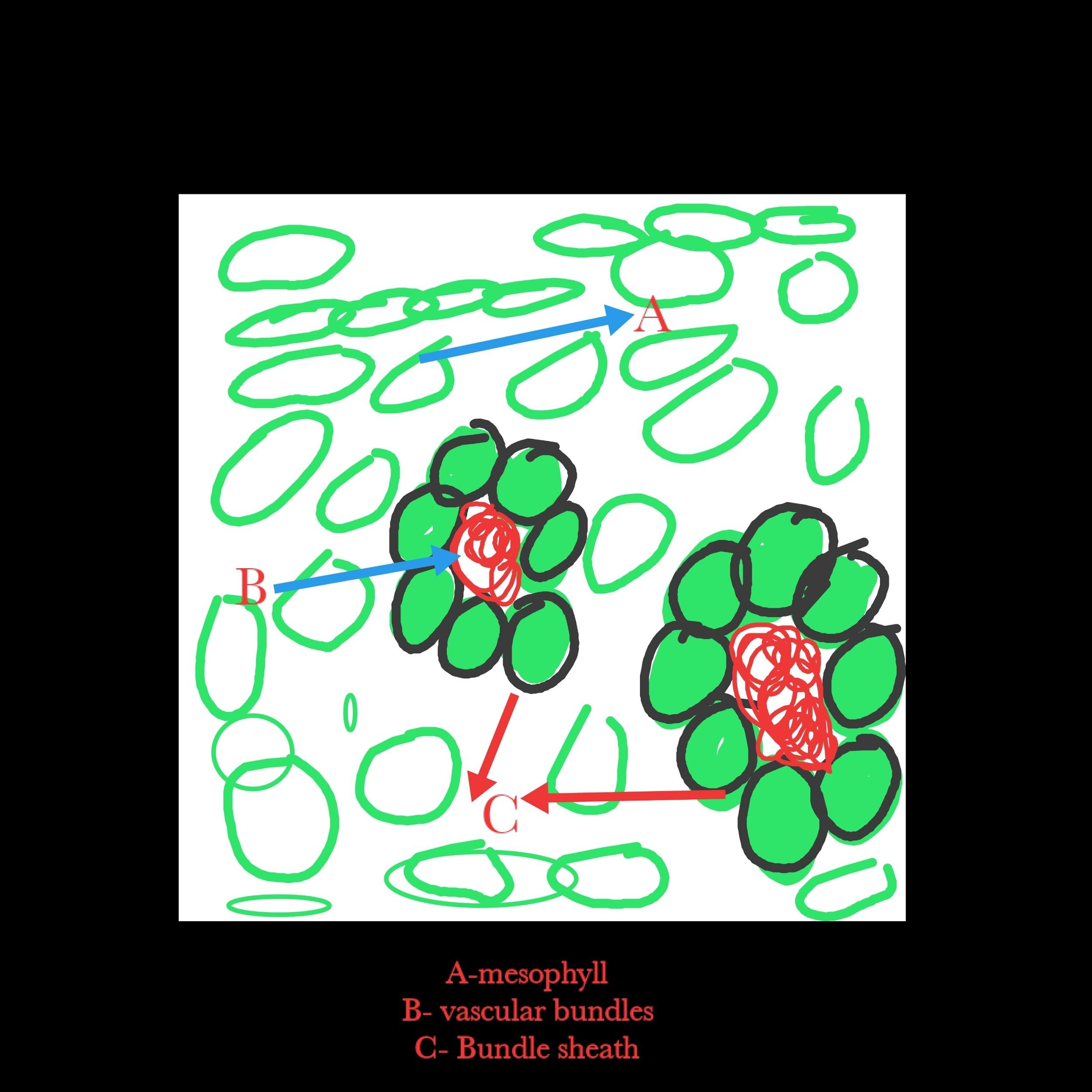
Self made sketch
Note: The word Kranz means “wreath” or “ring”. Kranz anatomy is a specialized pattern in C4 Plants where the mesophyll cells are piled around the bundle-sheath cells in a ring-like manner. The abundance of chloroplasts in the bundle-sheath cells is surplus than that in the mesophyll cells.
Complete answer:
The especially large cells around the vascular bundles of the C4 plants are named bundle sheath cells and the leaves have such anatomy meant to have Kranz anatomy. Kranz formulates a wreath and is a reflection of the structure of cells. The bundle sheath cells may create various layers around the vascular bundles depicted by a large number of chloroplasts, thick walls for gaseous swap, and no intercellular spaces. For example, maize.
Key Concepts
C4 photosynthesis is a carbon concentration mechanism utilized by some plants to enhance the efficiency of photosynthetic carbon fixation.
1.C4 photosynthesis encompasses modified leaf morphology, separation of carboxylation and decarboxylation/refixation steps of carbon assimilation, and specialized patterns of cell‐type‐specific gene expression.
2.The leaves of most C4 plants possess Kranz‐type anatomy consisting of bundle sheath and mesophyll cells. A further rare form of this pathway, called single‐cell C4 uses partitioning of dimorphic chloroplasts to distinct numerous sets of reactions within a single leaf cell type.
3.In C4 leaves, Rubisco is localized only within internalized bundle sheath cells, or internalized chloroplasts, to protect from atmospheric O2 and limit the oxygenase activity of this enzyme. 2.The first carbon assimilation enzyme in these leaves is PEPCase, which integrates CO2 but not O2.
4.Reactions of the C4 pathway work as a pump to concentrate CO2 in the vicinity of the internalized Rubisco enzyme. These decrease or abolish photorespiration, thereby improving photosynthetic efficiency.
5.C4 plants are more beneficial than C3 plants under arid conditions, comprising high temperatures and water stress. C4 plants show increased efficiency of water and nitrogen use, allowing them to outcompete C4 plants in marginal environments.
6.C4 characteristics into C3 species have the potential to enhance photosynthetic efficiency in crop plants employed for food and biofuel.
Self made sketch
Note: The word Kranz means “wreath” or “ring”. Kranz anatomy is a specialized pattern in C4 Plants where the mesophyll cells are piled around the bundle-sheath cells in a ring-like manner. The abundance of chloroplasts in the bundle-sheath cells is surplus than that in the mesophyll cells.
Recently Updated Pages
Master Class 11 Social Science: Engaging Questions & Answers for Success

Master Class 11 English: Engaging Questions & Answers for Success
Master Class 11 Maths: Engaging Questions & Answers for Success
Master Class 11 Chemistry: Engaging Questions & Answers for Success
Master Class 11 Biology: Engaging Questions & Answers for Success
Master Class 11 Physics: Engaging Questions & Answers for Success
Trending doubts
One Metric ton is equal to kg A 10000 B 1000 C 100 class 11 physics CBSE
Difference Between Prokaryotic Cells and Eukaryotic Cells
There are 720 permutations of the digits 1 2 3 4 5 class 11 maths CBSE
Draw a diagram of a plant cell and label at least eight class 11 biology CBSE
Two of the body parts which do not appear in MRI are class 11 biology CBSE
Which gas is abundant in air class 11 chemistry CBSE