




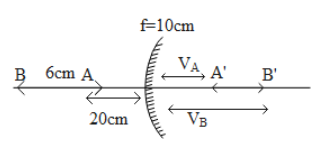
Size of image ?
${{V}_{A}}-{{V}_{B}}=?$
Answer
 Verified
573.9k+ views
Hint: Apply the mirror equation and by rearranging the equation we will get the equation for v. Then by substituting the values of u and f we will get an image at A. Similarly find the image for point B. Then find the difference between those two images. Thus we will have the answer. Focal length of a convex lens is always positive and object distance is usually negative.
Complete answer:
For point B
F= 10cm
Object distance AB = 6cm
U = -26cm
Now,
$\dfrac{1}{v}+\dfrac{1}{u}=\dfrac{1}{f}$
By rearranging the equation we get,
$\dfrac{1}{v}=\dfrac{1}{f}-\dfrac{1}{u}$
Substituting the values we get,
$\dfrac{1}{v}=\dfrac{1}{10}-\dfrac{-1}{26}$
$\Rightarrow \dfrac{1}{v}=\dfrac{1}{10}+\dfrac{1}{26}$
$\begin{align}
& \Rightarrow \dfrac{1}{v}=\dfrac{26+10}{260} \\
& \Rightarrow \dfrac{1}{v}=\dfrac{36}{260} \\
& \Rightarrow v=\dfrac{260}{36} \\
& \Rightarrow v=7.22cm \\
\end{align}$
For point A
F= 10cm
U=-20cm
Now,
$\dfrac{1}{v}+\dfrac{1}{u}=\dfrac{1}{f}$
By rearranging the equation we get,
$\dfrac{1}{v}=\dfrac{1}{f}-\dfrac{1}{u}$
Substituting the values we get,
$\begin{align}
& \dfrac{1}{v}=\dfrac{1}{10}-\dfrac{-1}{20} \\
& \Rightarrow \dfrac{1}{v}=\dfrac{1}{10}+\dfrac{1}{20} \\
& \Rightarrow \dfrac{1}{v}=\dfrac{20+10}{200} \\
& \Rightarrow \dfrac{1}{v}=\dfrac{30}{200} \\
& \Rightarrow v=\dfrac{200}{30} \\
& \Rightarrow v=6.67cm \\
\end{align}$
Size of image AB $=7.22-6.67=0.55cm$
Additional information:
A convex mirror or diverging mirror is a curved mirror in which the reflective surface bulges towards the light source Virtual images are always formed by convex mirrors. Plane mirrors and convex mirrors will always produce an upright image if the object is located in front of the focal point.
If the parallel light rays are incident on a convex lens then, making some angles with the principal axis, the reflected rays would converge from a point in a plane through F normal to the principal axis. This is the focal plane of the mirror. The distance between the focus and the pole P is called the focal length of the mirror. But in case of a concave lens the incident beam diverges from the surface of the concave lens.
Note:
The convex lens always converges from a point from the plane. This is known as the focal plane of the mirror. Therefore focal length of a convex lens is generally positive. But in case of a concave lens the incident beam diverges from the surface of the concave lens. Hence, the focal length of a concave mirror is always negative.
Complete answer:
For point B
F= 10cm
Object distance AB = 6cm
U = -26cm
Now,
$\dfrac{1}{v}+\dfrac{1}{u}=\dfrac{1}{f}$
By rearranging the equation we get,
$\dfrac{1}{v}=\dfrac{1}{f}-\dfrac{1}{u}$
Substituting the values we get,
$\dfrac{1}{v}=\dfrac{1}{10}-\dfrac{-1}{26}$
$\Rightarrow \dfrac{1}{v}=\dfrac{1}{10}+\dfrac{1}{26}$
$\begin{align}
& \Rightarrow \dfrac{1}{v}=\dfrac{26+10}{260} \\
& \Rightarrow \dfrac{1}{v}=\dfrac{36}{260} \\
& \Rightarrow v=\dfrac{260}{36} \\
& \Rightarrow v=7.22cm \\
\end{align}$
For point A
F= 10cm
U=-20cm
Now,
$\dfrac{1}{v}+\dfrac{1}{u}=\dfrac{1}{f}$
By rearranging the equation we get,
$\dfrac{1}{v}=\dfrac{1}{f}-\dfrac{1}{u}$
Substituting the values we get,
$\begin{align}
& \dfrac{1}{v}=\dfrac{1}{10}-\dfrac{-1}{20} \\
& \Rightarrow \dfrac{1}{v}=\dfrac{1}{10}+\dfrac{1}{20} \\
& \Rightarrow \dfrac{1}{v}=\dfrac{20+10}{200} \\
& \Rightarrow \dfrac{1}{v}=\dfrac{30}{200} \\
& \Rightarrow v=\dfrac{200}{30} \\
& \Rightarrow v=6.67cm \\
\end{align}$
Size of image AB $=7.22-6.67=0.55cm$
Additional information:
A convex mirror or diverging mirror is a curved mirror in which the reflective surface bulges towards the light source Virtual images are always formed by convex mirrors. Plane mirrors and convex mirrors will always produce an upright image if the object is located in front of the focal point.
If the parallel light rays are incident on a convex lens then, making some angles with the principal axis, the reflected rays would converge from a point in a plane through F normal to the principal axis. This is the focal plane of the mirror. The distance between the focus and the pole P is called the focal length of the mirror. But in case of a concave lens the incident beam diverges from the surface of the concave lens.
Note:
The convex lens always converges from a point from the plane. This is known as the focal plane of the mirror. Therefore focal length of a convex lens is generally positive. But in case of a concave lens the incident beam diverges from the surface of the concave lens. Hence, the focal length of a concave mirror is always negative.
Recently Updated Pages
Master Class 12 Economics: Engaging Questions & Answers for Success

Master Class 12 Physics: Engaging Questions & Answers for Success
Master Class 12 English: Engaging Questions & Answers for Success
Master Class 12 Social Science: Engaging Questions & Answers for Success
Master Class 12 Maths: Engaging Questions & Answers for Success
Master Class 12 Business Studies: Engaging Questions & Answers for Success
Trending doubts
Which are the Top 10 Largest Countries of the World?
What are the major means of transport Explain each class 12 social science CBSE
Draw a labelled sketch of the human eye class 12 physics CBSE
Differentiate between insitu conservation and exsitu class 12 biology CBSE
Draw a neat and well labeled diagram of TS of ovary class 12 biology CBSE
Differentiate between homogeneous and heterogeneous class 12 chemistry CBSE