




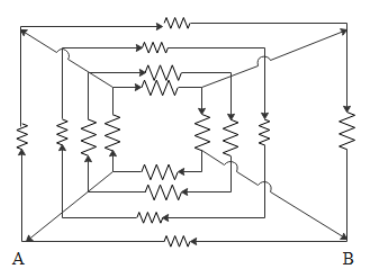
Sixteen resistors each of resistance 16$\Omega $ are connected in circuit as shown. Calculate the net resistance between A and B.
Answer
 Verified
574.2k+ views
Hint: Here the four resistors R on each side are in parallel. Thus first calculate the equivalent resistance for each side. Then re arrange the diagram using the calculated value. Then we will get a series connection across the resistor AB. Then the series resistor will be parallel to the resistor across AB. Hence, the resultant value of those two parallel resistors will be the net resistance across AB. Hence while calculating the equivalent resistance, first note whether it is connected in series or parallel. Then use the suitable equation of the given circuit.
Complete answer:
Here all resistance is $R=16\Omega $ on each parallel side.
Thus equivalent resistance of each side is,
Four resistors are connected parallel on each side.
Hence,
$\dfrac{1}{{{R}_{eq}}}=\dfrac{1}{R}+\dfrac{1}{R}+\dfrac{1}{R}+\dfrac{1}{R}$
$\begin{align}
& \Rightarrow \dfrac{1}{{{R}_{eq}}}=\dfrac{4}{R} \\
& \Rightarrow {{R}_{eq}}=\dfrac{R}{4} \\
\end{align}$
This is the equivalent resistance for one side. Since the equivalent resistance on four sides are equal, the equivalent resistance on four sides are equal to $\dfrac{R}{4}$.
Thus the resultant circuit becomes,
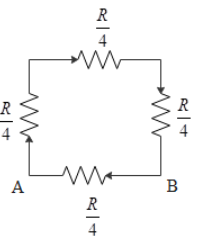
Here the three resistors are connected in series to the resistor connected between AB.
Hence the resistance for the series connection is,
$\begin{align}
& {{R}^{'}}=\dfrac{R}{4}+\dfrac{R}{4}+\dfrac{R}{4} \\
& \Rightarrow {{R}^{'}}=\dfrac{3R}{4} \\
\end{align}$
Then the resistors ${{R}^{'}}$ and ${{R}_{eq}}$ becomes parallel.
Thus the resultant circuit becomes,

Therefore the net resistance between A and B is,
$\dfrac{1}{{{R}_{AB}}}=\dfrac{1}{\left( \dfrac{3R}{4} \right)}+\dfrac{1}{\left( \dfrac{R}{4} \right)}$
$\begin{align}
& \Rightarrow \dfrac{1}{{{R}_{AB}}}=\dfrac{4}{3R}+\dfrac{4}{R} \\
& \Rightarrow \dfrac{1}{{{R}_{AB}}}=\dfrac{4}{3R}+\dfrac{4\times 3}{3R} \\
& \Rightarrow \dfrac{1}{{{R}_{AB}}}=\dfrac{16}{3R} \\
& \Rightarrow {{R}_{AB}}=\dfrac{3R}{16} \\
\end{align}$
Given that $R=16\Omega $
Hence,
$\begin{align}
& {{R}_{AB}}=\dfrac{3\times 16}{16} \\
& \Rightarrow {{R}_{AB}}=3\Omega \\
\end{align}$
Note:
The net resistance in a series connection is the sum of resistances connected in the given circuit. Whereas, the net resistance in a parallel connection, that is the reciprocal of equivalent resistance is the sum of reciprocals of the individual resistances. Hence while calculating the equivalent resistance, first note whether it is connected in series or parallel. Then use the suitable equation of the given circuit.
Complete answer:
Here all resistance is $R=16\Omega $ on each parallel side.
Thus equivalent resistance of each side is,
Four resistors are connected parallel on each side.
Hence,
$\dfrac{1}{{{R}_{eq}}}=\dfrac{1}{R}+\dfrac{1}{R}+\dfrac{1}{R}+\dfrac{1}{R}$
$\begin{align}
& \Rightarrow \dfrac{1}{{{R}_{eq}}}=\dfrac{4}{R} \\
& \Rightarrow {{R}_{eq}}=\dfrac{R}{4} \\
\end{align}$
This is the equivalent resistance for one side. Since the equivalent resistance on four sides are equal, the equivalent resistance on four sides are equal to $\dfrac{R}{4}$.
Thus the resultant circuit becomes,
Here the three resistors are connected in series to the resistor connected between AB.
Hence the resistance for the series connection is,
$\begin{align}
& {{R}^{'}}=\dfrac{R}{4}+\dfrac{R}{4}+\dfrac{R}{4} \\
& \Rightarrow {{R}^{'}}=\dfrac{3R}{4} \\
\end{align}$
Then the resistors ${{R}^{'}}$ and ${{R}_{eq}}$ becomes parallel.
Thus the resultant circuit becomes,
Therefore the net resistance between A and B is,
$\dfrac{1}{{{R}_{AB}}}=\dfrac{1}{\left( \dfrac{3R}{4} \right)}+\dfrac{1}{\left( \dfrac{R}{4} \right)}$
$\begin{align}
& \Rightarrow \dfrac{1}{{{R}_{AB}}}=\dfrac{4}{3R}+\dfrac{4}{R} \\
& \Rightarrow \dfrac{1}{{{R}_{AB}}}=\dfrac{4}{3R}+\dfrac{4\times 3}{3R} \\
& \Rightarrow \dfrac{1}{{{R}_{AB}}}=\dfrac{16}{3R} \\
& \Rightarrow {{R}_{AB}}=\dfrac{3R}{16} \\
\end{align}$
Given that $R=16\Omega $
Hence,
$\begin{align}
& {{R}_{AB}}=\dfrac{3\times 16}{16} \\
& \Rightarrow {{R}_{AB}}=3\Omega \\
\end{align}$
Note:
The net resistance in a series connection is the sum of resistances connected in the given circuit. Whereas, the net resistance in a parallel connection, that is the reciprocal of equivalent resistance is the sum of reciprocals of the individual resistances. Hence while calculating the equivalent resistance, first note whether it is connected in series or parallel. Then use the suitable equation of the given circuit.
Recently Updated Pages
Master Class 11 Computer Science: Engaging Questions & Answers for Success

Master Class 11 Business Studies: Engaging Questions & Answers for Success
Master Class 11 Economics: Engaging Questions & Answers for Success
Master Class 11 English: Engaging Questions & Answers for Success
Master Class 11 Maths: Engaging Questions & Answers for Success
Master Class 11 Biology: Engaging Questions & Answers for Success
Trending doubts
One Metric ton is equal to kg A 10000 B 1000 C 100 class 11 physics CBSE
There are 720 permutations of the digits 1 2 3 4 5 class 11 maths CBSE
Discuss the various forms of bacteria class 11 biology CBSE
Draw a diagram of a plant cell and label at least eight class 11 biology CBSE
State the laws of reflection of light
Explain zero factorial class 11 maths CBSE