




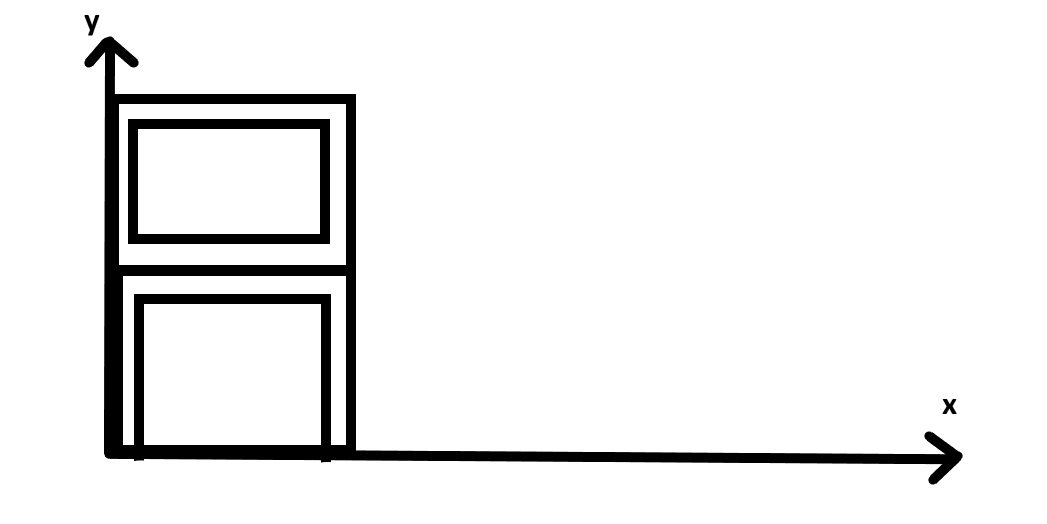
Six rods of the same mass m and length l are arranged as shown in figure. Calculate the coordinate of the centre of mass of system:
$ A.(\dfrac{L}{2},\dfrac{{7L}}{6}) \\
B.(\dfrac{L}{2},L) \\
C.(\dfrac{L}{2},\dfrac{{4L}}{3}) \\
D.(\dfrac{L}{2},\dfrac{{5L}}{3}) \\ $
Answer
 Verified
563.1k+ views
Hint : In order to solve this question first we have to find the midpoint of the rods. After this we have to locate the coordinate of these points. After locating these points we find for the X CM and Y CM respectively by the formula.
Complete Step By Step Answer:
As we know that the centre of mass of anybody lies on its centre, here in the rod centre of mass lies a rod of length l lying with a distance of $ \dfrac{l}{2} $ from the corner.
Now we are going to write the coordinate of each point in the figure.
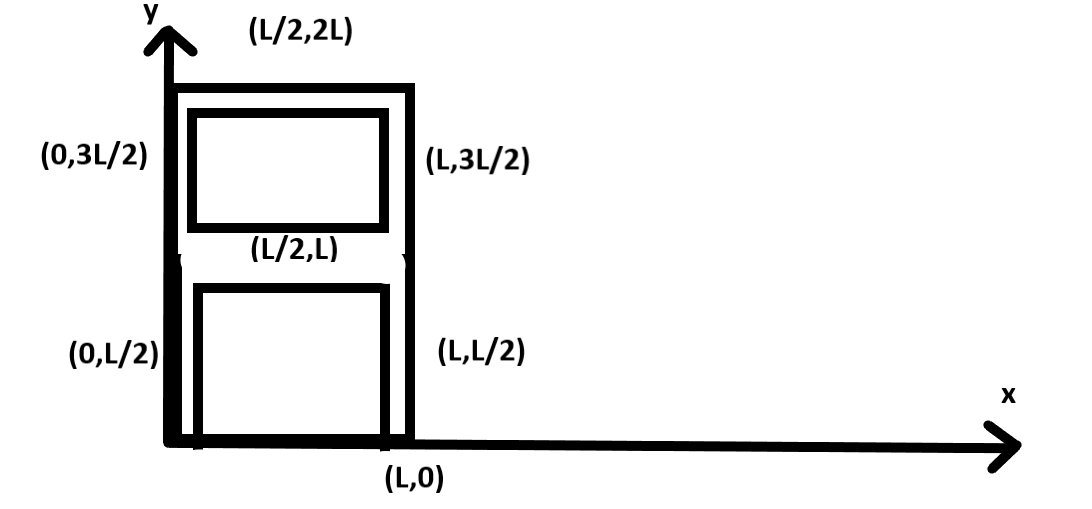
Here $ {X_{cm}} $ is the mean of the centre of mass of all rods. So;
$ {X_{cm}} = \dfrac{{m{x_1} + m{x_2} + m{x_3} + m{x_4} + m{x_5} + m{x_6}}}{{6m}} $
Taking common m we got;
$ {X_{cm}} = \dfrac{{{x_1} + {x_2} + {x_3} + {x_4} + {x_5} + {x_6}}}{6} \\
\\ $
Putting the values of x coordinate from the figure,
$ {X_{cm}} = \dfrac{{0 + 0 + \dfrac{L}{2} + \dfrac{L}{2} + L + L}}{6} \\
= \dfrac{{3L}}{6} \\
= \dfrac{L}{2} \\ $
Calculating the $ {Y_{cm}} $ of the rod,
$ {Y_{cm}} = \dfrac{{m{y_1} + m{y_2} + m{y_3} + m{y_4} + m{y_5} + m{y_6}}}{{6m}} $
Taking common m we got;
$ {Y_{cm}} = \dfrac{{{y_1} + {y_2} + {y_3} + {y_4} + {y_5} + {y_6}}}{6} $
Putting the values of y coordinate from the figure,
$ {X_{cm}} = \dfrac{{\dfrac{L}{2} + \dfrac{{3L}}{2} + L + 2L + \dfrac{L}{2} + \dfrac{{3L}}{2}}}{6} \\
= \dfrac{{7L}}{6} \\ $
Then the coordinate for the system is $ (\dfrac{L}{2},\dfrac{{7L}}{6}) $ .
Hence option A is the correct answer.
Note :
The centre of mass is a position defined relative to an object or at the given system of an object. If we are talking about the solid objects having uniform density, the centre of mass is called the centroid. It is the point where any uniform force on the objects act.
It can be calculated by taking the masses we are putting to find the centre of mass between multiplying them by their position.
Complete Step By Step Answer:
As we know that the centre of mass of anybody lies on its centre, here in the rod centre of mass lies a rod of length l lying with a distance of $ \dfrac{l}{2} $ from the corner.
Now we are going to write the coordinate of each point in the figure.
Here $ {X_{cm}} $ is the mean of the centre of mass of all rods. So;
$ {X_{cm}} = \dfrac{{m{x_1} + m{x_2} + m{x_3} + m{x_4} + m{x_5} + m{x_6}}}{{6m}} $
Taking common m we got;
$ {X_{cm}} = \dfrac{{{x_1} + {x_2} + {x_3} + {x_4} + {x_5} + {x_6}}}{6} \\
\\ $
Putting the values of x coordinate from the figure,
$ {X_{cm}} = \dfrac{{0 + 0 + \dfrac{L}{2} + \dfrac{L}{2} + L + L}}{6} \\
= \dfrac{{3L}}{6} \\
= \dfrac{L}{2} \\ $
Calculating the $ {Y_{cm}} $ of the rod,
$ {Y_{cm}} = \dfrac{{m{y_1} + m{y_2} + m{y_3} + m{y_4} + m{y_5} + m{y_6}}}{{6m}} $
Taking common m we got;
$ {Y_{cm}} = \dfrac{{{y_1} + {y_2} + {y_3} + {y_4} + {y_5} + {y_6}}}{6} $
Putting the values of y coordinate from the figure,
$ {X_{cm}} = \dfrac{{\dfrac{L}{2} + \dfrac{{3L}}{2} + L + 2L + \dfrac{L}{2} + \dfrac{{3L}}{2}}}{6} \\
= \dfrac{{7L}}{6} \\ $
Then the coordinate for the system is $ (\dfrac{L}{2},\dfrac{{7L}}{6}) $ .
Hence option A is the correct answer.
Note :
The centre of mass is a position defined relative to an object or at the given system of an object. If we are talking about the solid objects having uniform density, the centre of mass is called the centroid. It is the point where any uniform force on the objects act.
It can be calculated by taking the masses we are putting to find the centre of mass between multiplying them by their position.
Recently Updated Pages
Master Class 11 Social Science: Engaging Questions & Answers for Success

Master Class 11 English: Engaging Questions & Answers for Success
Master Class 11 Maths: Engaging Questions & Answers for Success
Master Class 11 Chemistry: Engaging Questions & Answers for Success
Master Class 11 Biology: Engaging Questions & Answers for Success
Master Class 11 Physics: Engaging Questions & Answers for Success
Trending doubts
Differentiate between an exothermic and an endothermic class 11 chemistry CBSE
One Metric ton is equal to kg A 10000 B 1000 C 100 class 11 physics CBSE
Difference Between Prokaryotic Cells and Eukaryotic Cells
There are 720 permutations of the digits 1 2 3 4 5 class 11 maths CBSE
Two of the body parts which do not appear in MRI are class 11 biology CBSE
Which gas is abundant in air class 11 chemistry CBSE