




What is the sine, cosine and tangent of 270 degrees?
Answer
 Verified
575.7k+ views
Hint: Express ${{270}^{\circ }}\text{ into }\left( {{270}^{\circ }}+\theta \right)$ . Then we should use the following two identities for sin and cosine respectively, $\sin \left( {{270}^{\circ }}+\theta \right)=-\cos \theta \text{ and }\cos \left( {{270}^{\circ }}+\theta \right)=\sin \theta $ . To find the tangent, we must remember that $\tan \theta =\dfrac{\sin \theta }{\cos \theta }$ . In case the value of tangent is undefined, verify using the graph of $y=\tan \theta \text{ at }\theta ={{270}^{\circ }}$ to check whether it is $+\infty \text{ or }-\infty $ .
Complete step by step solution:
For sine of 270 degrees:
We can write ${{270}^{\circ }}\text{ as }\left( {{270}^{\circ }}+{{0}^{\circ }} \right)$ . Or, in equation form
$\sin \left( {{270}^{\circ }} \right)=\sin \left( {{270}^{\circ }}+{{0}^{\circ }} \right)...\left( i \right)$
We know the trigonometric identity $\sin \left( {{270}^{\circ }}+\theta \right)=-\cos \theta $.
If we put $\theta ={{0}^{\circ }}$ and keep in mind the fact that $\cos {{0}^{\circ }}=1$ , we get
$\sin \left( {{270}^{\circ }}+{{0}^{\circ }} \right)=-\cos {{0}^{\circ }}=-1...\left( ii \right)$
Now substituting the value of $\sin \left( {{270}^{\circ }}+{{0}^{\circ }} \right)$ in equation (i), we get
$\sin \left( {{270}^{\circ }} \right)=-1$
Hence, the sine of 270 degrees is -1.
For cosine of 270 degrees:
We can write ${{270}^{\circ }}\text{ as }\left( {{270}^{\circ }}+{{0}^{\circ }} \right)$ . Or, in equation form
$\cos \left( {{270}^{\circ }} \right)=\cos \left( {{270}^{\circ }}+{{0}^{\circ }} \right)...\left( iii \right)$
We know the trigonometric identity $\cos \left( {{270}^{\circ }}+\theta \right)=\sin \theta $.
If we put $\theta ={{0}^{\circ }}$ and keep in mind the fact that $\sin {{0}^{\circ }}=0$ , we get
$\cos \left( {{270}^{\circ }}+{{0}^{\circ }} \right)=\sin {{0}^{\circ }}=0...\left( iv \right)$
Now substituting the value of $\cos \left( {{270}^{\circ }}+{{0}^{\circ }} \right)$ in equation (iii), we get
$\cos \left( {{270}^{\circ }} \right)=0$
Hence, the cosine of 270 degrees is 0.
For tangent of 270 degrees:
We are well aware of the identity that
$\tan \theta =\dfrac{\sin \theta }{\cos \theta }$
Thus, we can write
$\tan {{270}^{\circ }}=\dfrac{\sin {{270}^{\circ }}}{\cos {{270}^{\circ }}}$
We can write ${{270}^{\circ }}\text{ as }\left( {{270}^{\circ }}+{{0}^{\circ }} \right)$ . Or, in equation form
$\tan \left( {{270}^{\circ }}+{{0}^{\circ }} \right)=\dfrac{\sin \left( {{270}^{\circ }}+{{0}^{\circ }} \right)}{\cos \left( {{270}^{\circ }}+{{0}^{\circ }} \right)}$
We can now substitute the values of $\sin \left( {{270}^{\circ }}+{{0}^{\circ }} \right)\text{ and }\cos \left( {{270}^{\circ }}+{{0}^{\circ }} \right)$ from equation (ii) and equation (iv) respectively. Thus, we have,
$\tan \left( {{270}^{\circ }}+{{0}^{\circ }} \right)=\dfrac{-1}{0}$ , which is N.D. or undefined.
Now, to check whether the value is $+\infty \text{ or }-\infty $ , we should use the graph of $y=\tan \left( x \right)\text{ at }x={{270}^{\circ }}$
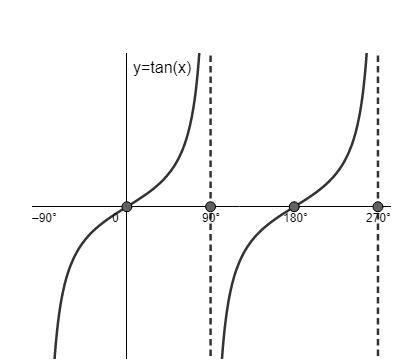
From this graph, we can clearly see that $y=\tan \left( x \right)\text{ approaches }+\infty \text{ at }x={{270}^{\circ }}$ .
\[\therefore \tan \left( {{270}^{\circ }} \right)=+\infty \]
Hence, the tangent of 270 degrees is positive infinity.
Note: We can express 270 degrees into multiple forms, such as, $\left( {{270}^{\circ }}+{{0}^{\circ }} \right),\left( {{180}^{\circ }}+{{90}^{\circ }} \right)\text{ or }\left( {{360}^{\circ }}-{{90}^{\circ }} \right)$ . All of these forms could be used separately to find the trigonometric values of ${{270}^{\circ }}$ . We should remember not to assume $\left( \dfrac{-1}{0} \right)\text{ as -}\infty $ when we are trying to find the tangent of ${{270}^{\circ }}$.
Complete step by step solution:
For sine of 270 degrees:
We can write ${{270}^{\circ }}\text{ as }\left( {{270}^{\circ }}+{{0}^{\circ }} \right)$ . Or, in equation form
$\sin \left( {{270}^{\circ }} \right)=\sin \left( {{270}^{\circ }}+{{0}^{\circ }} \right)...\left( i \right)$
We know the trigonometric identity $\sin \left( {{270}^{\circ }}+\theta \right)=-\cos \theta $.
If we put $\theta ={{0}^{\circ }}$ and keep in mind the fact that $\cos {{0}^{\circ }}=1$ , we get
$\sin \left( {{270}^{\circ }}+{{0}^{\circ }} \right)=-\cos {{0}^{\circ }}=-1...\left( ii \right)$
Now substituting the value of $\sin \left( {{270}^{\circ }}+{{0}^{\circ }} \right)$ in equation (i), we get
$\sin \left( {{270}^{\circ }} \right)=-1$
Hence, the sine of 270 degrees is -1.
For cosine of 270 degrees:
We can write ${{270}^{\circ }}\text{ as }\left( {{270}^{\circ }}+{{0}^{\circ }} \right)$ . Or, in equation form
$\cos \left( {{270}^{\circ }} \right)=\cos \left( {{270}^{\circ }}+{{0}^{\circ }} \right)...\left( iii \right)$
We know the trigonometric identity $\cos \left( {{270}^{\circ }}+\theta \right)=\sin \theta $.
If we put $\theta ={{0}^{\circ }}$ and keep in mind the fact that $\sin {{0}^{\circ }}=0$ , we get
$\cos \left( {{270}^{\circ }}+{{0}^{\circ }} \right)=\sin {{0}^{\circ }}=0...\left( iv \right)$
Now substituting the value of $\cos \left( {{270}^{\circ }}+{{0}^{\circ }} \right)$ in equation (iii), we get
$\cos \left( {{270}^{\circ }} \right)=0$
Hence, the cosine of 270 degrees is 0.
For tangent of 270 degrees:
We are well aware of the identity that
$\tan \theta =\dfrac{\sin \theta }{\cos \theta }$
Thus, we can write
$\tan {{270}^{\circ }}=\dfrac{\sin {{270}^{\circ }}}{\cos {{270}^{\circ }}}$
We can write ${{270}^{\circ }}\text{ as }\left( {{270}^{\circ }}+{{0}^{\circ }} \right)$ . Or, in equation form
$\tan \left( {{270}^{\circ }}+{{0}^{\circ }} \right)=\dfrac{\sin \left( {{270}^{\circ }}+{{0}^{\circ }} \right)}{\cos \left( {{270}^{\circ }}+{{0}^{\circ }} \right)}$
We can now substitute the values of $\sin \left( {{270}^{\circ }}+{{0}^{\circ }} \right)\text{ and }\cos \left( {{270}^{\circ }}+{{0}^{\circ }} \right)$ from equation (ii) and equation (iv) respectively. Thus, we have,
$\tan \left( {{270}^{\circ }}+{{0}^{\circ }} \right)=\dfrac{-1}{0}$ , which is N.D. or undefined.
Now, to check whether the value is $+\infty \text{ or }-\infty $ , we should use the graph of $y=\tan \left( x \right)\text{ at }x={{270}^{\circ }}$
From this graph, we can clearly see that $y=\tan \left( x \right)\text{ approaches }+\infty \text{ at }x={{270}^{\circ }}$ .
\[\therefore \tan \left( {{270}^{\circ }} \right)=+\infty \]
Hence, the tangent of 270 degrees is positive infinity.
Note: We can express 270 degrees into multiple forms, such as, $\left( {{270}^{\circ }}+{{0}^{\circ }} \right),\left( {{180}^{\circ }}+{{90}^{\circ }} \right)\text{ or }\left( {{360}^{\circ }}-{{90}^{\circ }} \right)$ . All of these forms could be used separately to find the trigonometric values of ${{270}^{\circ }}$ . We should remember not to assume $\left( \dfrac{-1}{0} \right)\text{ as -}\infty $ when we are trying to find the tangent of ${{270}^{\circ }}$.
Recently Updated Pages
Master Class 11 English: Engaging Questions & Answers for Success

Master Class 11 Social Science: Engaging Questions & Answers for Success
Master Class 11 Maths: Engaging Questions & Answers for Success
Master Class 11 Biology: Engaging Questions & Answers for Success
Master Class 11 Physics: Engaging Questions & Answers for Success
Master Class 11 Chemistry: Engaging Questions & Answers for Success
Trending doubts
Explain the Treaty of Vienna of 1815 class 10 social science CBSE
First Cotton Mill of India
In which year voting age was reduced from 21 to 18?
What planets have no moons Which one has only one moon class 10 physics CBSE
What is the full form of POSCO class 10 social science CBSE
Define Potential, Developed, Stock and Reserved resources