




What is $\sin \left( \dfrac{\theta }{2} \right)$ in terms of trigonometric functions of a unit $\theta $?
Answer
 Verified
529.8k+ views
Hint: We first draw a right-angle triangle. We use the concept of trigonometry to find the value as $\cos \theta =\dfrac{AB}{BC}$. We use the formula of $\cos \theta =1-2{{\sin }^{2}}\left( \dfrac{\theta }{2} \right)$ to simplify the problem.
We put the values to find the solution with respect to the value of $\cos \theta =m$.
Complete step-by-step solution:
The expression of $\sin \left( \dfrac{\theta }{2} \right)$ is the formula of submultiple angles.
We have to explain the significance of the trigonometric values.
Let us assume for $\Delta ABC$, $\angle A={{90}^{\circ }}$.
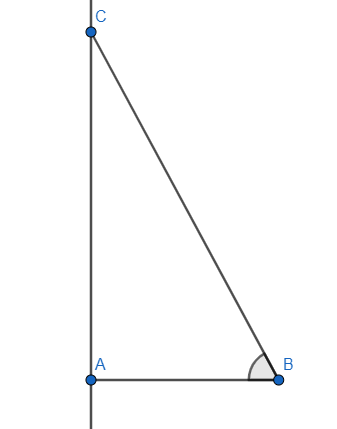
Now let us take $\angle B=\theta $.
We know the trigonometric ratio of cos gives the ratio of base and the hypotenuse.
Therefore, $\cos \theta =\dfrac{AB}{BC}$.
We will use the concept of submultiple to find the value of $\sin \left( \dfrac{\theta }{2} \right)$.
We have the relation between $\sin \left( \dfrac{\theta }{2} \right)$ and $\cos \theta $ which gives $\cos \theta =1-2{{\sin }^{2}}\left( \dfrac{\theta }{2} \right)$.
Let us assume that $\cos \theta =m$.
We get $1-2{{\sin }^{2}}\left( \dfrac{\theta }{2} \right)=m$.
From the relation we find the value of $\sin \left( \dfrac{\theta }{2} \right)$.
We get $2{{\sin }^{2}}\left( \dfrac{\theta }{2} \right)=1-m$ which gives
$\begin{align}
& 2{{\sin }^{2}}\left( \dfrac{\theta }{2} \right)=1-m \\
& \Rightarrow {{\left[ \sin \left( \dfrac{\theta }{2} \right) \right]}^{2}}=\dfrac{1-m}{2} \\
\end{align}$
Now we omit the root square part to find the value of $\sin \left( \dfrac{\theta }{2} \right)$.
So, ${{\left[ \sin \left( \dfrac{\theta }{2} \right) \right]}^{2}}=\dfrac{1-m}{2}\Rightarrow \sin \left( \dfrac{\theta }{2} \right)=\pm \sqrt{\dfrac{1-m}{2}}$.
The value of the trigonometric function $\sin \left( \dfrac{\theta }{2} \right)$ is $\pm \sqrt{\dfrac{1-m}{2}}$ where $\cos \theta =m$.
Note: We first need to find the relation where we have all the variables given. The use of the relation $\sin \theta =2\sin \left( \dfrac{\theta }{2} \right)\cos \left( \dfrac{\theta }{2} \right)$ also gives the same result. In this case we find two ratio values to get to the required solution.
We put the values to find the solution with respect to the value of $\cos \theta =m$.
Complete step-by-step solution:
The expression of $\sin \left( \dfrac{\theta }{2} \right)$ is the formula of submultiple angles.
We have to explain the significance of the trigonometric values.
Let us assume for $\Delta ABC$, $\angle A={{90}^{\circ }}$.
Now let us take $\angle B=\theta $.
We know the trigonometric ratio of cos gives the ratio of base and the hypotenuse.
Therefore, $\cos \theta =\dfrac{AB}{BC}$.
We will use the concept of submultiple to find the value of $\sin \left( \dfrac{\theta }{2} \right)$.
We have the relation between $\sin \left( \dfrac{\theta }{2} \right)$ and $\cos \theta $ which gives $\cos \theta =1-2{{\sin }^{2}}\left( \dfrac{\theta }{2} \right)$.
Let us assume that $\cos \theta =m$.
We get $1-2{{\sin }^{2}}\left( \dfrac{\theta }{2} \right)=m$.
From the relation we find the value of $\sin \left( \dfrac{\theta }{2} \right)$.
We get $2{{\sin }^{2}}\left( \dfrac{\theta }{2} \right)=1-m$ which gives
$\begin{align}
& 2{{\sin }^{2}}\left( \dfrac{\theta }{2} \right)=1-m \\
& \Rightarrow {{\left[ \sin \left( \dfrac{\theta }{2} \right) \right]}^{2}}=\dfrac{1-m}{2} \\
\end{align}$
Now we omit the root square part to find the value of $\sin \left( \dfrac{\theta }{2} \right)$.
So, ${{\left[ \sin \left( \dfrac{\theta }{2} \right) \right]}^{2}}=\dfrac{1-m}{2}\Rightarrow \sin \left( \dfrac{\theta }{2} \right)=\pm \sqrt{\dfrac{1-m}{2}}$.
The value of the trigonometric function $\sin \left( \dfrac{\theta }{2} \right)$ is $\pm \sqrt{\dfrac{1-m}{2}}$ where $\cos \theta =m$.
Note: We first need to find the relation where we have all the variables given. The use of the relation $\sin \theta =2\sin \left( \dfrac{\theta }{2} \right)\cos \left( \dfrac{\theta }{2} \right)$ also gives the same result. In this case we find two ratio values to get to the required solution.
Recently Updated Pages
Master Class 11 Business Studies: Engaging Questions & Answers for Success

Master Class 11 Economics: Engaging Questions & Answers for Success
Master Class 11 Computer Science: Engaging Questions & Answers for Success
Master Class 11 English: Engaging Questions & Answers for Success
Master Class 11 Maths: Engaging Questions & Answers for Success
Master Class 11 Biology: Engaging Questions & Answers for Success
Trending doubts
One Metric ton is equal to kg A 10000 B 1000 C 100 class 11 physics CBSE
Discuss the various forms of bacteria class 11 biology CBSE
Draw a diagram of a plant cell and label at least eight class 11 biology CBSE
State the laws of reflection of light
Explain zero factorial class 11 maths CBSE
10 examples of friction in our daily life